


November 4, 2026
Many factors can affect a student’s ability to attend school regularly, from health and family circumstances to their sense of connection to school. Educators are already working to address these challenges, sometimes with very limited resources. Partnerships with families and community organizations can build on those efforts, bringing additional perspectives, expertise, and support.
This Spotlight highlights three recent WestEd resources that explore ways to better understand attendance barriers, build partnerships, and coordinate support to help students attend school consistently.
Quick Takeaways
- Conversations with students and families can reveal barriers to regular attendance that data alone may not capture.
- Partnerships among schools, families, and community organizations can bring additional resources and expertise to attendance efforts.
- Coordination across education, health, and community services can help address the range of circumstances affecting student attendance.
Who Will Benefit
Teachers, families, school and district leaders, student support teams, state education agency staff, and community partners working to improve student attendance.
Understanding the Circumstances Behind Absenteeism
Understanding the circumstances behind student absences often requires looking beyond attendance data, talking with students and families, and reflecting on the assumptions that shape school responses.
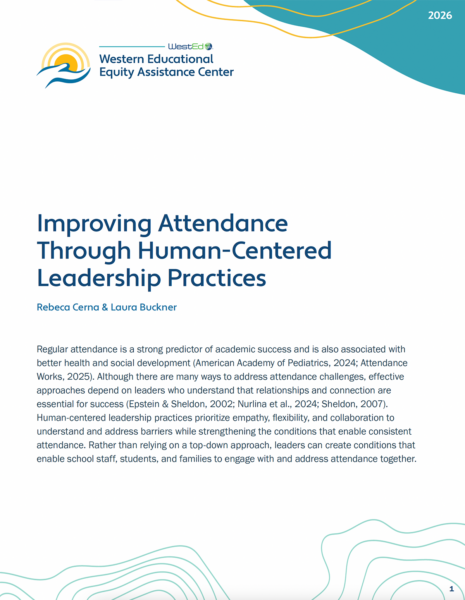
In the brief Improving Attendance Through Human-Centered Leadership Practices, Rebeca Cerna and Laura Buckner explore how education leaders can use human-centered approaches to better understand student and family experiences and inform policy and practice. The authors organize their guidance around three levels of action.
- At the individual level, leaders examine their own mindsets about absences.
- At the collective level, staff, students, and families work together to bridge perspectives and learn from shared data.
- At the systems level, leaders adapt policies and routines to better serve those least well supported by current approaches.
For each level, the brief pairs practices such as strengthening self-awareness, navigating diverse perspectives, and fostering transparent communication with reflection questions and practical “Try It Out” activities that leaders can apply in their schools.
Explore human-centered attendance practices.
The Power of Partnerships in Addressing Chronic Absenteeism
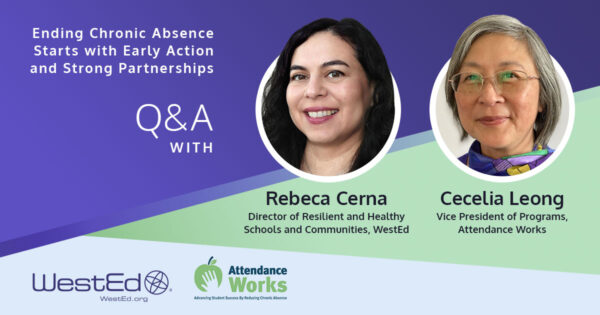
In her Q&A with WestEd’s Rebeca Cerna, Cecelia Leong of Attendance Works discusses how collaboration among school departments, county offices of education, and community organizations can help schools coordinate services, expand access to mental health support, and reduce administrative burdens.
Her examples illustrate how these partnerships can benefit different members of the school community:
- For families: greater trust, communication, and access to resources
- For educators and districts: more coordinated services, additional expertise, and fewer administrative burdens
- For students: support in addressing attendance barriers and more opportunities to connect with school
Leong also highlights Connecticut’s Learner Engagement and Attendance Program, which brought together school districts and community organizations to conduct relational home visits; reconnect with families; and provide resources, including summer school opportunities and enrollment information.
Read the Q&A with Cecelia Leong of Attendance Works.
Turning Research Into Action
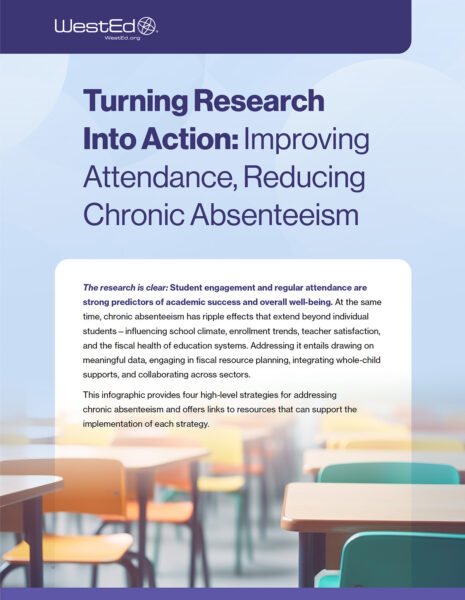
In the infographic Turning Research Into Action: Improving Attendance, Reducing Chronic Absenteeism, WestEd’s Dana Grayson, Lenay Dunn, and Rebeca Cerna present four research-based strategies for addressing chronic absenteeism:
- Use data to illuminate patterns and drive continuous improvement.
- Connect chronic absenteeism to enrollment and fiscal health.
- Support the whole child and improve school climate.
- Advance cross-sector collaboration and coherent systems.
For each strategy, the infographic offers three practical actions; identifies key players and what they bring to the table; and links to related resources, including podcasts, briefs, guides, and webinars.
View the Turning Research Into Action infographic.
Partner With WestEd to Improve Student Attendance
WestEd works with schools, districts, and community partners to address attendance barriers, improve school climate, and develop coordinated approaches that support student engagement.

Ready to Support Your Thriving Learners and Empowered Communities?
Connect with our WestEd experts.
"*" indicates required fields
More Related to This Post
Blogs & Podcasts
Research insights and stories designed to inform, engage, and inspire.




Events
Research insights and stories designed to inform, engage, and inspire.


Resources
Browse our high-quality publications and resources designed to inform and engage professionals in a variety of fields including K–12 education, early childhood, and health and justice.