

June 2, 2026
By Svetlana Darche, Nico Janik, and Matt Silberglitt
To prepare all students for success beyond high school, science experiences need to develop disciplinary knowledge and skills along with social, emotional, and career readiness competencies. Decades of research show that students need deep, rich experiences that go far beyond memorization and demonstration labs.
—Sarna et al. (2021), WestEd
Imagine students running outside to collect water samples, poring over data with teammates, or feeling relieved and beaming with pride after presenting their projects to NASA scientists. Through NASA’s GLOBE program, students participate in real science and contribute to work that matters while gaining critical knowledge and skills.
Science education commonly relies on textbooks and scripted labs. However, students need opportunities to ask questions, collect and analyze data, and share results with a broader community as scientists do every day. These experiences build scientific knowledge, STEM identity, and a sense of belonging in science. They also help students develop skills they need for life and work: curiosity, teamwork, problem-solving, and continuous learning.
What Is GLOBE?
Launched on Earth Day 1995, GLOBE (Global Learning and Observations to Benefit the Environment) is a NASA-funded science and education program active in 127 countries. Through GLOBE, students and community volunteers collect local environmental observations (e.g., about cloud cover, atmospheric conditions, water quality, soil characteristics) using protocols developed by scientists. They enter their findings into the global GLOBE database and investigate questions relevant to their own communities. Their observations also support NASA’s “crowdsourcing” efforts by complementing satellite data and helping researchers better understand Earth systems.
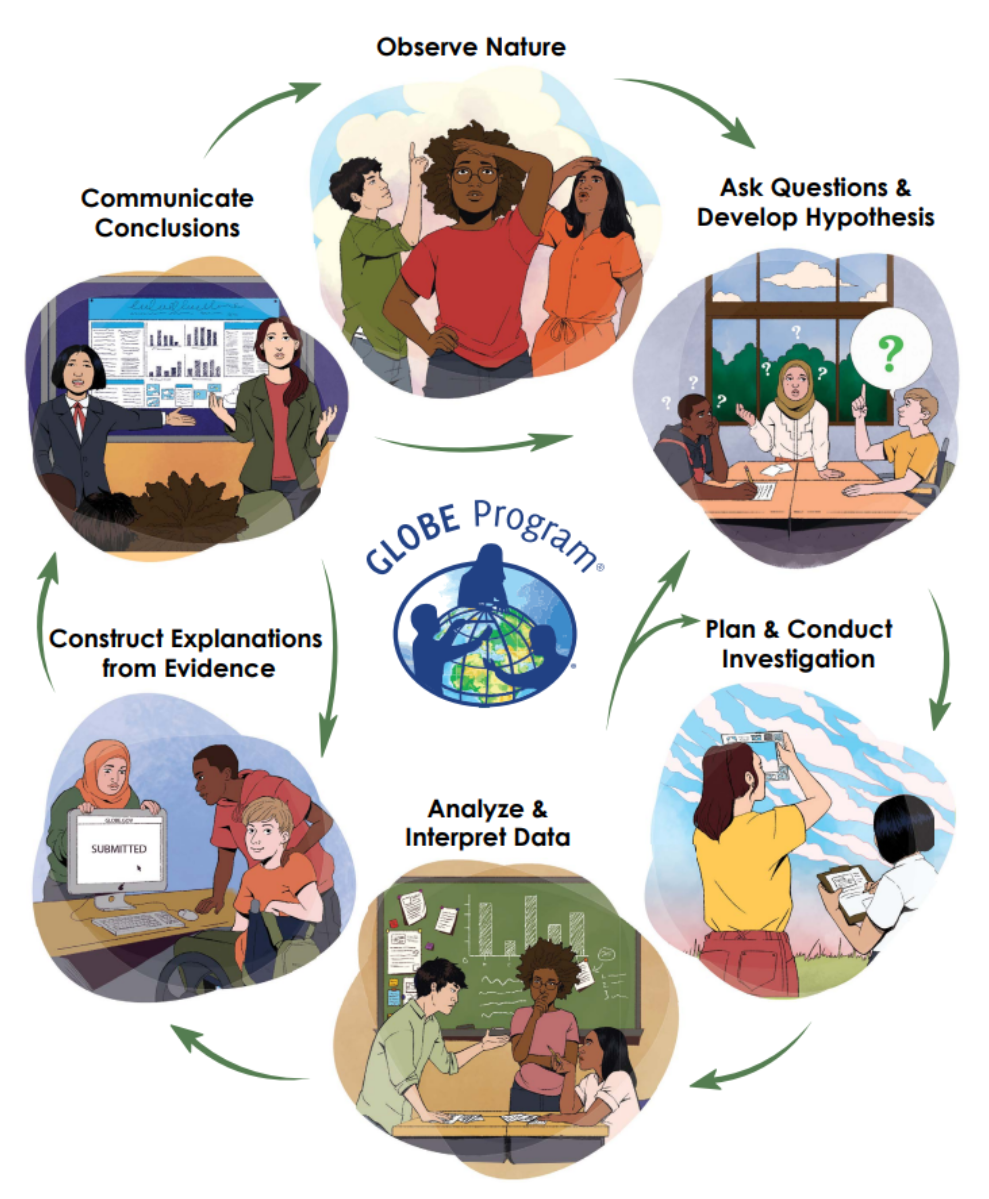
GLOBE supports teachers in guiding students through the complete scientific research process: asking questions, collecting and analyzing data, interpreting findings, and communicating results. These steps align with the multidimensional science standards used in many states, especially the Science and Engineering Practices, and help students see science as an active process of investigation, evidence, and explanation.
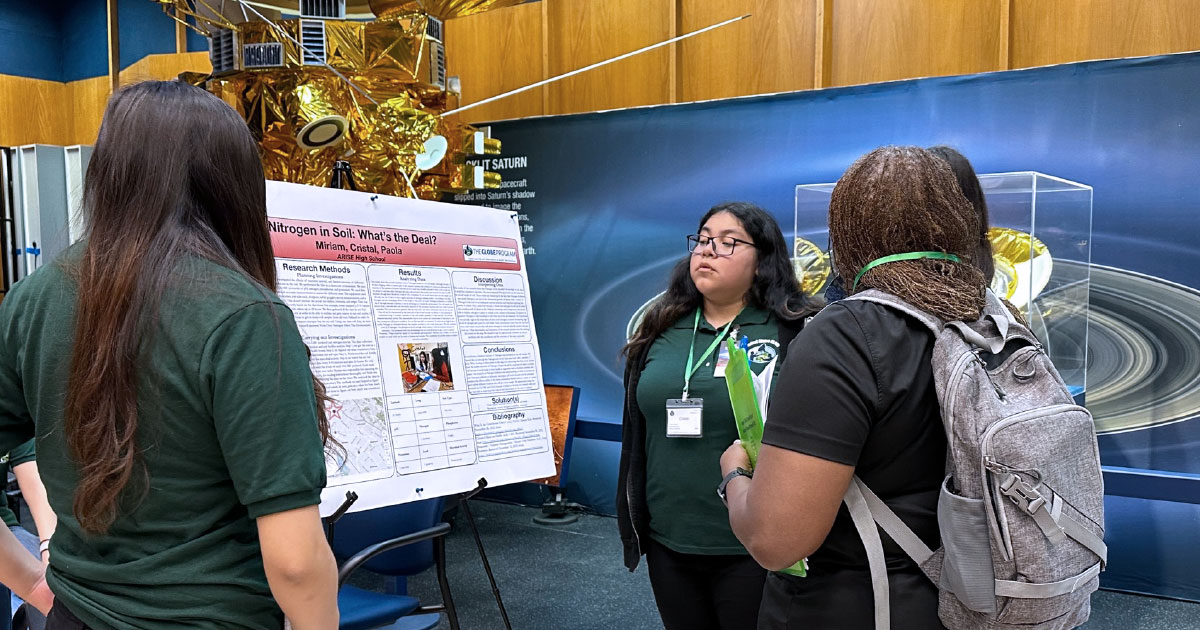
Students can present their projects at in-person or virtual student research symposia, often hosted at NASA research centers. There they receive professional feedback from NASA and other scientists, with no ribbons or rankings—just meaningful scientific dialogue. Students often arrive a little anxious and leave exhilarated.
GLOBE in Action: The WestEd–UC Berkeley Partnership
Since 2011, WestEd and the University of California at Berkeley have led one of approximately 100 GLOBE partnerships in the United States, with sustained support from the National Science Foundation and NASA. The partnership is part of Mission Earth, a NASA Science Activation collaborative led by the University of Toledo.
In California and New Mexico classrooms, the partnership has helped teachers bring GLOBE into field-based science learning. Long-standing teachers report that they have greater confidence in facilitating research outdoors and that students show increased interest in science, more motivation, deeper collaboration and communication skills, and greater awareness of environmental issues and STEM careers.
Students report that GLOBE deepened their learning and research skills. As one student put it, the experience “really made me think.” Evaluation data show growth in students’ STEM identity and sense of belonging in science. Students are especially motivated by knowing their observations become part of a NASA database. That connection helps them see their work as real science with purpose beyond the classroom.
Students are impacted by the fact that their data is uploaded to a NASA database. It makes them aware that what they do as student scientists can have an impact on a wider community. — GLOBE Teacher
GLOBE for All Students
Because students investigate their own environments, GLOBE can make science feel relevant, community connected, and accessible to students with a wide range of backgrounds, achievement levels, and career interests, in varied geographic locations. Its hands-on, project-based approach helps students practice transferable skills such as collaboration, communication, and critical thinking—skills that matter in science and beyond.
GLOBE also supports STEM career pathway programs, including CTE courses, by connecting students with working scientists and giving them experience with field research, data analysis, and project presentations. For example, at Skyline High School in Oakland, GLOBE has been part of a Green Energy Pathway for more than a decade, reaching nearly 1,000 students. Many students describe their interactions with NASA scientists as transformative.
Scaling the Work: GLOBE SPARKS
To help more educators bring GLOBE to their classrooms, WestEd worked with partners to develop GLOBE SPARKS (Supporting Practice, Awareness, Research, and Knowledge for Science), a free, asynchronous online course launched in 2025.
SPARKS introduces educators to GLOBE through text and video, connecting program resources to the full research cycle and science practices. The course walks educators through the steps of observing; asking questions; collecting, analyzing, and interpreting data; and communicating conclusions. This course also includes planning tools for implementation , lessons, and projects. Educators can also use the SPARKS facilitation guide to support structured or cohort-based professional learning.
Through GLOBE and SPARKS, WestEd supports educators in creating science learning experiences that help students learn key science practices, understand data from the ground up; develop transferable skills; and grow as environmental stewards, global citizens, and future STEM professionals.
I now know why I need to study science, and it is so much fun! — GLOBE Student
Next Steps
GLOBE is a NASA-funded international science and education program that invites students, educators, and community volunteers to collect environmental observations using scientist-developed protocols. Participants upload their findings to an open-source database with more than 250 million measurements gathered worldwide over 3 decades. Through GLOBE, students can explore local questions, join global measurement campaigns, and contribute observations that help scientists better understand Earth systems.
Get Involved
For more information on WestEd’s GLOBE work, or to recommend partners, schools, or teachers who may be interested in GLOBE, please contact Svetlana Darche at [email protected], Nico Janik at [email protected], or [email protected].
Additional Resources
- SPARKS flyer
- SPARKS Canvas website
- A facilitation guide is available by request for educators who want to use the course in a structured or cohort-based professional learning setting.
- All GLOBE data collection protocols, learning activities, and information about ongoing research campaigns are also available at no cost at globe.gov.
About the Authors
Svetlana Darche is a senior research associate and the Director of Career Education in the Center for Teaching and Learning at WestEd, working at the nexus of science and career development. Her particular area of interest is in experiential and work-based learning as a means to enhance student engagement, depth of understanding, social capital development, and the attainment of skills needed for long-term career success. She cofounded the WestEd–UC Berkeley GLOBE Partnership in 2011.
Nico Janik is a senior professional learning specialist in the Center for Teaching and Learning at WestEd. She supports research, teachers, and school systems in science and engineering education and design thinking. Her work draws on a career that has moved from mechanical engineering and product design to elementary STEM teaching to districtwide STEM leadership. She has been working with GLOBE teachers since 2022.
Matt Silberglitt is the Manager of Science Assessment for WestEd’s large-scale assessment portfolio. Silberglitt also contributes to WestEd’s research in culturally relevant science assessment and project-based science learning, interests which he first developed as a high school science teacher. He has been working with GLOBE teachers and supporting the assessment of GLOBE student projects since 2015.
Note: This post was authored by Svetlana Darche, Nico Janik, and Matt Silberglitt. AI tools were used to shorten this blog post from a longer draft.

Work With Us
Connect with a WestEd expert.
"*" indicates required fields
More Related to This Post
Blogs & Podcasts
Research insights and stories designed to inform, engage, and inspire.


Events
Research insights and stories designed to inform, engage, and inspire.

Resources
Browse our high-quality publications and resources designed to inform and engage professionals in a variety of fields including K–12 education, early childhood, and health and justice.