


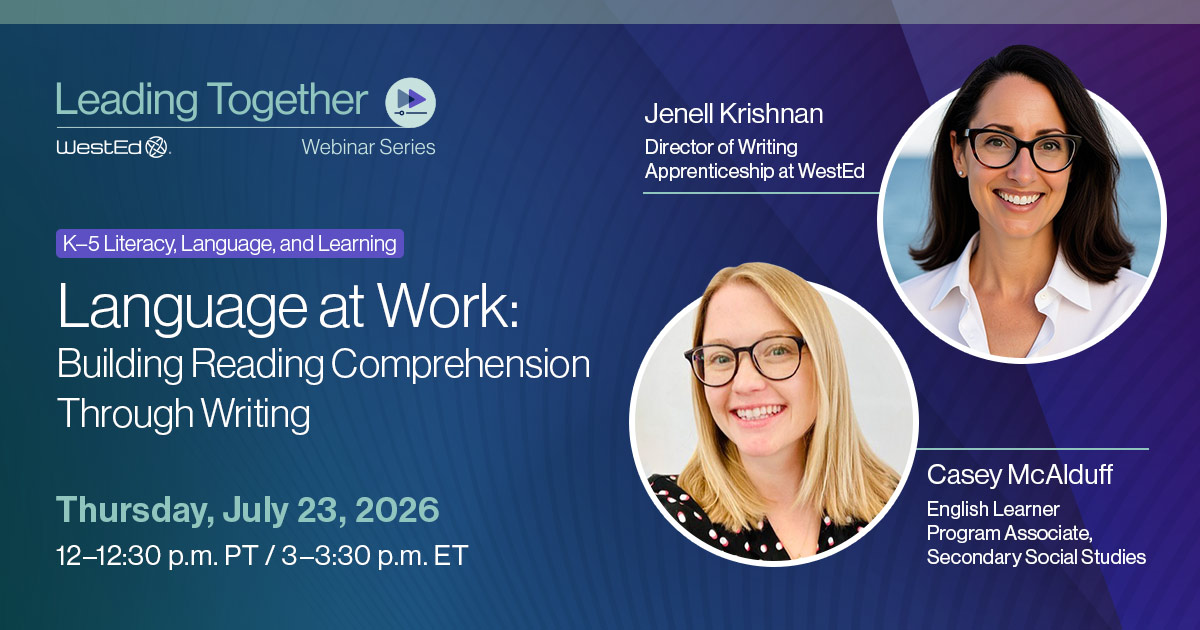
In this 30-minute webinar, we will explore how writing about content, in students’ own voices and in the language of each discipline, building and honing the skills that complex texts demand. We offer practical strategies for K–12 classrooms and content areas throughout.
Date: Thursday, July 23, 2026
Time: 12–12:30 p.m. PT / 3–3:30 p.m. ET
Reading, writing, speaking, and listening are not separate skills. They are part of the same language system, and they grow stronger together. When students write, they do more than record what they know. They reach for precise words, shape their thinking into sentences, and develop the academic and disciplinary language that makes complex texts accessible.
In this session, we will explore the research connecting writing instruction to reading comprehension gains, and we will spend most of our time on what this looks like in practice. From summary writing to text-based argument to discipline-specific writing routines, you will see how leveraging a student’s language to express their thinking also gives them language to understand what they read. Whether you work in ELA, in content areas, or across a whole school, you will leave with strategies you can use right away.
Who Should Attend?
- District and site leaders
- Instructional coaches and literacy specialists
- K–5 classroom teachers
Session Discussion Topics
- Language at Work: Reading, Writing, and the System They Share: a grounded look at why reading, writing, speaking, and listening develop together and what the research says about writing’s role in building comprehension and language knowledge
- Summary Writing: Finding the Words for What Matters: how teaching students to summarize in their own words builds both comprehension and expressive language, revealing what they understand and what language they still need
- Text-Based Argument and Academic Language: how writing to argue from evidence develops the academic language structures (claim, evidence, reasoning) that students need to both produce and comprehend complex texts
- Disciplinary Writing and the Language of Each Subject: what it means to write like a scientist, historian, or literary critic and how discipline-specific writing routines build the vocabulary and discourse structures that unlock content-area texts
- Low-Lift Routines That Build Language and Comprehension Together: quick writes, language frames, annotation-to-writing bridges, and reading responses are practical tools that develop student voice and academic language without requiring a redesigned unit
Featured Speakers

Dr. Jenell Krishnan is Director of Writing Apprenticeship at WestEd. Krishnan supports teachers, literacy coaches, schools, and districts in teaching discipline-specific writing with a focus on real audiences and authentic purposes using research-based practices. Krishnan’s work is published in Scientific Studies of Reading, Reading and Writing, and the Journal of Adolescent and Adult Literacy. Her research is recognized by the American Educational Research Association.

Casey McAlduff is an educator and writer who spent the past decade teaching college writing and high school English language arts, social studies, and English language development courses in Oakland, California. Now located in Chicago, she works with colleagues across the country to leverage English Learners’ language skills through WestEd’s Quality Teaching for English Learners (QTEL) approach.