

February 2, 2026
Amid the daily demands of leading a school, principals rarely have time to reflect on who they are as leaders, how they’re growing professionally, and how they’re supporting the development of their staff. WestEd’s Leadership Playbook helps shift that reality by guiding school and district leaders to build on their strengths and foster positive relationships that drive lasting school improvement.
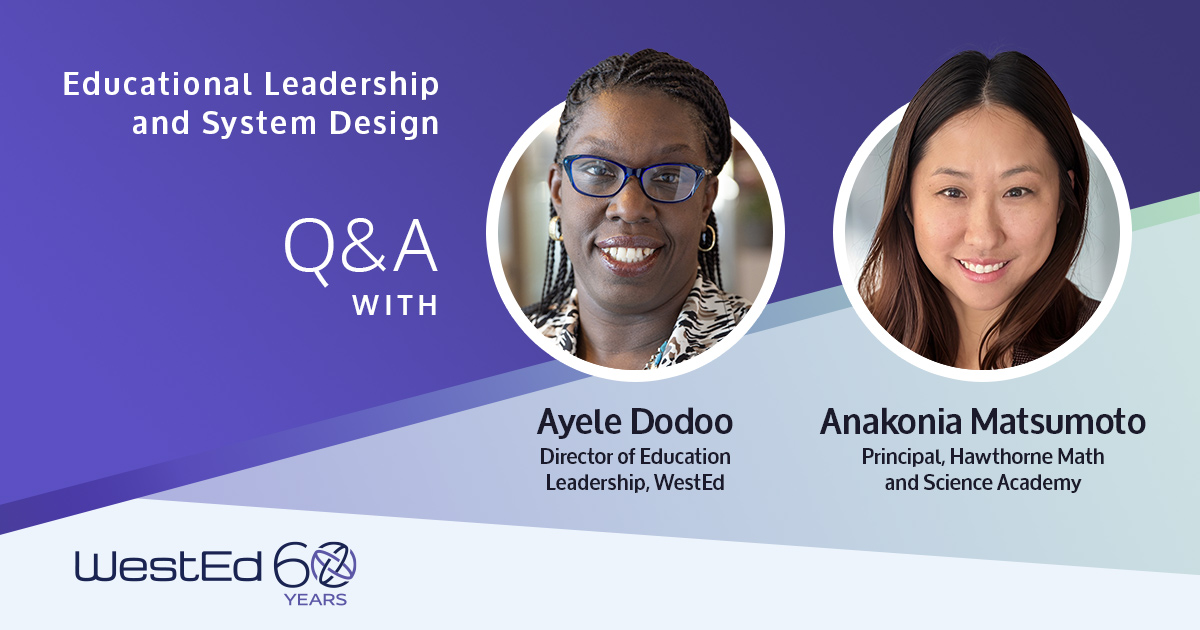
In this Q&A, Ayele Dodoo, Leadership Playbook facilitator and Director of Education Leadership at WestEd, and participant Anakonia Matsumoto, principal at Hawthorne Math and Science Academy, discuss what becomes possible when principals have structured time to engage in self-reflection and deepen their leadership practice.

AM: For me, the Leadership Playbook encourages intentional leadership. We’re given the ability to reflect before we react, and we do a lot of self-assessment. It’s taught me how to approach situations with curiosity rather than assumptions, and it pushes me to explore who I am as a person because who I am is how I lead. Having time to explore who we are through a variety of activities has been so meaningful because it’s translated into how I’m helping to develop my own leadership team.
AD: School and district leaders don’t often have the time to stop and think about their leadership. This series is sort of a gift of time and a guided conversation for leaders to think and talk about themselves with some tools. Reflecting inward allows leaders to adjust, reflect, shift mindsets—and doing so as you sit with your colleagues allows you to bounce ideas back and forth. It’s really about getting leaders thinking about and practicing interpersonal leadership moves.
AM: In one activity, the facilitator said, “I’m going to group you guys. I’m not going to give any rules; I’m just going to give you a topic.” And they said, “birth order,” so, without any other explanation, all the middle children grouped together, all the only children, and so on. I’m an only child; there were two others with me, and it was really interesting to hear how we all take on a lot of responsibility and struggle with delegation. Then the question was “how do you think that translates to how you lead, or who you are as a person?”
In the 4 weeks since I’ve had that session, I’ve given more ownership to my lead onsite, and I have felt the difference. My leadership team is also feeling more empowered. They’ve said before, “You don’t have to take it all on. I got this,” and I’m seeing the immediate success [of delegating more].
AD: I appreciate listening to how you receive it, Anakonia. We, as facilitators, don’t tell participants what to think or how to feel. We’re just presenting some ways to think about yourself and the work that you do every day in a way you don’t usually get a chance to do. The activity Anakonia describes is called Diversity Rounds; we call it Finding My People. Leaders are given a series of fairly broad prompts, then asked to develop categories, self-identify, and, with colleagues who chose the same category, discuss why they selected it and how that characteristic affects their leadership.
AM: One of the shifts is that I’m more intentional about listening. I want to understand what the person’s asking before trying to fix the issue . I’m a new administrator here. I started as an assistant principal, and this is my 2nd and a half year as a principal. I came in with the lens of “I want to solve,” but the Playbook has taught me to listen, and instead of just trying to respond, I try to understand first. I try to make sure that, especially with things that I don’t understand, I create a safe environment for teachers to feel that I’m here to listen.
School and district leaders don’t often have the time to stop and think about their leadership. This series is sort of a gift of time and a guided conversation for leaders to think and talk about themselves with some tools.
AM: Absolutely. Usually, if a parent would call or send an email, I’d try to get a response quickly, but now, since I’m also more intentionally building capacity within my leadership team, I’m not trying to solve it all myself. I’m relying on my leadership team on campus to support me in supporting others—our families and community.
AM: I would say the overall pace of the way I try to do things. We’re a small school with 570 students and 35 staff members. Because we’re so small, my leadership team tends to burn out easily because they’re holding so many tasks. What I’ve found is we’ve all been in silos trying to take care of everything ourselves, and bringing our team together and having meaningful conversations has helped with the challenges of fatigue.
AD: It varies and depends on how participants come into the space. Anakonia mentioned some, such as using norms and pausing to reflect. Another one, I would say, is emotional intelligence. We talk about it, and it sort of walks through the whole Playbook, and depending on who you are and how emotionally intelligent you are, you may have already been practicing this. But intentionally understanding and reflecting on the impact of emotional intelligence isn’t taught in what a colleague of mine calls “principal school.” Providing leaders with a common language to examine, reflect on, communicate about, and improve their interpersonal leadership can lead to positive shifts in team and organizational culture.
I came in with the lens of “I want to solve,” but the Playbook has taught me to listen, and instead of just trying to respond, I try to understand first.
AM: My advice would be to trust the process. The more honest you are with yourself, the more growth will happen, and that’s going to allow true transformation at your school. The growth that I’ve experienced is directly shaping who I am as a leader and how I’m building capacity and positivity within my team and my school community. And what does that mean? That means better outcomes for my kids, and that’s why we’re here.
Turn Reflection Into Impact
Matsumoto’s experience shows how even small shifts, such as more reflection, deeper listening, and shared leadership, can meaningfully strengthen a school community. The Leadership Playbook creates the space for these kinds of breakthroughs. To learn more about how to bring the Playbook to your school or district leaders, contact Ayele Dodoo.

Work With Us
Connect with a WestEd expert.
"*" indicates required fields
More Related to This Post
Blogs & Podcasts
Research insights and stories designed to inform, engage, and inspire.



Events
Research insights and stories designed to inform, engage, and inspire.

Resources
Browse our high-quality publications and resources designed to inform and engage professionals in a variety of fields including K–12 education, early childhood, and health and justice.