


February 9, 2026
By Molly Faulkner-Bond, Aaron Soo Ping Chow, and Mariann Lemke
States across the country are strengthening early literacy laws to ensure that all students receive timely, effective reading support. The policies created through these new laws often require schools to screen young learners multiple times each year to identify students who may be at risk of reading difficulties.
For Multilingual Learners—students who are developing literacy while also acquiring English language skills—these policies hold both promise and risk. On the one hand, early and ongoing screening can help identify students who need targeted support before small gaps widen. On the other hand, if assessments are not designed for students learning in more than one language, these students can be misidentified as struggling readers even when they are developing normally.
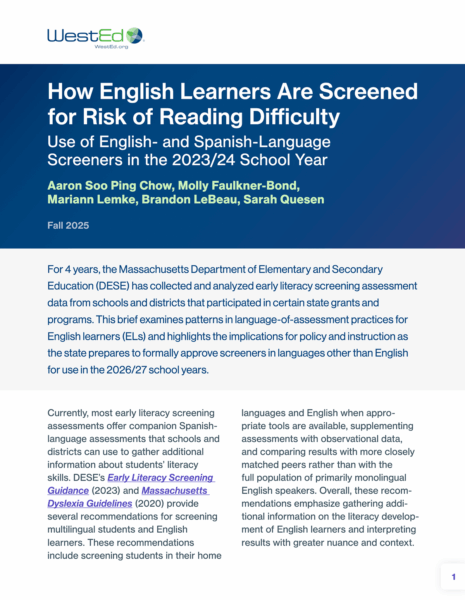
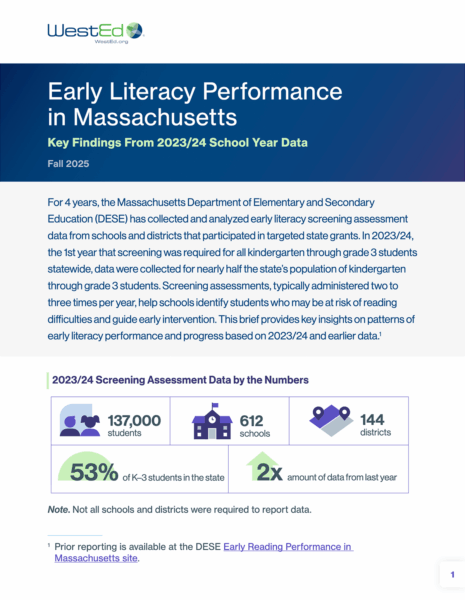
This blog post summarizes key lessons from a recent WestEd study conducted in partnership with the Massachusetts Department of Elementary and Secondary Education (DESE). For readers looking for a deeper dive, a detailed research paper accompanies this post and offers additional data, analysis, and recommendations.
Understanding Language and Literacy Development
Multilingual Learners develop language and literacy differently than monolingual students do. Their skills can vary across languages depending on how and where they use each one. For example, a child who speaks Spanish at home and uses English only at school might have stronger oral language in Spanish but stronger reading skills in English.
Because oral language supports literacy, progress in one language can influence progress in another. That’s why Multilingual Learners’ reading trajectories often differ from those of monolingual students and why assessments designed for native English speakers may not fully capture Multilingual Learners’ strengths.
Challenges in Screening Multilingual Learners
Validity of English-Language Screeners
Massachusetts has 11 English-language literacy screeners approved for early-grade literacy screening. Most of these tests haven’t been specifically proven to give accurate results for students who are learning English and another language. Publishers often don’t say how many English Learners were part of the group they used to set test expectations or whether the scores are equally meaningful for all students. Without this transparency, states and districts cannot be confident that these assessments provide useful information for multilingual students.
In some cases, linguistic differences may even affect test accuracy. For instance, Spanish-speaking students may pronounce English vowels differently during rapid naming tasks, which could lead to incorrect scoring despite correct letter recognition.
What are rapid naming tasks? Rapid Automatized Naming (RAN) tasks ask students to quickly and accurately name a limited set of visual symbols repeatedly presented to them. RAN tasks are timed and show how well students can retrieve the names of familiar objects or letters (or sometimes colors or numbers). These types of tasks have been shown to be predictive of later reading fluency. (Source: Massachusetts Dyslexia Guidelines)
Limited Use of Non-English Screeners
Many publishers now offer Spanish-language versions of literacy screeners. While Massachusetts has not yet formally approved them for mandated screening, some districts have begun using these tools voluntarily. Our analysis shows that about 10 percent of English Learners were screened in both Spanish and English. This expansion is promising, but questions remain about validity. For example, scores from assessments whose validity or norms are based on data from students in dual language programs may not be meaningful for English Learners in English-only or other settings.
Interpreting Data Across Languages
When students are screened in multiple languages, results can diverge. In our study, English and Spanish screening outcomes aligned about 70 percent of the time, with patterns varying by grade level. Younger students tended to perform better in English; older students often scored higher in Spanish. Educators need clearer guidance for interpreting such mixed results—especially when deciding whether intervention is necessary and, if so, in which language it should be rendered.
Moving Toward Meaningful Screening
Massachusetts’s experience underscores what states and districts need to ensure that literacy screening policies serve all learners effectively:
- Test developers should adopt more inclusive norming and reporting: Publishers should analyze and publish data showing how Multilingual Learners perform and whether score meanings are consistent across groups in different instructional settings.
- Educators should demand bilingual or multilingual screeners: Tools that assess both languages within one session could reduce testing time and yield richer information about student strengths.
- Researchers and research funders should continue to investigate multilingual literacy development: Continued study is essential to define typical growth patterns and inform better benchmarks for Multilingual Learners.
By prioritizing these improvements, states can help ensure that literacy policies that are designed to help all students truly do so, recognizing the diverse linguistic assets that Multilingual Learners bring to classrooms.
Partner With Researchers to Transform Evidence Into Action
Join WestEd’s Research–Practice Partnership Network and gain access to a no-cost solution designed to help educational agencies partner with WestEd researchers. Together, we turn research and practice into actionable insights to support effective teaching and decision-making and improve student outcomes. Our experts are standing by to support your continued use of evidence to improve outcomes for every learner.
About the Authors
Molly Faulkner-Bond is a research director on WestEd’s English Learner and Migrant Education Services team. She works with educators, researchers, and communities on Multilingual Learner education.
Aaron Soo Ping Chow is a research associate on WestEd’s Literacy team, primarily conducting research and assessments of literacy projects and programs nationwide.
Mariann Lemke is a senior associate at WestEd who has more than 20 years of experience managing assessment and evaluation projects at the federal, state, and local levels.

Work With Us
Connect with a WestEd expert.
"*" indicates required fields
More Related to This Post
Blogs & Podcasts
Research insights and stories designed to inform, engage, and inspire.


Resources
Browse our high-quality publications and resources designed to inform and engage professionals in a variety of fields including K–12 education, early childhood, and health and justice.