


April 1, 2026
Key Takeaways:
- California’s English Learner reclassification standard is rigorous and accessible, but questions remain about other exit criteria.
- The NBA Math Hoops program produces measurable math gains for students while remaining affordable for schools.
- Early literacy screening data can predict later reading outcomes, but identification isn’t enough without targeted intervention.
Every day, educators and policymakers make decisions that impact students’ entire school experience, such as how students are classified, which programs get funded, and when intervention begins. Getting those decisions right requires good evidence. This spotlight highlights three recent WestEd research studies that provide that necessary evidence and focus on English Learner reclassification, math enrichment, and early literacy screening.
Rethinking English Learner Reclassification in California
California is the only state that requires students to meet four separate criteria before exiting English Learner (EL) status. As questions about the fairness and necessity of those criteria have grown, a new study takes a close look at whether the standards hold up.
The findings offer some reassurance. California’s current English language proficiency benchmark, identified as Level 4 on the ELPAC, is both rigorous and appropriate and has remained so over time. The study also finds that EL students who reach Level 4 tend to outperform English-only peers on the statewide language arts assessment across multiple student groups.
Read Finding the Sweet Spot for English Learner Reclassification: A Study of California’s Criteria.
Math Gains From the Court to the Classroom
NBA Math Hoops is a math enrichment program used by thousands of educators, often in out-of-school settings. A recent randomized controlled trial puts the program’s impact to the test, and the results are encouraging.
Students in NBA Math Hoops classrooms scored an average of 0.19 standard deviations higher than peers in STEM enrichment classrooms, which is essentially the equivalent of moving from the 50th to the 58th percentile. The program also stands out for its accessibility because it
- requires just 3 hours of training and uses free materials,
- is straightforward to implement, and
- costs less than $20 per student beyond standard programming expenses.
Read The Impact of NBA Math Hoops on Students’ Math Achievement: A Randomized Controlled Trial.
Turning Early Literacy Screening Into Early Wins
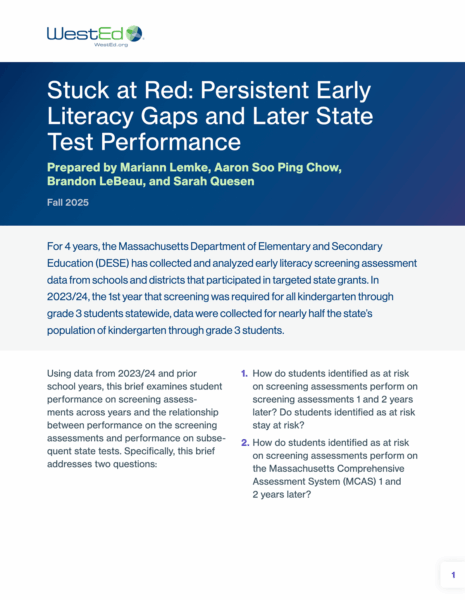
Early literacy screening exists to catch struggling readers before they fall too far behind, but what happens when being identified doesn’t lead to catching up? This brief examines Massachusetts screening data from 2021 to 2024, tracking students flagged as significantly below benchmark and following their progress through grade 3.
The study reveals a concerning pattern. Most students who are identified as at risk stay at risk, and the problem compounds over time. Indicators include the following:
- Most students flagged as significantly below benchmark in early grades remain at risk 1 and 2 years later.
- The persistence of early risk increases in higher grades, underscoring the importance of acting early.
- Students who meet benchmarks earlier are more likely to meet or exceed state expectations by grade 3.
Read Stuck at Red: Persistent Early Literacy Gaps and Later State Test Performance.
Partner With WestEd on Research That Drives Meaningful Change
These studies reflect WestEd’s commitment to producing actionable research that supports students and informs the decisions of educators, leaders, and policymakers. Whether you’re designing a new program evaluation, investigating the effectiveness of existing practices, or building an evidence base for policy change, WestEd can help.
Learn more about our Research-Practice Partnerships and Evaluation Services.

Work With Us
Connect with a WestEd expert.
"*" indicates required fields
More Related to This Post
Blogs & Podcasts
Research insights and stories designed to inform, engage, and inspire.



Resources
Browse our high-quality publications and resources designed to inform and engage professionals in a variety of fields including K–12 education, early childhood, and health and justice.