


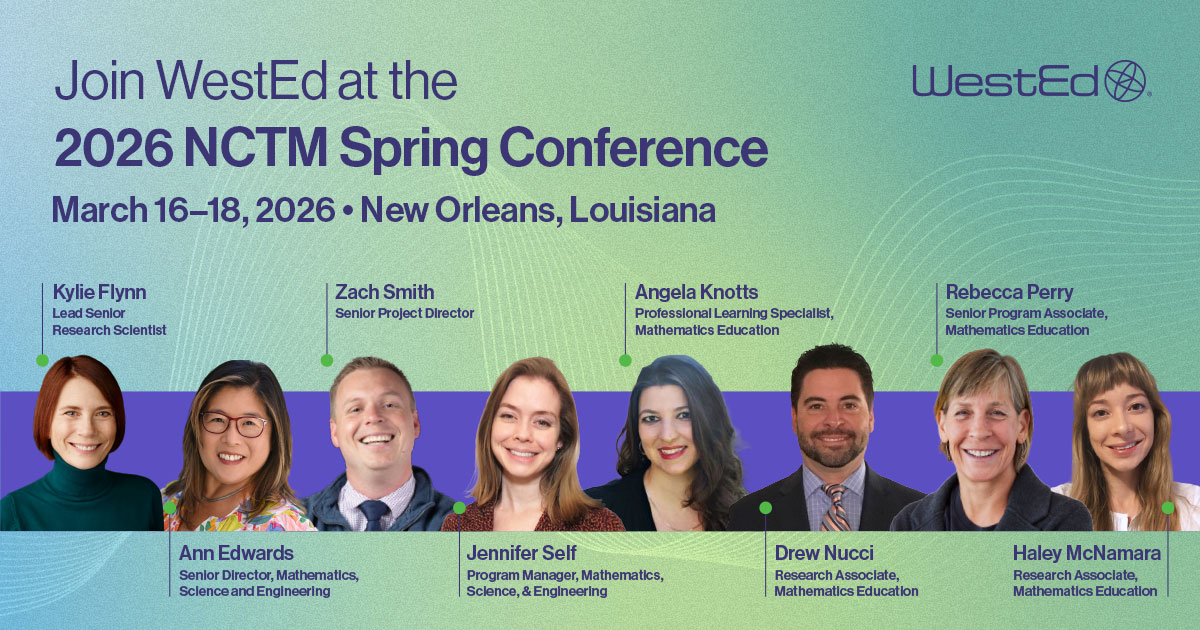
WestEd mathematics education experts will present at the 2026 National Council of Teachers of Mathematics (NCTM) 2026 Spring Conference, March 16–18, 2026, in New Orleans, Louisiana.
This year’s conference theme is Rhythm, Roots, & Reasoning: Cultivating Joie de Vivre in Mathematics.
Add WestEd’s presentations (see below) to your calendar, and visit our team to learn about our resources, professional development opportunities, and research.
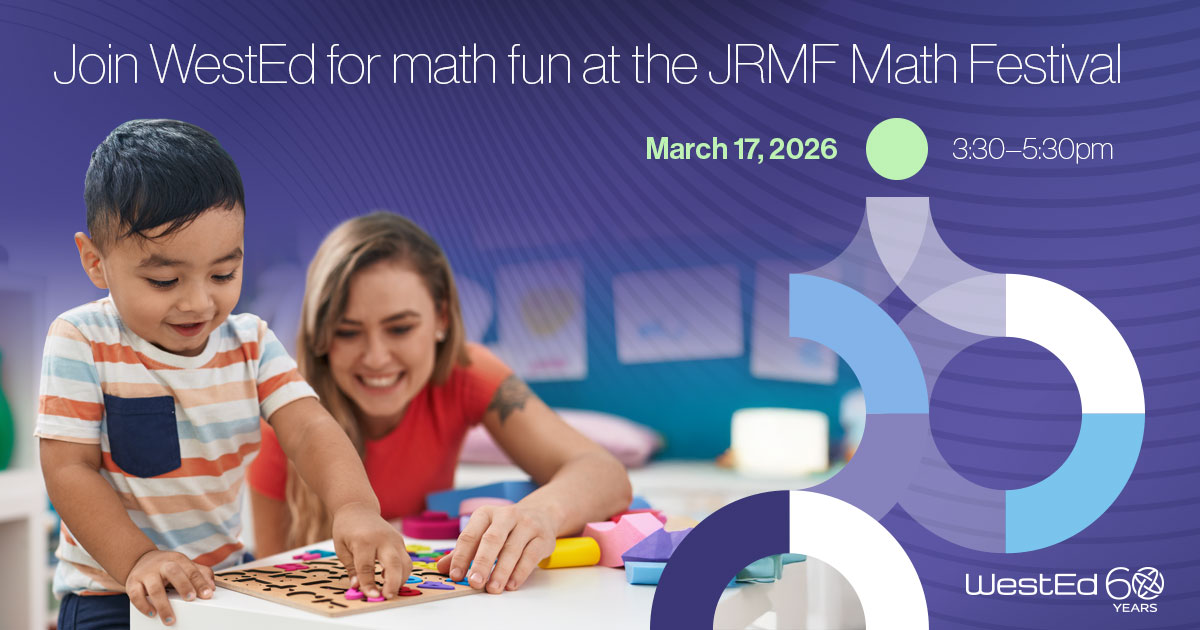
In addition to our sessions, WestEd and JRMF will host a free, interactive math festival for families, educators, developers, and researchers on Tuesday, March 17th.
Join us for a free, math-filled lunch!
Date: Tuesday, March 17th
Time: 3:30 PM – 5:30 PM
Location: New Orleans Main Public Library, 219 Loyola Ave
WestEd Presentations
Tuesday, March 17
Leveraging Student Voice to Understand High-Quality Instructional Materials (HQIM) Implementation
Time: 11:30 a.m.–12 p.m.
Presenters: Drew Nucci and Rebecca Perry
We share research findings on how students experience HQIM implementation compared with their teachers’ perceptions. Results reveal discrepancies in perceptions of coherence, rigor, and mathematical discourse and greater belonging and self-efficacy in classrooms that center collaborative problem-solving and discourse. These findings can inform leadership strategies to improve classroom implementation and emphasize the importance of student voice in understanding curriculum implementation.
In Sync: Cocreating a New High School Mathematics Course With Diverse Stakeholder Groups
Time: 1–2 p.m.
Presenter: Haley McNamara
We will present ongoing work to cocreate the Integrated Statistics and Quantitative Reasoning (ISQR) course with stakeholders (i.e., students, teachers, district staff, and family and community members). We will share the processes we used to engage with stakeholders and the ways in which stakeholder feedback shaped course development, with a specific focus on the following course components: mindful integration of AI, flexible assessment options, and selecting relevant contexts.
Beyond Intervention: Using Alternate Means of Expression to Improve Math Outcomes for All Students
Time: 1–2:15 p.m.
Presenters: Angela Knotts and Zach Smith
While tiered intervention is one tool for supporting students struggling to demonstrate proficiency, there is often a lot more we can do in Tier 1 to make math more accessible and engaging for all students. We share how teachers can create a richer, more accessible math experience for all by designing for alternate means of expression—that is, having students engage with math ideas and demonstrate understanding through a variety of options that align with their strengths, abilities, and preferences.
An Effective and Inclusive Tier 2 Early Math Intervention With a Flexible Implementation Model
Time: 4:30–5 p.m.
Presenter: Kylie Flynn
We will present evidence from two studies of PreK Mathematics Tutorial (PKMT), a small-group intervention designed to build children’s foundational knowledge through hands-on activities. In one study, PKMT was delivered by tutors in a pullout setting—outside the classroom. In another, it was delivered by classroom staff within the classroom. Both models produced significant gains in math knowledge compared to business-as-usual instruction, with the pullout model showing slightly stronger effects.
Wednesday, March 18
Dual Enrollment Math CIRCLs That Foster Joy, Interest, and College Identity: Framework and Practice
Time: 2:45–4 p.m.
Presenters: Ann Edwards and Haley McNamara
This session explores our work with students and teachers from Dallas College to develop a research-based framework and set of instructional practices for creating socially, culturally, and emotionally supportive learning environments for dual enrollment classrooms. We will focus on components and practices from our CIRCL framework—Cultivating Inclusive, Resilient Communities of Learning—that promote joy, future interest in math, and college-going identity.
Raising the Bar for Culturally Responsive Curriculum: Making It a Reality in Math Education
Time: 2:45–4 p.m.
Presenters: Jennifer Self, Shannon Wachowski (EdReports), and Stephanie Barnett
This session will explore the current state of culturally responsive math curriculum in the country as well as lessons learned from the field to increase the uptake and use of materials that empower all students. We will also facilitate breakout discussions in which participants will explore opportunities to overcome common challenges in implementing culturally response curricula in districts and schools in an effort to community-source and solve these challenges.

Ready to Improve Math Learning and Achievement?
Connect with our WestEd experts.
"*" indicates required fields