


April 15, 2026
Key Takeaways
- Professional learning is most effective when it is embedded in teachers’ daily instruction.
- Ongoing coaching is an essential component of helping teachers turn new knowledge into sustained changes in instruction.
- Improvements in early literacy often begin with shifts in how teachers make instructional decisions.
- Teacher professional learning should center on content and pedagogical content knowledge in literacy.
Who May Find This Useful
- School and district leaders focused on strengthening early literacy instruction and choosing professional learning that leads to measurable gains.
Arizona has made significant investments in early literacy, aligning policy with the science of reading and building momentum across the state. The next phase of that work is supporting how those shifts are reflected in classrooms across the state.
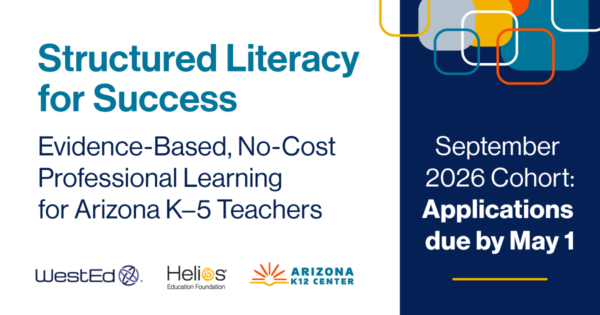
Arizona’s Structured Literacy for Success Initiative is helping strengthen K–5 literacy instruction in Arizona. In partnership with the Arizona K12 Center and the Helios Education Foundation, WestEd is providing 300 teachers with coursework and classroom coaching as they work toward Arizona’s K–5 Literacy Endorsement. The initiative is designed to build educator capacity and improve literacy outcomes for students across the state.
Jennifer Blitz is a senior program associate with WestEd’s English Learners and Migrant Education Services team. In this Q&A, she discusses how the program supports literacy instruction for all learners.

States have made really important moves in early literacy. Teachers are being asked to implement evidence-based approaches, but they haven’t always had access to the kind of sustained, job-embedded learning that actually builds that expertise over time. What we’re seeing on the ground is that policy has moved faster than practice.
The biggest growth opportunities tend to show up in two places. One is depth of content knowledge, especially around how reading develops and what to do when it doesn’t. The other is translating that knowledge into daily instruction, particularly for students who need more support, including English Learners and students with reading difficulties. The opportunity right now is to connect strong content with coaching and practice so it actually sticks.
It’s very intentionally designed not to feel separate from classroom practice. Teachers aren’t just learning about structured literacy in the abstract. They’re applying it directly to what they’re already teaching.
So instead of “one more thing,” it’s more like refining and strengthening what’s already happening. Assignments are tied to their own students, their own lessons, and their own data. Then they get feedback and coaching on that real work. Over time, it becomes less about completing a course and more about improving instruction in a way that’s immediately relevant.
In a typical week, there’s a 1-hour live session via Zoom, which is designed to be interactive. Then there are flexible online tasks you complete on your own time asynchronously.
What makes it different is the coaching layer. Teachers also get ongoing support from a coach, which might include co-planning, modeling, or just talking through what happened in a lesson and what to try next. It’s not overwhelming, but it is consistent and connected to practice, which is key. In some cases, the coach is someone from their own campus, but in other cases, the coach is a National Board Certified Teacher provided by the Arizona K12 Center.
This is really the core of the model. The courses build knowledge, but the coaching is what helps that knowledge turn into changes in practice.
Coaches are working alongside teachers in very concrete ways. A coach might plan a lesson with the teacher, model part of that lesson, observe, or debrief using actual student work or evidence from the lesson. That cycle repeats over time, so teachers are not just trying something once. They’re refining it.
There’s also a level of accountability and support that keeps the work going. It’s so much more effective to grow your practice when someone is in your classroom thinking with you about your students and your instruction.
It almost always shows up first in teacher decision-making. You start to see shifts in how teachers plan, what they pay attention to, and how they respond to student needs.
From there, you see changes in instruction. Lessons become more explicit, more systematic, and more responsive. And then, over time, that’s when you start to see movement in students’ reading achievement and how children feel about reading—their enjoyment in it and their willingness to read harder and more complex texts.
A few things stand out. First, it’s comprehensive. It’s not just a workshop or a set of materials. It is content, coaching, and collaboration over time, which is what we know actually leads to changes in instruction.
Second, it’s aligned with Arizona’s K–5 Literacy Endorsement requirements, so teachers are working toward something that matters for a state requirement while also improving their practice.
And third, it’s fully funded. That removes a huge barrier and allows districts to focus on selecting the right teachers and supporting their participation rather than figuring out how to pay for it.
I’d say this is one of those opportunities that’s hard to recreate locally. It brings together strong content, sustained coaching, and a community of educators across the state, all at no cost.
If a school is already trying to strengthen literacy instruction, this can accelerate that work in a really meaningful way. And if they’re still building momentum, it can help create that foundation. It’s also important to note that this opportunity is designed for school teams to participate in together rather than for individual teachers to enroll in on their own. Because of that, it does require a commitment from school and district leaders.
So, the question I’d encourage schools to ask is not just “Do we have time?” but “Is this the kind of support our teachers need to improve instruction?” If the answer is yes, it’s worth leaning in now rather than waiting.
It’s also worth noting that, if they aren’t ready to commit by the upcoming deadline for the Fall 2026 Cohort, another opportunity will be available for fall 2027. They should still complete our interest form so we can reach out with information as it becomes available.
Learn How Your School or District Can Participate
For schools and districts working to strengthen reading instruction, Arizona’s Structured Literacy for Success initiative offers more than one-time training; rather, it connects structured literacy with ongoing coaching and classroom practice.

Ready to Strengthen Your Assessment Systems to Support All Learners?
Connect with our WestEd experts.
"*" indicates required fields
More Related to This Post
Blogs & Podcasts
Research insights and stories designed to inform, engage, and inspire.




Events
Research insights and stories designed to inform, engage, and inspire.
Resources
Browse our high-quality publications and resources designed to inform and engage professionals in a variety of fields including K–12 education, early childhood, and health and justice.