

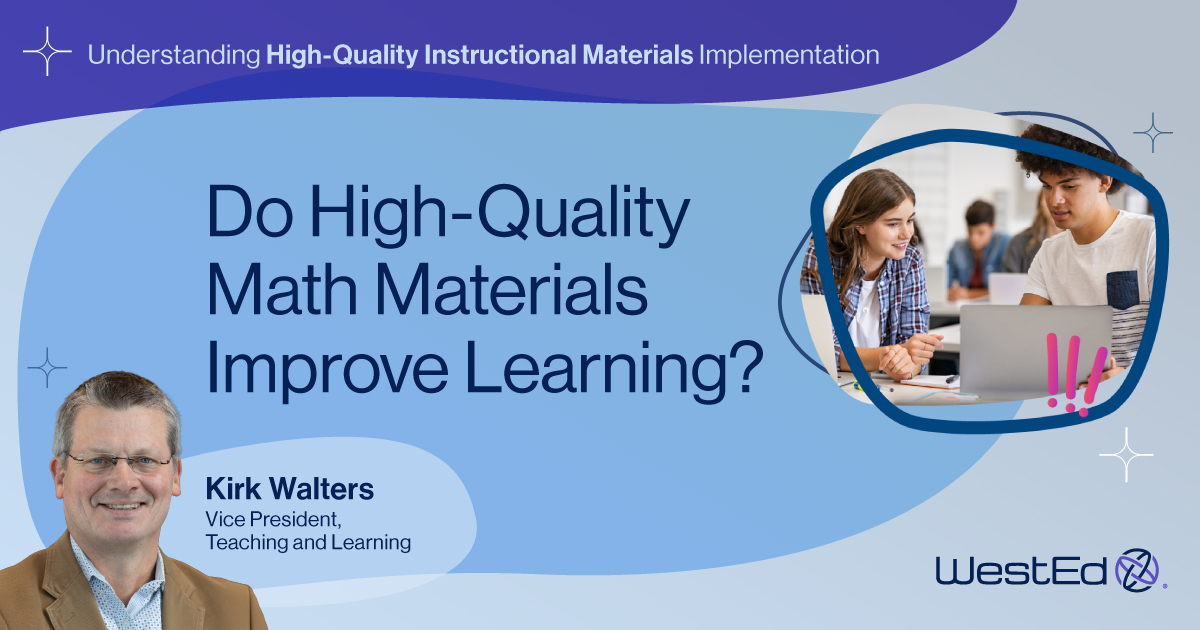
June 11, 2026
By Kirk Walters
Key Takeaways
- High-quality math materials alone are unlikely to produce better student outcomes.
- HQIM developers say that effective implementation is essential for realizing the benefits of their programs.
- WestEd’s research shows positive results for Illustrative Mathematics at the middle school level.
Useful for: district and school practitioners responsible for math curriculum selection and implementation, including curriculum leaders, principals, instructional coaches, and teacher leaders
In this five-part series, WestEd math education experts share the latest WestEd research on how high-quality instructional materials (HQIM) and their implementation impact math teaching and learning.
Accelerating rigorous mathematics learning remains a key priority for policymakers and educators. Even before the pandemic, students were not reaching levels of mathematical proficiency needed to propel them to success in high school and beyond.
One contributing factor was uneven access to high-quality instructional resources. While it’s easy to find resources focused on skill development, fewer resources supported conceptual understanding and application. Developing mathematics proficiency requires that students understand not only how to solve problems but also why those approaches work and when to apply them.
Fortunately, the mathematics resource landscape has improved significantly in recent years. Thanks to product reviews by independent organizations like EdReports, math educators now have at their fingertips an increasing number of HQIM that attend to skills, concepts, and applications. Many of these programs also have aligned professional development resources to help teachers use the materials as intended.
States are also responding to the push for HQIM. The Council of Chief State School Officers, for example, has a network of 15 states that are actively engaged in supporting HQIM implementation, sharing lessons learned, and fostering continuous improvement.
But these advances have not yet translated into broad gains in student proficiency.
Studying the Implementation and Impact of High-Quality Instructional Materials
With support from the Gates Foundation, WestEd launched the Math Curriculum Implementation and Impact Study to understand this new landscape. This study examines three questions:
- Does student mathematics achievement improve with the adoption and ongoing use of HQIM?
- Are there particular HQIM programs that produce stronger effects on students’ math learning?
- What are the most salient challenges and enablers to implementing HQIM well?
Our research team initially planned a randomized controlled trial (RCT) to measure the impact of HQIM programs on student achievement. In partnership with districts, we shifted to a quasi-experimental design (QED) to better reflect how HQIM is being implemented in real-world settings and to generate actionable insights for supporting schools and teachers.
We are now working with state and district partners across the country, with research continuing through the 2026–27 school year. To date, we have released two papers: one examining the impact of Illustrative Mathematics (IM) in grades 6–8 across different contexts showing significant positive effects, and one outlining our approach to measuring HQIM implementation and why it matters for interpreting student outcomes.
We are excited to share these papers (see below) and have more in progress. We welcome your questions and comments and hope you might join a future learning event, which will be posted on our website.
- Measuring What Matters: Considerations for Measuring the Implementation of High-Quality Instructional Materials in Mathematics
- Impact of the Illustrative Math Curriculum on Math Achievement
Stay tuned for more in this series. In upcoming posts, we’ll share what we are learning about how HQIM is being used in practice, what supports effective implementation, and where challenges need to be addressed.
About the Author
Kirk Walters is Vice President of WestEd’s Center for Teaching and Learning. He designs, implements, and evaluates cutting-edge approaches to mathematics teaching and learning, including several current field studies focused on HQIM. Walters’s experience as a middle and high school math teacher in urban public schools continues to inform his commitment to strengthening connections between practice and research.
Helping Schools Make Math Materials Count
A strong mathematics foundation is a key component of success in school and beyond. WestEd partners with educators and education systems to support the effective implementation of HQIM and rigorous mathematics teaching and learning for all students.

Ready to Strengthen Your Assessment Systems to Support All Learners?
Connect with our WestEd experts.
"*" indicates required fields
More Related to This Post
Blogs & Podcasts
Research insights and stories designed to inform, engage, and inspire.

Resources
Browse our high-quality publications and resources designed to inform and engage professionals in a variety of fields including K–12 education, early childhood, and health and justice.