

January 6, 2026
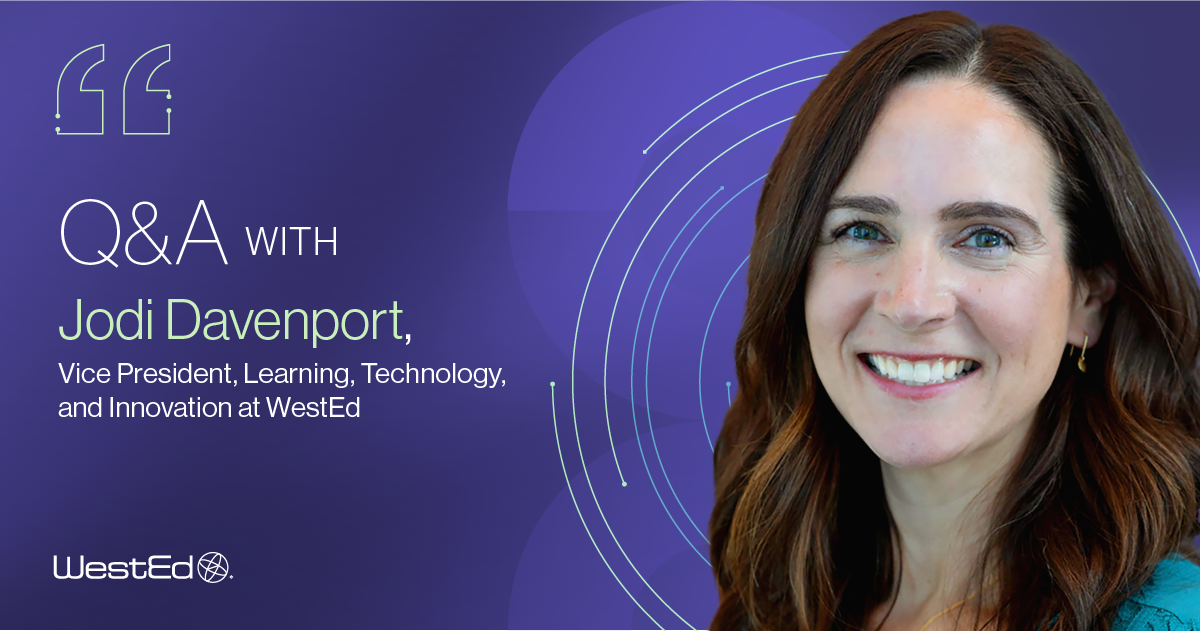
As interest in AI grows, many leaders are taking time to consider what thoughtful, responsible engagement looks like for their systems. In this Q&A, Jodi Davenport, Vice President of Learning, Technology, and Innovation at WestEd, shares insights drawn from her work with education systems at different stages of exploration.
She reflects on how leaders can build shared understanding, strengthen professional confidence, and approach AI in ways that remain grounded in people and purpose, whether they are beginning the conversation or already testing tools and policies.

One of the things I love most about working at WestEd is the broad range of expertise our staff bring that enables us to support leaders at every stage of the AI implementation process.
For states, our DISC team offers support to state education and workforce leaders to understand AI readiness, security, ethics, and compliance issues and provides phased adoption assistance. For districts and postsecondary institutions, our professional learning experts offer customized, hands-on learning experiences that build AI confidence and fluency. In all of our offerings, we start where leaders are and build roadmaps to where they want to be. Although the pace of AI innovation can feel overwhelming, we’re still in the early days, and the best time to start is now.
I love how our Digital Fluency team’s Friction by Design framework centers learning for both educators and students in the age of AI. Learning is a biological process, and it takes practice and time to strengthen the neural pathways for knowledge and skill development. Friction can either be productive, leading to meaningful change and understanding, or counterproductive, making it harder to get started. Productive interactions with AI enable students to take ownership of their learning, engage in productive struggle, and engage collaboratively with each other.
Our professional learning offerings enable educators to experience productive friction firsthand. When working with middle school teachers on writing with AI, our team first focuses on the goal of writing—intentionally communicating something (purpose) to someone (audience) and offers concrete examples of how to foster cognitive ownership, productive struggle, and social sense-making through writing activities that include AI. For example, to maintain cognitive ownership, students can use AI to generate counterarguments to drafts and then ask students to refine their positions. To maintain productive struggle, teachers can adapt peer feedback protocols to AI and encourage students to share their reflections on the input. Finally, to encourage social sense-making, teachers can foster discussions around AI responses to prompts in order to anticipate potential reader questions.
Our professional learning keeps teachers at the center of orchestrating learning experiences for their students and helps them discern how to integrate in effective and engaging ways.
There’s already a huge influx of AI-related products in the market. As these offerings proliferate, district leaders will need to discern which meet the needs of the students they serve and the constraints of their schools and systems. REL Northwest, led by WestEd and Marzano Research, created a framework for district leaders as they consider adopting new technology. The framework, Leveraging Technology for Student Success, offers key questions for leaders to consider as they select tools, evaluate their infrastructure, anticipate implementation supports, and plan for continuous evaluation.
In a partnership with the Washington Rural Alliance, the REL Northwest team worked with three districts in their technology adoption journey and discovered some key lessons, including that sometimes the best solution may not involve technology at all.
In other words, the question isn’t whether AI will change the landscape—it already has. The real work is building the shared understanding, guardrails, and learning supports that help systems respond with clarity instead of whiplash.
Thank you for talking with us, Jodi.
Ready to Navigate the Promise of AI?
As conversations about AI continue to evolve, many education leaders are choosing a thoughtful path forward, asking deeper questions about purpose, readiness, and what responsible use looks like in practice.
WestEd works alongside education leaders to support that process. Whether you are clarifying readiness, strengthening professional learning, or developing policies and guardrails that reflect your values and context, our teams can help you take the next steps with intention. If you would like to discuss where your system is and which support might be most useful, we invite you to connect with us.

Ready to Strengthen Your Assessment Systems to Support All Learners?
Connect with our WestEd experts.
"*" indicates required fields
More Related to This Post
Blogs & Podcasts
Research insights and stories designed to inform, engage, and inspire.






Resources
Browse our high-quality publications and resources designed to inform and engage professionals in a variety of fields including K–12 education, early childhood, and health and justice.