

October 1, 2025
In 2023, the superintendent of Tolleson Union High School District in Arizona undertook a listening tour to learn directly from staff and students about their experiences and uncover areas for improvement. Among the feedback was a call from teachers for a more cohesive and aligned curriculum to support deeper teaching and learning.
In response, district leadership partnered with WestEd to conduct a districtwide curriculum review, in all subject areas, to understand and strengthen instructional practices and materials across all schools. Over the course of a year, WestEd engaged in a multiphase process that included surveys; classroom observations; focus groups with students, teachers, and administrators; and an in-depth review of the district’s instructional systems, curriculum, and resources. The resulting report provided detailed findings and four key recommendations to strengthen teaching and learning across the district.
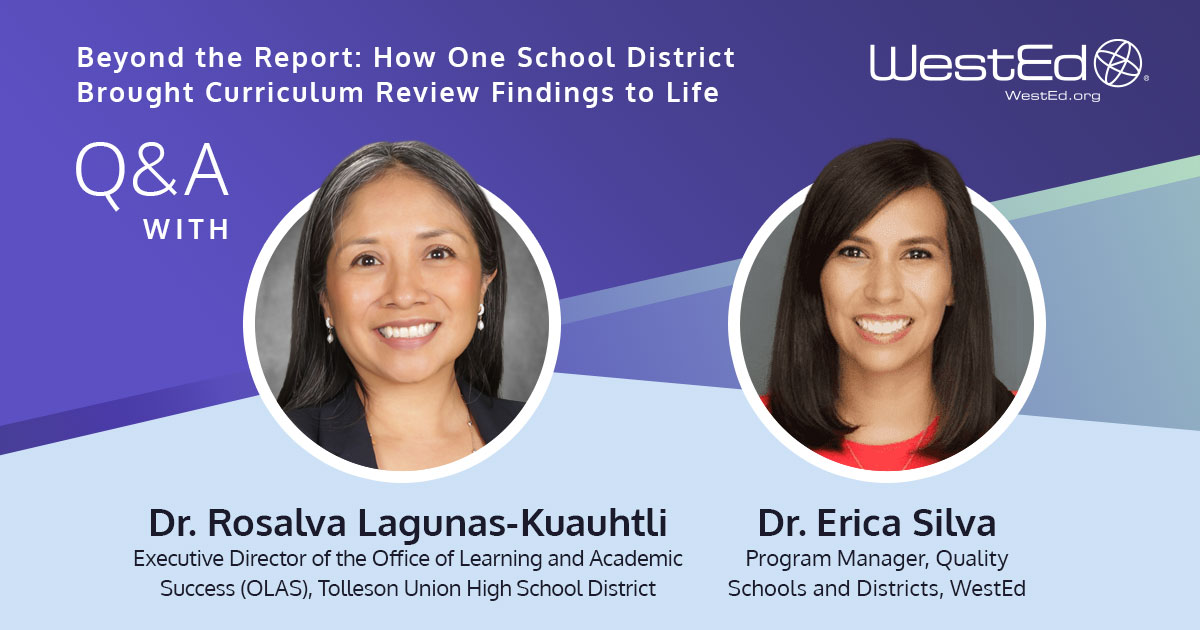
What followed was a model of how district leadership can translate feedback and data into action. Rather than letting the report gather dust, Tolleson’s leaders began a series of change efforts aimed at strengthening their curriculum and improving student outcomes. In this Q&A with Dr. Rosalva Lagunas-Kuauhtli, Executive Director of the Office of Learning and Academic Success (OLAS) at Tolleson Union High School District, and Dr. Erica Silva, Program Manager at WestEd, learn how Tolleson’s efforts led to positive change through thoughtful collaboration with internal and external partners.
Rosalva Lagunas-Kuauhtli: We collaborated with an external partner to do this work because it’s very time-consuming to review all of the curriculum that we have. No one here from the district had capacity to undertake that work, so we were happy that we were able to partner with WestEd. They also brought a neutral perspective to the work, especially in the interviews and surveys they conducted related to our curriculum.
Erica Silva: There were multiple phases to our work in Tolleson. The first phase consisted of a curriculum department review of OLAS, surveying and talking with curriculum department leaders, and providing recommendations to strengthen department operations.
Simultaneously, our team also conducted the larger curriculum review of the entire district. We used our intended, lived, and learned framework to guide our work with Tolleson. The review process consisted of administering surveys to all content areas, visiting over 200 classrooms to conduct observations, hosting focus groups and interviews, and reviewing the district’s repository of materials in their online systems and their curriculum materials across their 11 content areas. Using that data, we then created a report that used the quantitative and qualitative data we collected to provide recommendations for Tolleson leaders. The data also informed our strategic planning and professional learning sessions with key district leaders that focused on creating action plans informed by our findings.
RLK: Many people were involved in this process: our superintendent, OLAS staff, coaches, principals, teachers, and students.
ES: Students were a key component of the focus groups that we conducted. We asked principals to give us a representative sample of their school site, and then we had a 1-hour focus group with students at each site to talk about their experience with teaching and learning at their school. Those were huge drivers of the narrative that informed the recommendations.
RLK: The curriculum review itself was informed by the feedback our superintendent received during his listening tour. After we received the report, our department and district leaders, including our superintendent, collaborated on how we would move forward with WestEd’s four recommendations.
During our 30-60-90-day planning with WestEd, we broke out into teams, and each team became experts in our assigned recommendation. This was so great because, typically, when you get a report, it gets put on a shelf, especially when it’s long like this one is, at 160 pages. Instead, with our group work, we developed 30-, 60-, and 90-day action plans to implement with each recommendation. WestEd team members were there to help us answer any questions and provide guidance.
RLK: In the first phase of this work, we presented WestEd’s preliminary findings to our board in January 2024. Soon after, we reorganized our department so that it better met the needs of our staff and students. We also renamed our department to more accurately reflect our mission and contribute to a more positive culture and climate in the district.
For example, our department changed its name from the Department of Curriculum and Instruction to the Office of Learning and Academic Success to better reflect our purpose and identity. We also changed the name of our Academic Planning Guide to Course Catalog to make our guide to school courses more user-friendly for students and their parents.
Now, in our second phase of work, we’re digging into the input we received from our students, teachers, and families to determine what more we can do to improve the curriculum for our students. One thing we heard from teachers is that there is an opportunity to strengthen student skills, so we decided to launch Flex, an intervention that helps support students during the school day because they aren’t available after school for tutoring due to various circumstances, such as commitments to extracurricular activities, work, or family responsibilities.
Additionally, we listened to our teachers and provided a SharePoint platform where they can easily access curriculum guides, resources, and materials. We are working closely with our teachers to ensure that their voices are included in new district initiatives.
ES: We also had the opportunity to partner with Tolleson and present our work at AERA 2025 on the impacts of a district-research partnership. It’s been inspiring to see how the result of our work together can inspire other districts looking to strengthen instructional coherence in their district.
RLK: Be open to feedback. Feedback is used for continuous growth—to improve—and sometimes we have to be vulnerable. But that’s the only way you’ll learn where you need to grow. It’s also important to create reasonable action steps to strive for. There are always things that happen, and sometimes we want to get everything done, but it’s important to be patient with yourself as a leader and as a team in achieving ambitious goals.
Lastly, once you have a completed report like the one WestEd provided, put it to use. It has so much information and data that we use constantly in professional learning for our staff. Relying on that was crucial for achieving our goals. If you complete a curriculum review correctly, you don’t put your findings on the shelf, you put them into action.
Review Your Curriculum with WestEd
Reviewing your district’s curriculum with WestEd begins with a conversation. If you’re interested in learning more about how to partner with Erica Silva and the WestEd team to undertake a comprehensive, research-based review of your curriculum, contact Bob Rosenfeld, Senior Engagement Manager on WestEd’s Quality Schools and Districts.

Ready to Support Your Thriving Learners and Empowered Communities?
Connect with our WestEd experts.
"*" indicates required fields
More Related to This Post
Blogs & Podcasts
Research insights and stories designed to inform, engage, and inspire.



Resources
Browse our high-quality publications and resources designed to inform and engage professionals in a variety of fields including K–12 education, early childhood, and health and justice.