October 1, 2026
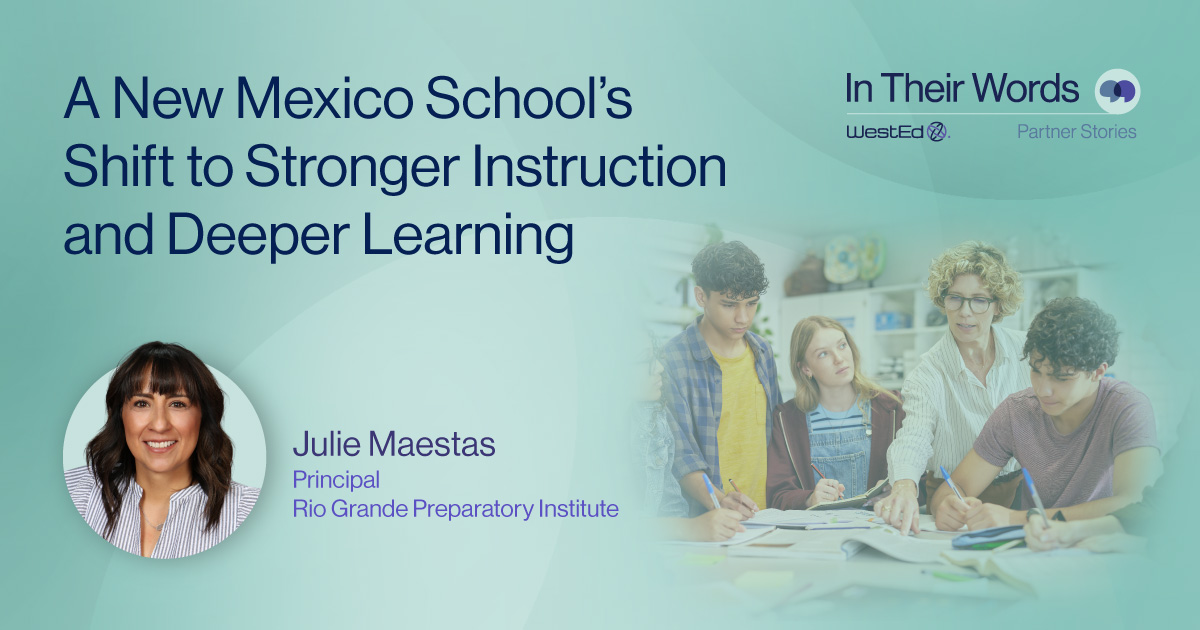
We wanted the students to experience classrooms where their ideas mattered, where their voice mattered, and where they were expected to think and to leave with confidence, purpose, and perseverance.
— Julie Maestas
Principal, Rio Grande Preparatory Institute
When Principal Julie Maestas arrived 4 years ago at Rio Grande Preparatory Institute (RGPI), a small public school in Mesilla, New Mexico, she saw an opportunity to build on the school’s unique approach to education while challenging long-held perceptions about its students and what they could achieve.
RGPI serves students with a wide range of experiences, strengths, and needs. Maestas was drawn to the school’s project-based learning and career and technical education and its mission of helping students build the knowledge, skills, and confidence to navigate life beyond school.
Inside classrooms, she saw teachers who cared deeply about their students. But she also saw students spending much of their time completing work rather than deeply engaging in learning.
“There was a large emphasis on what students needed to finish,” Maestas said. “It was more about completion—completion of their assignment, completion of the class, get to the graduation.”
She also encountered a perception she wanted to change.
Within the district, RGPI had come to be viewed primarily as an alternative school for students seeking a different path to graduation, including those who had faced academic or disciplinary challenges in other school settings.
“I really wanted to challenge that perception because I believed the students here deserved better … and I wanted them to be proud to come here,” Maestas said.
She wanted RGPI to shift from a culture of mere completion to a culture of learning. That meant raising expectations for students while giving teachers the tools to help them meet those expectations.
Raising Expectations and Providing Support
At 2025 UNITED: The National Conference on School Leadership, cohosted by the National Association of Elementary School Principals and the National Association of Secondary School Principals, a session covered four high-leverage practices for principals: instructional coaching, a productive school climate, teacher collaboration and professional learning communities, and strategic management of people and resources.
Those practices closely aligned with what Maestas wanted to build at RGPI. Rather than introduce another instructional strategy that teachers might use for a year and then replace, she wanted a comprehensive approach that could influence how they thought about teaching and learning.
After attending WestEd’s Quality Teaching for English Learners (QTEL) administrator training offered by the district, she saw a connection between QTEL’s approach and RGPI’s goals.
QTEL is a sociocultural approach to teaching and learning that engages English Learners in rigorous, collaborative learning with high levels of support. Its research-informed professional learning helps educators strengthen students’ conceptual understanding, academic practices, language development, and classroom engagement with practices that can benefit all learners.
For Maestas, QTEL’s emphasis on rigorous learning, academic discourse, collaboration, and meaningful student engagement reflected the kind of classroom experience she wanted for RGPI students.
“QTEL seemed to connect directly to the mission that we had started developing here where we wanted the students to experience classrooms where their ideas mattered, where their voice mattered, and where they were expected to think and to leave with confidence, purpose, and perseverance,” she said.
RGPI teachers began QTEL professional learning and coaching during the 2025–26 school year, participating in multiple coaching cycles that gave them opportunities to put what they were learning into practice and refine their instruction.
As teachers participated in QTEL professional learning and coaching, Maestas began to notice changes not only in the strategies they used but also in how they planned.
Previously, teachers often planned around what they would be doing during a lesson. Increasingly, Maestas heard them considering what students would be doing, thinking, saying, and writing. Teachers reflected on where academic discourse and writing appeared in their lessons and how students were interacting with both the content and one another.
The coaching component proved especially important.
At first, some teachers were nervous about having a coach enter their classrooms because they associated observation with evaluation. Over successive coaching cycles, Maestas watched that perception change. Teachers began stopping during lessons to ask QTEL coaches reflective questions and inviting their feedback.
Eventually, that openness extended beyond the coaching relationship. Teachers began conducting peer walk-throughs and inviting colleagues into their classrooms to see what they were trying.
Giving Students a Reason to Engage
Research suggests that students who enter the classroom behind can make significant academic gains when they have access to rigorous instruction, meaningful engagement, and high expectations.
At RGPI, Maestas began to see shifts in student engagement as teachers held higher expectations for their students and put their new instructional practices into action.
“I see the students becoming more confident. I see them defending their ideas, which is hard for their age group—it can be scary to defend an idea in front of the class,” she said. “Students have really opened up.”
During one classroom visit, Maestas saw a student presenting and participating in a role-play in front of the class who had once spoken so quietly that Maestas sometimes had to lean in or ask her to repeat herself.
“I was like, wow, she’s come out of her shell,” she said. “I really feel like it’s because of the [QTEL] strategies where she was encouraged to share her thinking— student voices matter, and it’s a powerful tool for them.”
Maestas believes those changes have also contributed to another challenge RGPI has been working to address: chronic absenteeism.
She said that at the same point in the previous school year, RGPI’s chronic absenteeism rate was around 60 percent. Since then, it has fallen to about 28 percent.
Attendance is complex, but Maestas sees a connection between students’ willingness to come to school and what happens when they arrive.
A few years ago, she asked her staff, “When students are here, are we giving them a reason to come back?”
She said that, previously, students who missed class could often collect worksheets, complete them, and receive credit. Now, classroom learning increasingly involves discussion, debate, collaboration, and opportunities to contribute—experiences students don’t want to miss.
Maestas said that sense of participation can also create something she sees as equally important: belonging.
“When you’re in a classroom, and you’re having a conversation, and you get it, and you’re like, ‘Oh yeah, I’m contributing,’ I just feel that that gives students a sense of where they belong and that’s what makes them want to come back,” she said.
Sustaining Instructional Change
RGPI plans to continue partnering with QTEL through professional learning and coaching, strengthening its professional learning communities, using walk-through data, and creating more opportunities for teachers to learn from one another. The goal is not mastery of a single instructional strategy but rather continued reflection on what students are experiencing in classrooms.
This work has reshaped Maestas’s understanding of her own role. Participating in QTEL professional learning and staying connected to classroom practice has helped her see herself more clearly as an instructional coach, not as someone who enters classrooms only to evaluate teachers.
Her advice to other principals considering professional learning to improve teaching and learning begins with understanding why the work matters and recognizing that meaningful professional learning requires more than a training session.
She said that teachers need modeling, coaching, collaboration, opportunities to practice, feedback, and permission to refine what they are doing. Leaders, in turn, need to remain close enough to classroom practice to understand both its successes and its challenges.
“This past year has been the most rewarding because I feel like we really changed the mindset of how people in the building think about the students,” Maestas said. “Those kids have been given the opportunity to be proud, to feel like they learned, and to feel accomplished—seeing students who’ve typically been told they can’t do it be successful has been very rewarding.”

Julie Maestas is an experienced educational leader with 14 years of administrative service in Las Cruces Public Schools and currently serves as Principal of Rio Grande Preparatory Institute. She is passionate about creating innovative, student-centered learning opportunities that prepare students for success in college, career, and life.
Her leadership is grounded in holding high expectations, cultivating meaningful relationships, and ensuring that every student has the opportunity to reach their full potential.

Ready to Strengthen Instruction and Student Engagement?
Connect with our WestEd experts.
"*" indicates required fields
More Related to This Post
Blogs & Podcasts
Research insights and stories designed to inform, engage, and inspire.



Resources
Browse our high-quality publications and resources designed to inform and engage professionals in a variety of fields including K–12 education, early childhood, and health and justice.