

May 20, 2026
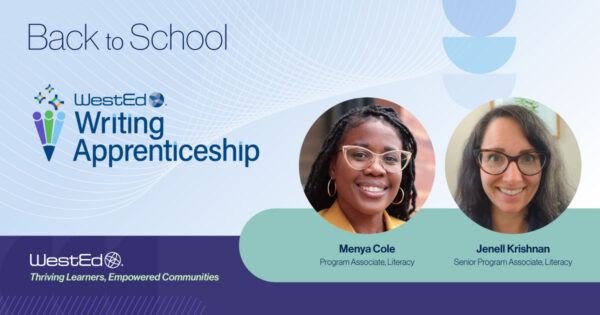
By Jenell Krishnan and Menya Cole
When teachers know how to apprentice writers, writing becomes a way of thinking, connecting, and doing in the world.
When a student at a California high school recorded in their learning goals notebook, “This week, I want to learn how to write a poem,” her teacher didn’t hand out a worksheet. She reached for Sylvia Plath. Moments like this show how writing instruction can change when teachers rethink their approach to teaching writing.
WestEd’s Writing Apprenticeship is a research-based professional development model that helps middle and high school educators teach discipline-specific writing in every classroom. Here are eight core ideas educators should know about Writing Apprenticeship’s approach to instruction.
1. Authentic audiences transform student writing for real results.
Engagement and craft shift when students write for real readers. Dana Dutcher, a Writing Apprenticeship alum at the San Joaquin County Office of Education, can personally attest to this. Recently, she helped a student turn a personal narrative into a speech for a local homeless shelter fundraiser. At the podium, her student began with “I could never have imagined standing in front of a group of people and sharing my story, but here I am.” The event raised over $90,000, and a college representative offered her a scholarship.
Writing Apprenticeship supports teachers in retrofitting lessons with rhetorically based prompts—prompts that name a real purpose and a real audience. This helps students use the power of their pen to do real work in the classroom and in the world.
2. Writing Apprenticeship honors students as the writers they already are.
Students come to school as writers. They write text messages, lyrics, fan fiction, code, and family storytelling. Allison Gadeke, a middle school history teacher in Lincoln Union School District, had students show what they’d learned about West African culture through oral storytelling, drafting scripts that blended historical evidence with narrative voice. Many drew on family and community traditions.
Writing Apprenticeship supports teachers in building on learner strengths as a core practice. This core practice helps teachers build on students’ multiple literacies to feed students’ writing identities in each discipline.
3. A collaborative environment is integral to writing.
Students take writing risks in classrooms that are meaningful, collaborative communities. Rather than posting classroom rules, Gadeke opened her year by having each class cowrite social contracts—agreements that every student helped author and sign.
In the Discovery Challenge Academy classroom of Briana Zafranovich Serros, Think–Write–Pair–Share does similar work: Students write before they speak and pair before they share. Writing Apprenticeship offers teachers routines that build these environments deliberately, lowering the barrier to entry while raising the expectation that every voice is necessary.
4. Metacognitive conversation sits at the heart of the framework.
Writing is thinking, and talking openly about writers’ choices builds student agency. This can happen through the writing think-aloud routine. When Zafranovich Serros asks her students how she might borrow poet Carl Sandburg’s personification for her own poem, that is metacognition in action. The framework organizes four interconnected practices—Building on Learner Strengths, Building Writing Knowledge, Building Writing Skills, and Building a Collaborative Environment—around this central move: the ongoing talk between teachers and students about the choices writers make and why.
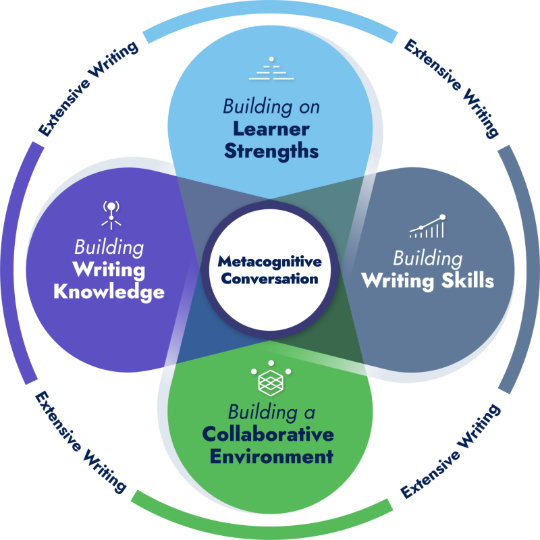
The Writing Apprenticeship instructional framework. Source: WestEd.
5. Writing Apprenticeship helps students see how reading and writing are connected practices.
Learning to read and write in the disciplines is like two buckets drawing water from the same well. Tinka Cisneros, a Writing Apprenticeship alum and an educator for an alternative education program, integrates this practice into her instruction. While teaching The House on Mango Street, a text featuring multiple vignettes, Cisneros invited her students to choose one text structure from the set of vignettes in the book to write their own story. These offered students both choice and structure to support them in writing in a new genre and text type.
Writing Apprenticeship supports teachers in integrating both reading and writing into their instructional practice through the reading like a writer routine and the text structure analyzer app. This helps students adopt and adapt the writing moves of mentor texts.
6. Writing has a place in every learning environment.
Every discipline has unique ways of communicating. Chicago ELA teacher and Writing Apprenticeship alum Paul Mirek co-led a staff workshop to share his new knowledge. The physical education department was also a part of this professional learning. Physical education teachers, some with revisions to lessons plans, invited students to record and publish exercise-technique videos with scripts for their peers. The goal was to learn the movements without injury.
Writing Apprenticeship helps teachers across content areas redesign lessons so that students’ writing helps to improve our world.
7. Writing strategy lists help students identify the techniques they can use in their own writing.
Students benefit when they can name the craft moves they use in their writing. Writing strategies lists can be posted as anchor charts in the classroom when introducing a new genre and text type. In Zafranovich Serros’s classroom, Carl Sandburg’s “Fog” and Sylvia Plath’s “Mirror” show what personification, imagery, and structural choices look like. After analyzing these poems for these literary elements, students were offered the opportunity to draft concrete poems shaped like fire. A writing strategy list benefits students writing poetry when students identify, name, and record the craft moves that poets make in their work so they can adopt or adapt them in their own poems. Writing Apprenticeship supports teachers in creating these lists with students.
8. It grows out of more than 30 years of literacy research.
Teachers deserve professional learning grounded in evidence. Mirek called Writing Apprenticeship the “best PD of the second half of his career,” and Gadeke described her students maturing as writers who see writing as something to tackle one sentence at a time.
Writing Apprenticeship is built on Reading Apprenticeship, which has a strong evidence base across five federally funded studies. Early findings from Writing Apprenticeship show that participating teachers improve across all five framework dimensions and build confidence in teaching writing as a tool for thinking and doing real work in the world.
Why It Matters
The Writing Apprenticeship framework and professional learning provide teachers with the confidence and preparation to elevate their writing instruction in ways that will elevate students’ learning opportunities. When teachers know how to apprentice writers, writing becomes a way of thinking, connecting, and doing in the world.
Explore Writing Apprenticeship in San Francisco This Summer
This summer, Writing Apprenticeship offers a 3‑day, in‑person institute for middle and high school educators seeking to transform writing instruction. Participants engage in experiential learning that supports discipline‑specific writing, builds student confidence, and strengthens instructional practice across classrooms.
San Francisco, CA | June 29–July 1, 2026
Learn more and register for the Writing Apprenticeship Summer Institute.
About the Authors
Jenell Krishnan, PhD, is a developer of Writing Apprenticeship. For 2 decades, Krishnan’s work has been at the intersection of literacy, language, and technology. She strengthens the connection between research and practice by engaging teachers, school leaders, and faculty to improve literacy teaching and learning.
Menya Cole, MS, is also a developer of Writing Apprenticeship. She is an experienced educator with more than 15 years of dedicated service in elementary and middle school settings as both a teacher and literacy coach.

Ready to Support Your Thriving Learners and Empowered Communities?
Connect with our WestEd experts.
"*" indicates required fields
More Related to This Post
Blogs & Podcasts
Research insights and stories designed to inform, engage, and inspire.

Events
Research insights and stories designed to inform, engage, and inspire.

Resources
Browse our high-quality publications and resources designed to inform and engage professionals in a variety of fields including K–12 education, early childhood, and health and justice.