


October 20, 2026
By Randal Tillery
We are beset by two complicating assumptions when we think about education and economic and social mobility. One is that the unit of service we use when discussing education is the individual student (particularly K–12 learners and traditional-age college students) and that their outcomes and achievements are proxies for advancing family and community interests. The second is a persistent belief that it is the job of education and training systems to continuously and reflexively react to the needs of the economy and industry.
While we need not question the importance of improving outcomes at the individual level or the critical importance of continuously gauging the needs of industry and employers, it is important to shift our frame of reference around the place of education and training in building community wealth. What happens when we make families and communities our unit of service?
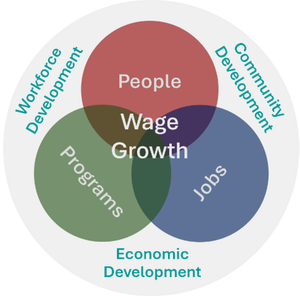
Thinking about the conditions for increasing community wealth broadens our purview to include the social and economic determinants that drive intergenerational poverty and keep communities from realizing economic mobility and social inclusion. Rather than focusing only on education, we can focus on bridges between workforce, economic, and community development with holistic approaches that connect job creation, education, and human service systems.
This also allows us to move our thinking beyond the learners already served by education training systems to those forgotten customers whose needs, labor, and abilities are central to the economic growth and vitality of local communities and regional economies.
How Adult Learners Impact Regional Economies and Communities
Sociologists who are interested in how communities become more economically self-sufficient and dynamic places to live, such as Manuel Pastor, suggest that if you want to create community wealth you should focus on shorter term credential attainment (credentials or associate degrees). This reflects the reality that in lower income or rural contexts, learners who pursue bachelor’s degrees tend to leave their communities, creating a talent drain in the regional economy.
This doesn’t discount the importance of bachelor’s degree attainment—a bachelor’s degree is still the fundamental building block for most individuals to attain a living wage. But what if a primary lever for increasing bachelor’s degree attainment is stabilizing and increasing income for adult learners and parents?
One of the things we know is that the likelihood of a child completing high school and continuing into postsecondary education strongly correlates to family (or household) income and their parents’, particularly their mother’s, highest level of education. Intergenerational, or “2-gen,” approaches to family economic mobility lean into this recognition that outcomes for children and adults are closely tied together. Getting dad or mom a better job is one sure route to improving educational outcomes for young people.
Finally, the ability to address critical workforce gaps, even in industries such as advanced manufacturing, which need skilled workers with technical skills, is completely dependent on our ability to help adult learners gain skills to pivot into these opportunities, particularly in a time of declining K–12 and college enrollment. These populations include the 42 million working or unemployed adults who have stopped out of education, the 10 million adults working but still in poverty, and the 2 million adults who cannot contribute to the economy of their families and communities due to incarceration.
Moving Beyond Workforce to Wage Growth
The WestEd Center for Economic Mobility was invited to work with residents, employers, local government, and educators to develop a comprehensive workforce and wage growth strategy for Santa Cruz County, Arizona. Central to this plan is the foundational belief that creating community wealth is everybody’s business—everybody plays a role and has the responsibility for shifting the conditions that stimulate and increase economic mobility and community wealth.
Instead of leaning into education and training alone to increase economic mobility, the plan includes (a) levers and strategies focusing heavily on adult learners to increase access to existing or anticipated quality jobs with low barrier to entry, (b) creation of new credential programs in the community tied to immediate or anticipated job demand, and (c) economic development strategies for stimulating demand. Sample strategies include the following:
- Tie workforce strategies into the binational and bicultural character of the region—bridging new training capacity with growing cross-border collaboration, nearshoring manufacturing capacity in reaction to new tariffs, and generally ensuring that technical training both responds to economic shifts and becomes a business attractor and industry growth strategy.
- Create on-ramps and awareness of quality jobs with growth potential with low barriers to entry for working adults with low wages and those experiencing poverty. As an example, federal customs and border patrol occupations will experience significant demand due to oncoming retirements.
- Leverage infrastructure investments in construction of a new mine facility, Nogales port expansion, and supply chain warehouse expansion to build locally accessible pathways into construction and the trades for existing workers.
- Implement business attraction and incubation strategies that can increase retail amenities that capture more of the 50,000 cars that cross the border from Mexico every day to shop at big box retailers 60 miles to the north in Tucson.
- Build stronger pathways from local K–12 CTE programs into internships and apprenticeships with employers in anchor industries. This will create cross-class relationships and establish a foothold in local employment that incentivizes students to return after completing college.
Most critically, the emerging Santa Cruz Collaborative partnership is committed to a new shared governance decision-making structure with a formalized table of champions, action teams, a charter, key performance indicators, and performance measurement strategies and will adopt 1-, 3-, and 7-year goals for implementing dozens of strategies in the plan. It will provide a space for the community/communities and interest holders in Santa Cruz County to create and control their own narrative and future.
The Santa Cruz Collaborative will drive coherence across K–12 and postsecondary education, the workforce system, industry, and local government. It will implement sector strategies for industrial trades, manufacturing, and trade and logistics. If fully implemented, this shared governance process will bring resident, employer, government, and educator voices to the table to bridge education and training; economic development; and community development strategies that help industry grow and create opportunity, prepare adult learners to access those opportunities, and strengthen pathways for school-age youth to see the region as an opportunity rather than something to escape.
Work With Us
The WestEd Center for Economic Mobility team is currently supporting this approach to economic mobility in multiple communities through regional workforce and economic strategic planning, technical assistance for emerging community and workforce collaboratives, and regional scans.
For more information on our services, contact us.
About the Author
Randal Tillery is a Senior Director, Economic Mobility and Workforce Systems, and the Co-Director of the Center for Economic Mobility at WestEd.

Ready to Support Your Thriving Learners and Empowered Communities?
Connect with our WestEd experts.
"*" indicates required fields
More Related to This Post
Blogs & Podcasts
Research insights and stories designed to inform, engage, and inspire.



Events
Research insights and stories designed to inform, engage, and inspire.


Resources
Browse our high-quality publications and resources designed to inform and engage professionals in a variety of fields including K–12 education, early childhood, and health and justice.


