


August 28, 2026
Key Takeaways
- Recent federal waivers give states flexibility to redesign their accountability systems, but flexibility without a clear design rationale can add complexity without improving outcomes.
- Better accountability systems create better opportunities, but realizing those opportunities depends on whether LEAs have the organizational conditions to turn evidence into action.
- There are three persistent forces working against assessment coherence: systems that grow but never subtract, communication that cannot keep pace with design complexity, and flexibility that produces fragmentation without coordination.
Who Can Benefit? State education leaders, district administrators, and accountability and assessment teams.
Accountability systems are built to identify where improvement is needed, but identification alone does not produce improvement. For that to happen, the system must be designed with a clear purpose, supported by organizational conditions that help educators act on what the data show. Accountability systems must also be grounded in assessments that work together rather than against each other. This Spotlight highlights three WestEd resources that examine what it takes to build accountability systems that do more than measure.
What Indiana’s Waiver Means for State Accountability Design
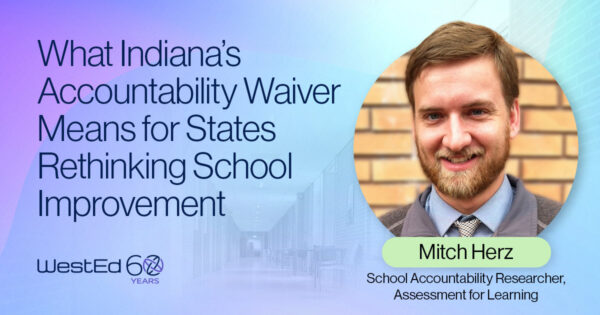
In June 2026, the U.S. Department of Education approved Indiana’s Returning Education to the States Waiver, the third such waiver granted following Iowa and Louisiana. Unlike other waivers, Indiana’s modifies core requirements set by the Every Student Succeeds Act (ESSA), including removing the requirement that academic indicators receive “much greater weight” in Indiana’s accountability system. WestEd’s Mitch Herz examines what this decision means for any state watching how far ESSA flexibility can extend.
Herz outlines both the opportunity and the risk this flexibility creates:
- Flexibility is an opportunity to reconsider system design. States can use it to ask whether their accountability indicators are aligned with school improvement efforts and whether the system has grown too complex to drive meaningful action.
- Adding indicators without strengthening the link to improvement adds complexity, not outcomes. New flexibility should prompt system streamlining along with the consideration of new measures.
- Technical changes signal what a state values. States should clearly articulate the goals driving any changes and communicate them thoroughly so that adjustments are not misread by educators, families, or the public.
Read What Indiana’s Accountability Waiver Means for States Rethinking School Improvement.
The Organizational Conditions That Turn Accountability Into Action
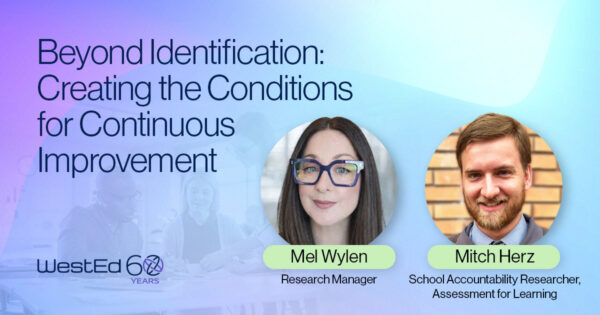
A well-designed accountability system creates opportunities for improvement. Whether those opportunities lead to better outcomes depends on what happens after a need is identified. WestEd’s Mel Wylen and Mitch Herz examine Arkansas’s July 2026 federal waiver approval as an example of one state working to connect accountability with planning, funding, and differentiated support. They identify organizational conditions that help LEAs turn accountability data into action.
Their analysis offers a framework that applies beyond Arkansas:
- Accountability data are signals, not diagnoses. LEA and school leaders need a shared understanding of what indicators measure, what they do not measure, and what additional evidence is needed before moving toward solutions.
- Collaborative inquiry structures turn evidence into understanding. States can support this by providing inquiry protocols and differentiated technical assistance. LEAs activate it by embedding collaborative inquiry into routine decision-making.
- Strategy selection is only part of the work. LEAs need routines for monitoring implementation and adapting based on what they learn rather than waiting for the next annual accountability cycle.
When accountability connects to this kind of continuous cycle, identification becomes the starting point for improvement rather than the destination.
Read Beyond Identification: Creating the Conditions for Continuous Improvement.
Three Forces Working Against Assessment Coherence
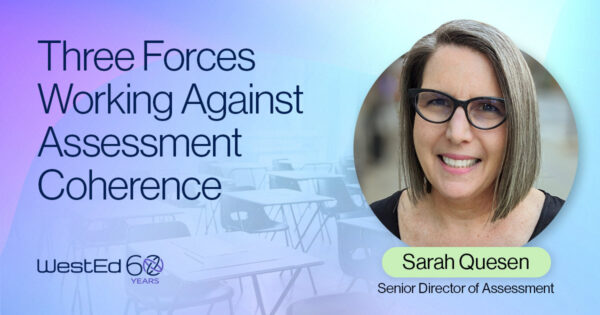
Even when states design accountability systems with clear goals and LEAs build the organizational conditions to act on them, the assessments underlying those systems can undermine that effort. WestEd’s Sarah Quesen examines why coherent assessment systems remain rare in practice, identifying three forces that work against them. Each is driven by reasonable people responding to real pressures, which is part of what makes them persistent.
- Systems add processes but rarely subtract them.. Every new concern produces a new measure, and nothing gets removed. The result is sometimes purposeless assessments and a paradox in which more measurement produces less clarity about what students know and what to do about it.
- Communication problems are often design problems. When a system produces contradictory signals, outreach alone will not fix it. If the architecture makes clear communication impossible, the architecture needs to change.
- Flexibility without coordination produces fragmentation. When districts use different interim systems, screeners, and benchmarks, educators and parents lose the ability to compare results, and the instinct to add another assessment to reconcile the gap only deepens the problem.
Read Three Forces Working Against Assessment Coherence.
Partner With WestEd to Strengthen Your Accountability Systems
WestEd works with state and local education leaders to strengthen the connections among accountability, assessment, and school improvement. From system design to building assessment literacy to supporting continuous improvement, WestEd helps education systems move from identifying needs to acting on them.
Learn more about WestEd’s work in Assessment Systems and connect with a WestEd expert.

Ready to Support Your Thriving Learners and Empowered Communities?
Connect with our WestEd experts.
"*" indicates required fields
More Related to This Post
Blogs & Podcasts
Research insights and stories designed to inform, engage, and inspire.


Resources
Browse our high-quality publications and resources designed to inform and engage professionals in a variety of fields including K–12 education, early childhood, and health and justice.