

September 15, 2026
Improving student outcomes depends not only on what teachers know but also on the support they receive to translate that knowledge into daily classroom practice. For schools and districts, Tier 1 instructional coaching can play a pivotal role in that system. When coaching is connected to clear instructional priorities, collaborative planning, and ongoing feedback, it can help districts move beyond isolated professional learning events toward consistent, systemwide improvement.
WestEd’s Tier 1 Instructional Practice and Coaching team, led by Sofia Aburto, works with schools and districts to build the capacity of teachers, instructional coaches, and administrators to implement high-quality instructional practices for grades K–12 with support for planning, implementation, and follow-up to ensure continuous improvement.
In this Q&A, the team discusses how effective Tier 1 instructional coaching shows up in the classroom, why coaching is never one-size-fits-all, and how education leaders can use coaching to improve instruction across a school or district.

We would see both a lesson intentionally designed around clear learning goals and a variety of instructional strategies that overtly engage all students in grade-level standards. These strategies would include both checks for understanding and student-to-student academic conversations, and we would see the teacher using their observations of learning to provide meaningful feedback. Students would have the necessary materials and resources, such as sentence frames and graphic organizers, that support learners at all skill levels.
Reflective coaching is where the coach supports the teacher’s reflective thinking through the use of questioning, prompting, and probing. Directive coaching is when the coach focuses more on providing guidance or instruction through teaching, telling, and demonstrating. It is useful when teaching new skills or helping make course corrections as needed. Using a blended approach along a continuum allows coaches to meet the needs of individual teachers.
For example, if there were a need to develop a common understanding around a high-leverage instructional practice (e.g., “linguistic support”), a coach may shift to more of a direct coaching stance for the purpose of providing a learning opportunity.
“When coaching is done well, it is customized to fit the individual needs of each teacher and helps them grow and strengthen their practice.”
Suppose a district has determined that they want to add Academic Conversations as a consistent instructional practice across its schools to help develop students’ language and complex thinking skills. Academic conversations are sustained, purposeful conversations centered on school topics with partners taking turns talking, listening, and responding to each other’s comments. The school or district could do a needs assessment (e.g., by briefly observing all classrooms to gather baseline data) to determine needs across grade levels, departments, and individual teachers and develop a coaching plan to meet the needs of all teachers. How do we build common language and understanding for all while valuing those who have some experience and supporting those who are new(er) to it? You can then differentiate your approach (direct/reflective/blend) as well as the format (e.g., side-by-side coaching, in-and-out coaching).
Classroom observations and conversations are meaningful because they are grounded within a process that is aligned with state academic standards and that improves K–12 student achievement by improving classroom instruction. Administrators, instructional coaches, and teachers learn specific high-effect size, research-based teaching strategies that lead to increased student achievement and are able to recognize those strategies in practice. This creates a common language for objectively discussing, planning, and examining standards-based classroom instruction. Coaching conferences prepare leaders and instructional coaches to provide teachers with differentiated coaching aligned with teacher and student learning needs, and they prepare teachers to implement rigorous standards-based instruction.
A productive conversation looks and sounds like a discussion around the evidence gathered during a classroom observation. In this conversation, the teacher and the coach discuss what is happening as it pertains to student learning. These collaborative conversations naturally lead to deeper questions and the sharing of more and more instructional practices that can help students learn. Conversations feel purposeful, relevant, and nonjudgmental.
On the ground, support looks like walking through classrooms together with a site administrator, sharing how you collect data, discussing observation data, calibrating on interrater reliability with specific “look fors,” preparing coaching conferences, role-playing, modeling, co-facilitating, and providing feedback on leader coaching conversations.
The part of this work that is often the most challenging includes time management (i.e., How is the coaching schedule developed to ensure that you are able to observe and provide timely feedback to teachers?), gathering of classroom observation data (i.e., What specific types of evidence do you collect during classroom observations?), and the documentation of coaching conversations (i.e., How are classroom observations documented, and how is the information that is gathered utilized and shared with staff?).
Our experience shows that helping a site administration team recognize the value of coaching conversations as a “formative” support for their teachers, and the impact those conversations can have on daily instruction for students, can be transformational.
Tier 1 instructional coaching is foundational to school improvement. What happens in the classroom is key to helping schools address and prevent widespread academic and behavioral challenges. Yet we also know from research and experience that instructional knowledge and skills learned solely through professional development rarely automatically transfer to use in the classroom.
Professional development supported by coaching is what allows for the transfer of skills into the classroom and is crucial for meaningful and lasting individual teacher and schoolwide progress in instructional practice. We find that a majority of schools have a focus on instruction within their school improvement plan and that coaching helps strengthen implementation.
A misconception we often address is about coaching being a one-size-fits-all model. Coaching is not standardized; it’s responsive and ongoing to ensure that all teachers receive support based on their individual strengths and opportunities for growth. Coaches provide feedback, modeling, and professional learning to positively impact instruction using evidence- and research-based high-leverage practices.
Coaching is often viewed as formulaic and not individualized. When coaching is done well, it is customized to fit the individual needs of each teacher and helps them grow and strengthen their practice, resulting in improved student outcomes. It is a critical tool that school leaders often do not employ consistently but that can dramatically improve instructional practice and increase student achievement.
Tier 1 Instructional Practice and Coaching
Transform K–12 instruction and ensure access and outcomes with professional development and job-embedded coaching that help students understand content standards and prepare for postsecondary success. Learn more about Tier 1 Instructional Practice and Coaching or contact Sofia Aburto to discuss how we can help.
Thanks to our instructional coaching team for collaborating to share their expertise.
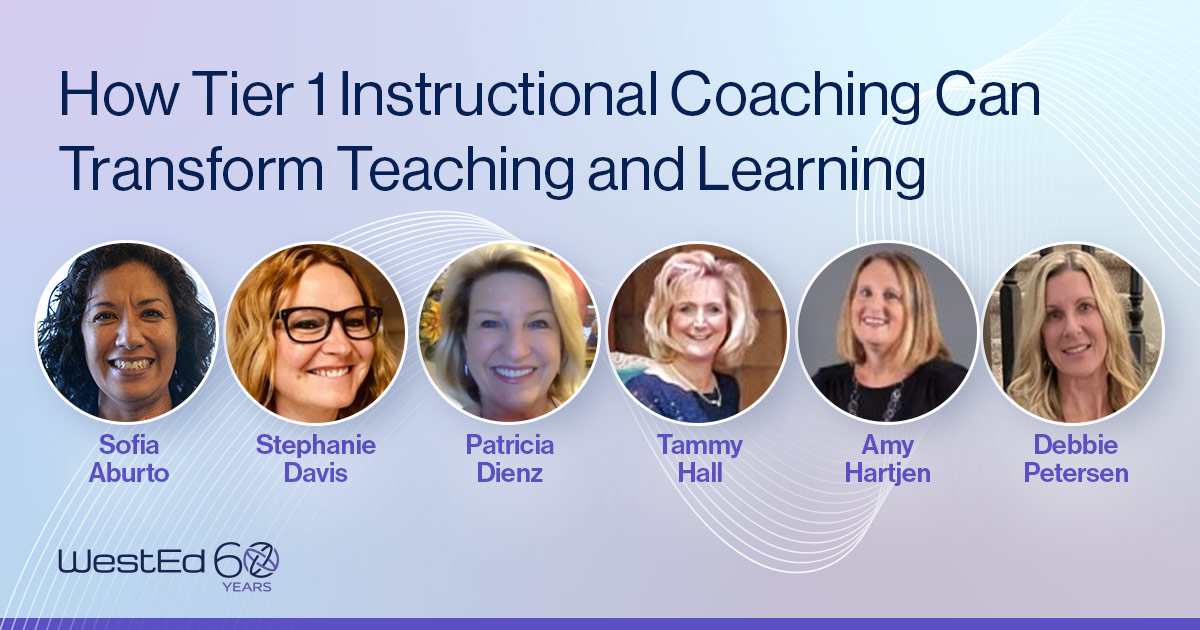
Sofia Aburto, Engagement Director with the Center for Education Systems team, helps leaders and teachers leverage strengths and address persistent challenges by implementing or refining educational systems; enhancing Tier 1 instructional practice; and aligning leader growth, site needs, and district goals.
Stephanie Davis, a school and district improvement specialist, supports school and district leaders in aligning systems with a shared vision, building a positive school culture, and strengthening Tier 1 instructional practices and data systems.
Patricia Dienz, a school and district improvement specialist, helps school and district leaders implement a rigorous, standards-based curriculum; conduct analyses of data to inform instruction (Professional Learning Communities); and implement and monitor effective teaching strategies and programs.
Tamara Hall, a school and district improvement specialist, supports site and district administrators, coaches, and teachers in areas including professional learning communities, standards-based instruction, and classroom observation and coaching.
Amy Hartjen, a school and district improvement specialist, draws on years as a teacher and administrator in Title I schools to support continuous improvement, data analysis, instructional coaching, and expansion of opportunities for students.
Debbie Petersen, a school and district improvement specialist, draws on years of serving as a principal, district turnaround coach, director of curriculum and professional development, instructional coach, and teacher to support school and district improvement.

Ready to Support Your Thriving Learners and Empowered Communities?
Connect with our WestEd experts.
"*" indicates required fields
More Related to This Post
Blogs & Podcasts
Research insights and stories designed to inform, engage, and inspire.



Resources
Browse our high-quality publications and resources designed to inform and engage professionals in a variety of fields including K–12 education, early childhood, and health and justice.