

August 5, 2026
For decades, the traditional high school math sequence has been the same. But today, educators and policymakers are taking a closer look at whether those sequences really provide students with the knowledge and skills they will need to thrive in college, careers, and everyday life. One alternative to traditional pathways is the Integrated Statistics and Quantitative Reasoning (ISQR) course developed through a partnership between WestEd and the Charles A. Dana Center.
Through ISQR, 3rd and 4th year high school students experience math in a way that authentically represents how it is used in daily life, from comparing prices and planning a budget to forecasting sales, improving manufacturing processes, and making sense of research findings. The course is being piloted in 11 states, with broader scaling planned in 2027.
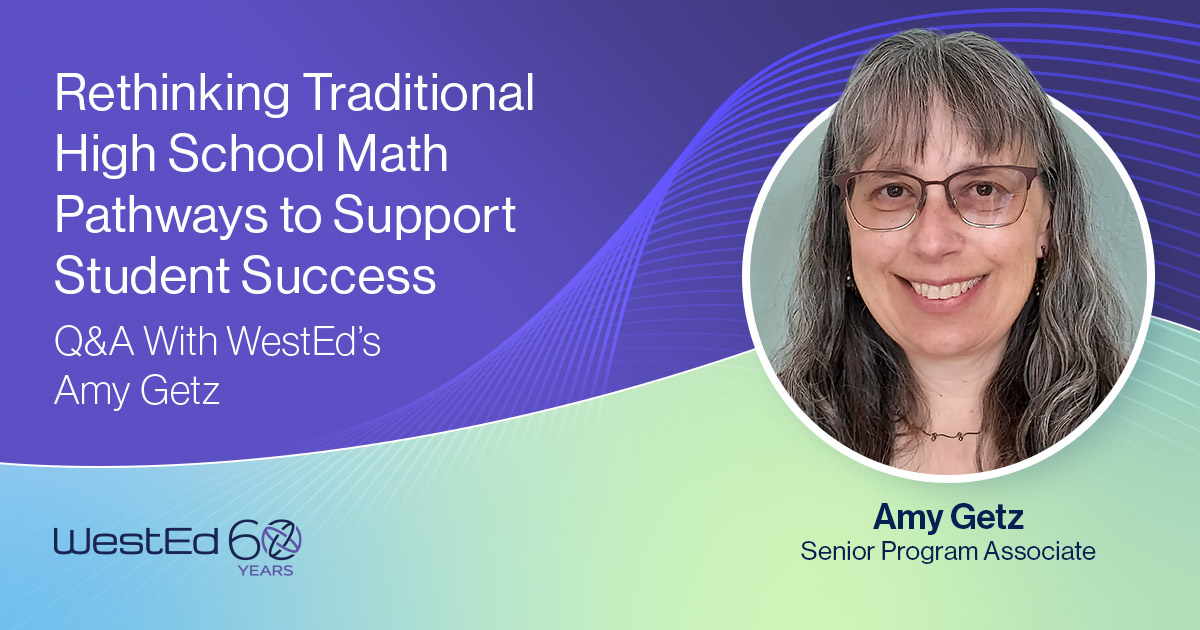
Amy Getz is a senior program associate in Mathematics Education and project director for the ISQR project at WestEd. In this Q&A, Getz discusses why it’s important to modernize traditional math sequences, what the course is revealing about math teaching and learning, and how schools can implement the course in their own states and districts.

A few years ago, I was helping my grandson with his math homework, and he pulled out a worksheet that looked like it was from the 1970s. The world had changed, yet he was learning the same math content in the same way I did. It is true that the fundamentals of mathematics don’t change, but the ways in which we use math have changed, and we need to prepare students with the skills they will need to navigate a data-driven society.
Students need to know how to reason with data, evaluate evidence, and solve complex problems. The advent of AI makes this even more urgent because, increasingly, technology can do the types of mathematical tasks we have traditionally taught. We have to ask ourselves what additional value human beings bring to solving problems and how to prepare students to take that role.
In our work with teachers and students, we’ve learned that they want innovation, both in the content and the presentation of that content. They pushed the curriculum designers to think creatively about how to organize content and design learning opportunities that move beyond the traditional approach of presenting information and then having students practice skills.
In response to this input, the Dana Center designed the course around big questions like “What is the cost?” and “Is it fair?” Students explore the questions in a variety of contexts through activities designed to build their content knowledge, mathematical and statistical skills and fluency, and critical thinking skills.
Today’s careers increasingly require both advanced mathematics and the ability to reason with data. There’s a misperception that there is a clear divide between careers that need math and careers that don’t. The assumption tends to be that those in the former category need the traditional math sequence leading to and through Calculus and into more advanced mathematics, while the others need different content. That line is increasingly blurred.
At a recent meeting held by the National Academies of Science, Engineering, and Medicine, a machine learning engineer and a data science tech noted that while they use highly advanced math in their jobs, they also see a need for more people to be able to evaluate evidence, solve problems, and make decisions—skills that they felt are best taught through quantitative reasoning and statistics courses.
The takeaway is that quantitative reasoning and data literacy skills are important for a wide variety of careers and are also important life skills. That’s the balance ISQR is designed to provide.
It’s always interesting to talk to people about rigor. Some people think that a lot of students failing is a sign of rigor. Others think of rigor only in terms of fluency with algebraic manipulations. I like to ask, rigor for what? For me, the answer is that a rigorous course should prepare students to be successful in whatever comes next. We need to test ISQR through the pilot, but we believe it will be an excellent preparation for college and the workforce and that it will inspire some students to take more math. We’re basing this hypothesis on the facts that the content has been vetted by a number of experts to ensure it provides a strong foundation for college courses and for the workplace and that the pedagogy has a strong research base.
Regarding accessibility, ISQR is designed to provide students with multiple ways to engage with the content and to support teachers in providing additional instruction when needed. This is often not true of traditional curricular materials.
Schools can begin offering the course in fall 2027. An implementation toolkit will be available in early 2027 to support those who want to offer the course, and WestEd will provide direct support. We are piloting the course now and the course materials will be revised and published as an Open Education Resource in summer 2027. Some examples of the course materials are available now on the Dana Center website, and more will be made available over the next year. We encourage people to sign up to receive updates and information about opportunities to hear from teachers, the release of new materials, and ways to prepare to offer ISQR. We also work with state agencies to offer informational events and provide communications materials at the state level.
Every district’s math needs are different, and there are many strong options to consider. I can speak to why districts in our pilot have been so excited about ISQR.
ISQR provides a strong grounding in both quantitative reasoning and statistics, which means districts don’t have to offer two courses and students don’t have to choose.
The instruction provides a different kind of foundation for students. Many real-world applications don’t only use quantitative reasoning or statistics. People are better prepared to address complex problems when they can pull from a variety of tools. Many teachers hope that ISQR will motivate students to take AP or college-level statistics.
In short, ISQR students learn mathematics the way people actually use it in their lives.
Leading Together Webinar
View this recent webinar recording for more details about the ISQR pilot and the ways the course can support students in your state or district.
Explore ISQR
Email us to receive updates and learn how your school, district, or state can adopt the Integrated Statistics and Quantitative Reasoning course.

Ready to Support Your Thriving Learners and Empowered Communities?
Connect with our WestEd experts.
"*" indicates required fields
More Related to This Post
Blogs & Podcasts
Research insights and stories designed to inform, engage, and inspire.


Resources
Browse our high-quality publications and resources designed to inform and engage professionals in a variety of fields including K–12 education, early childhood, and health and justice.