


September 8, 2026
Key Takeaways
- High-quality math instructional materials are a necessary starting point, but effective implementation is what helps determine whether they produce better outcomes for students.
- Early childhood is a critical window for math development, and educators and families both play a role in supporting it.
- High schools are redesigning math pathways to be more relevant and engaging for students with a range of postsecondary goals.
Who Can Benefit? District and school leaders, curriculum coordinators, instructional coaches, early childhood educators, and high school math teachers.
Strong math outcomes require thoughtful implementation, support for educators at every level, and pathways designed to meet students where they are. This Spotlight highlights three WestEd resources that examine what it takes to build math systems that work, from the instructional materials used in middle school classrooms to family engagement in early childhood to new course options for high school students.
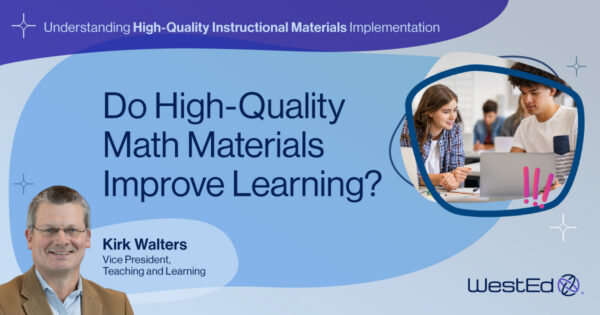
Do High-Quality Math Materials Improve Learning?
Access to high-quality instructional materials has improved in recent years, thanks in part to independent reviews by organizations like EdReports. But gains in access have not yet translated into broad gains in student proficiency. In this blog post, WestEd’s Kirk Walters introduces a five-part series examining how high-quality instructional materials (HQIM) and their implementation affect math teaching and learning.
Drawing on findings from WestEd’s Math Curriculum Implementation and Impact Study—supported by the Gates Foundation—Walters outlines the essentials of HQIM:
- HQIM developers say effective implementation is necessary for realizing the benefits of their programs.
- Early findings show positive results for one program. WestEd’s study of Illustrative Mathematics in grades 6 through 8 found significant positive effects on student achievement across different contexts.
- Implementation conditions shape outcomes. The study examines not only whether the use of HQIM improves achievement but also what challenges and enablers most influence how well programs are put into practice.
Read Do High-Quality Math Materials Improve Learning?
Supporting Early Math Development Through Instruction and Family Engagement
While much attention to math improvement focuses on older students, early childhood is a critical window for building the foundations that support later academic success; and as with HQIM, how that support is provided matters as much as whether it happens at all.
WestEd experts Kylie Flynn and Ashli-Ann Douglas discuss how to best assist early childhood educators with practical tools for strengthening math instruction and for engaging families as partners in children’s math development.
The session covers research-grounded practices that educators and family engagement staff can put to use immediately:
- Effective early math instruction is grounded in research on mathematics learning progressions. Educators can use standards-aligned activities to support children’s math learning in ways that build understanding progressively.
- Families want to support their children’s math development but often do not know how. The webinar highlights the kinds of resources families say they would like to receive from early childhood programs and offers practical strategies for home-based math support.
- Early childhood educators and family engagement staff can use the strategies and resources from this session to build partnerships that extend math learning beyond the classroom.
Strengthening math instruction and family engagement together creates a more connected foundation for children’s early math development.
Watch Advancing Math Instruction and Family Engagement in Early Childhood
A New High School Math Course for Students With Diverse Postsecondary Goals
High schools across the country are redesigning their math systems and pathways to be more rigorous, relevant, and engaging for students with varying interests and postsecondary plans. WestEd and the Charles A. Dana Center are collaborating to develop and pilot a new course, Integrated Statistics and Quantitative Reasoning (ISQR), in 11 states during the 2026–27 school year.
In this webinar, Angela Knotts and Kadron Johnson introduce the course and what it offers students and districts:
- The course is designed for 3rd- and 4th-year high school students. It integrates statistics and quantitative reasoning content in ways that reflect how mathematics and statistics are used in business, industry, and research.
- Hands-on projects and technology-driven investigations are central to the course design. ISQR is built to prepare students with diverse postsecondary goals for both college and the workforce.
- Districts can plan ahead for access. Course materials will be available as open educational resources for districts wishing to offer the course starting in fall 2027.
Partner With WestEd to Strengthen Math Across Your System
WestEd works with districts, schools, and state leaders to improve math outcomes across grade levels; from early childhood through high school, our teams bring research and practical expertise to the work.
Learn more about WestEd’s work in mathematics and connect with a WestEd expert.

Ready to Support Your Thriving Learners and Empowered Communities?
Connect with our WestEd experts.
"*" indicates required fields
More Related to This Post
Blogs & Podcasts
Research insights and stories designed to inform, engage, and inspire.




Resources
Browse our high-quality publications and resources designed to inform and engage professionals in a variety of fields including K–12 education, early childhood, and health and justice.