

June 22, 2026
Special education system reviews can help education leaders look beyond isolated challenges to understand how policies, practices, staffing, data, and instruction work together to support students with disabilities.
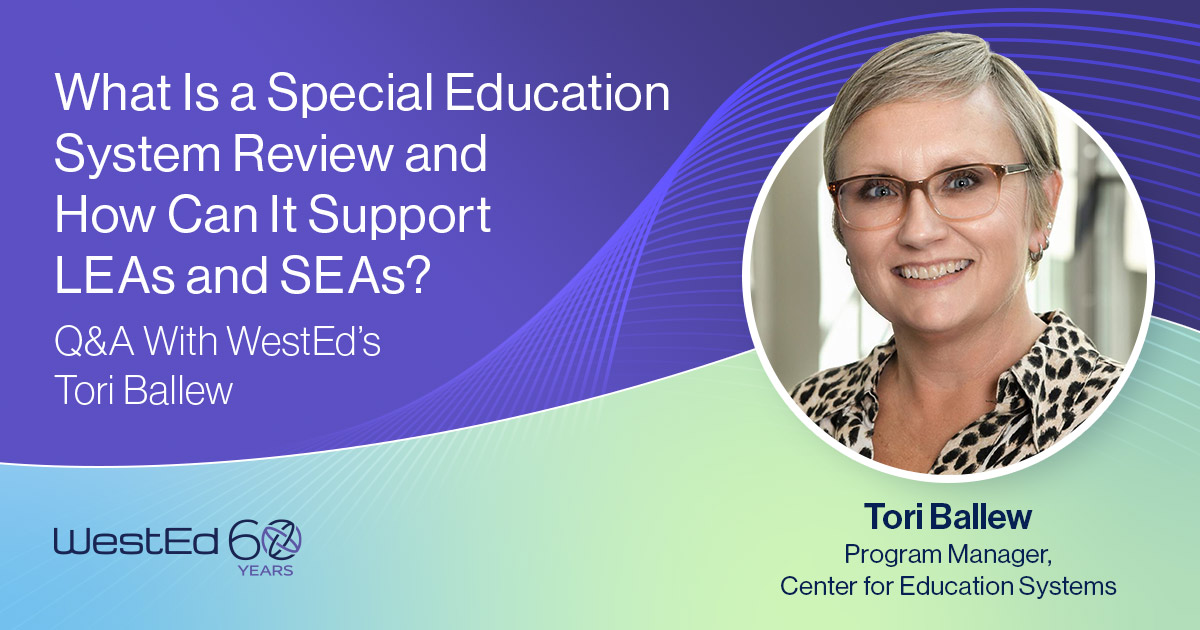
Tori Ballew leads multi-tiered system of supports implementation and special education system reviews at WestEd, partnering with districts and schools nationwide to evaluate systems, identify opportunities for improvement, and develop strategic action plans.
In this Q&A, Ballew explains how special education system reviews can help local and state education agencies (LEAs and SEAs, respectively) identify root causes, strengthen implementation, and move from compliance-focused fixes to sustainable improvement.

Persistent challenges in special education, such as high rates of restrictive placements, staffing shortages, or repeated parental concerns, are often signs of larger system issues rather than isolated problems. For example, if multiple schools struggle with IEP implementation, the issue may be unclear processes, inconsistent training, or weak oversight, not individual staff performance.
A systems-level response helps leaders look at how policies, staffing, data, and instructional practices work together. A review of the entire system helps identify root causes, align improvement efforts, and strengthen how services are delivered. When systems improve, students with disabilities are more likely to experience stronger instruction, better supports, and improved outcomes.
“Persistent challenges in special education … are often signs of larger system issues rather than isolated problems.”
A special education system review looks at how well a district’s system, services, and practices are working to support students with disabilities. Unlike a compliance audit, which focuses on whether legal requirements are being met, a system review asks a broader question: Are all the parts of the system working together in a way that produces positive outcomes for students?
It examines areas like instructional practices; staffing; service delivery; inclusive opportunities; and the experiences of all students, families, educators, and administrators. For example, a district may be technically compliant with IEP timelines but still have weak progress-monitoring practices or inconsistent access to grade-level instruction. A system review helps leaders move beyond checking boxes to understanding what is helping—or limiting—student success.
“A system review helps leaders move beyond checking boxes to understanding what is helping—or limiting—student success.”
Several challenges can signal the need for a system review. These may include stagnant achievement for students with disabilities, increasing due process complaints, high staff turnover, rising out-of-district placements, or concerns about inconsistent practices across schools. Some districts also seek a review when they are working to improve inclusion or better align general and special education. Leadership changes can also create an opportunity to take a closer look at how systems are functioning.
These issues often point to deeper problems that routine troubleshooting can’t solve. A system review helps leaders step back, see the bigger picture, and identify where focused changes can improve services and student outcomes.
Routine data reports can show what is happening, but they often don’t explain why. A system review helps connect the numbers to actual practices by combining data with classroom observations, interviews, focus groups, document reviews, surveys, and IEP reviews. For example, a district may see an increase in restrictive placements, but a review may reveal inconsistent behavior supports, limited staff training, or unclear decision-making processes driving those placements. It can also uncover gaps between written policies and day-to-day practice.
These deeper insights help leaders understand what is working, where systems are breaking down, and what changes are most likely to improve outcomes for students with disabilities.
“Routine data reports can show what is happening, but they often don’t explain why.”
System review findings can help leaders shift from fixing isolated issues to strengthening the larger system. Instead of only addressing compliance concerns, such as missed timelines or incomplete documentation, leaders can use findings to improve instruction, staffing, communication, and decision-making processes. For example, if a review finds inconsistent intervention practices across schools, the response might include common protocols, training, and progress-monitoring systems.
The key is to turn findings into clear action steps with timelines, responsible staff, and measurable goals. This helps districts build stronger systems over time, leading to more consistent services and better academic, behavioral, and postsecondary outcomes for students with disabilities.
After a system review, the most important step is turning the findings into action. Leaders should prioritize the most urgent issues, assign clear ownership, and set realistic timelines for improvement. This might include updating procedures, providing targeted professional learning, or adjusting how resources are used.
It’s also important to share findings with staff and families to build understanding and support for the work ahead. Regular progress checks help teams know whether changes are making a difference.
A review should not sit on a shelf; it should guide ongoing decision-making. When leaders stay focused on implementation, the review becomes a tool for lasting improvement and better outcomes for students.
Strengthen Your Special Education System
When leaders have a clearer picture of how their special education systems are functioning, they are better positioned to make focused, sustainable improvements. A special education system review can help leaders move from reacting to individual concerns to identifying patterns, setting priorities, and taking action that strengthens services and supports for students with disabilities.
WestEd partners with LEAs and SEAs to conduct special education system reviews that are grounded in data; informed by the experiences of students, educators, and families; and focused on strengthening outcomes.

Ready to Support Your Thriving Learners and Empowered Communities?
Connect with our WestEd experts.
"*" indicates required fields
More Related to This Post
Blogs & Podcasts
Research insights and stories designed to inform, engage, and inspire.


Events
Research insights and stories designed to inform, engage, and inspire.

Resources
Browse our high-quality publications and resources designed to inform and engage professionals in a variety of fields including K–12 education, early childhood, and health and justice.