January 12, 2026
By Mariann Lemke and Aaron Soo Ping Chow
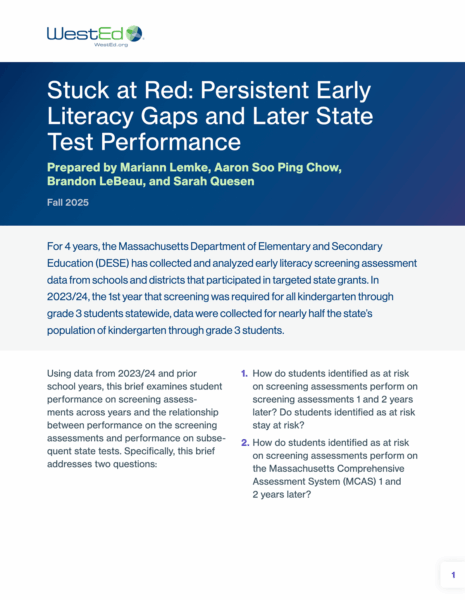
If a 1st grader is flagged for reading difficulty, will early warning and support change that student’s trajectory, or will the student remain “stuck at red” year after year? New longitudinal data offer important insight into that question.
In partnership with the Massachusetts Department of Elementary and Secondary Education (DESE), WestEd analyzed 4 years of early literacy screening data to examine what happens to students who begin the year at risk for reading difficulty. Do they catch up, stay behind, or fall further back over time?
The analysis reveals a concerning pattern. Students identified as significantly below benchmark are often repeatedly identified in subsequent years. For state and district leaders, these patterns raise urgent questions about how early screening data are used and how long students are allowed to remain at risk without additional support.
At the same time, the results point to the potential of early identification and sustained intervention to make a meaningful difference, particularly when support begins early and continues over time.
How Students’ Literacy Skills Change Within a School Year
Screening data from 2023/24 show that literacy skills do improve during the year: About 48 percent of students met benchmarks at the beginning of the year compared with 60 percent at the end. However, most students stayed in the same performance category across the year—those who began at “meeting benchmark” usually stayed there, and those who began at “significantly below” often remained behind. This pattern suggests that while instruction moves many students forward, those with the greatest needs require intensive and sustained intervention to catch up.
Encouragingly, once students got on track, they tended to stay there. Nearly 95 percent of students meeting benchmarks at the start and middle of the year maintained that status at year’s end. Even among those who began below benchmark, 81 percent improved, and 77 percent of students who started significantly below benchmark showed progress. Gains varied across student groups, underscoring the importance of equitable access to effective reading instruction and support.
What Longitudinal Data Show About Persistent Literacy Gaps
The state’s expanding screening data now make it possible to follow individual students across multiple years. The data show results for more than 37,000 students across 2 years and for more than 4,000 students across 3 years.
The data reveal persistent warning signs for students over time. About two thirds (67%) of students identified as significantly below benchmark remained there 1 year later. After 2 years, 84 percent of those students were still at risk.
In contrast, more than 90 percent of students who met reading benchmarks continued to meet expectations. These findings underscore how early reading difficulties can persist without strong, targeted intervention. Once students fall behind, catching up becomes increasingly difficult.
Early Intervention Helps, but Timing and Intensity Matter
Patterns differ notably by grade. Among students who ended kindergarten significantly below the benchmark, 64 percent were still below the benchmark 1 year later compared with 80 percent of students in grades 1–2 and 78 percent in grades 2–3. Two years later, the differences persisted—58 percent of those initially at risk in kindergarten remained behind compared with 73 percent of those first identified in grade 1.
These differences may reflect two truths: Early screeners sometimes overidentify students who are still developing language and print awareness, yet early intervention can be especially powerful when delivered in earlier grades. National research supports this: Foundational reading skills are most malleable before grade 2, and the benefits of early, evidence-based instruction often compound over time.
Encouragingly, students who got on track earlier—those who met screening benchmarks by the end of grade 1—were more than 3 times as likely to meet or exceed expectations on the state’s Massachusetts Comprehensive Assessment System (MCAS) in grade 3 compared to those who never met the benchmark.
How Early Literacy Screening Relates to Later Academic Outcomes
The study also linked screening results to later MCAS performance. The connection is clear: Students identified as significantly below benchmark in grades 1–3 were far less likely to meet MCAS expectations 1 or 2 years later. Only 11 percent of students identified in grade 1 met expectations by grade 3 compared with 10 percent of those identified in grade 2 and 6 percent identified in grade 3. Earlier identification, paired with effective support, clearly increases the odds of later success.
Still, meeting screener benchmarks does not guarantee MCAS proficiency. Screeners focus on foundational skills—phonemic awareness, decoding, and fluency—while MCAS measures a broader range of reading and writing skills. The takeaway: Screening is a powerful early-warning system, not a prediction of state test performance.
Why Staying on Track Matters as Much as Early Gains
The data tell a consistent story. Students who finish a school year below benchmark are likely to remain below benchmark. Those who meet benchmark early are more likely to stay there—and more likely to meet expectations later. Screening data can help educators monitor progress, adjust instruction, and ensure that no student remains “stuck at red” year after year.
The challenge, then, is ensuring that interventions are sustained, targeted, and effective.
Partner With WestEd Researchers to Transform Evidence Into Action
Join WestEd’s Research–Practice Partnership Network and gain access to a no-cost solution designed to help educational agencies partner with WestEd researchers. Together, we turn research and practice into actionable insights to support effective teaching and decision-making and improve student outcomes. Our experts are standing by to support your continued use of evidence to improve outcomes for every learner.
About the Authors
Mariann Lemke is a senior associate at WestEd with more than 20 years of experience managing assessment and evaluation projects at the federal, state, and local levels.
Aaron Soo Ping Chow is a research associate on WestEd’s Literacy team, primarily conducting research and assessments of literacy projects and programs nationwide.
More Related to This Post
Insights & Impact




Resources
Browse our high-quality publications and resources designed to inform and engage professionals in a variety of fields including K–12 education, early childhood, and health and justice.