


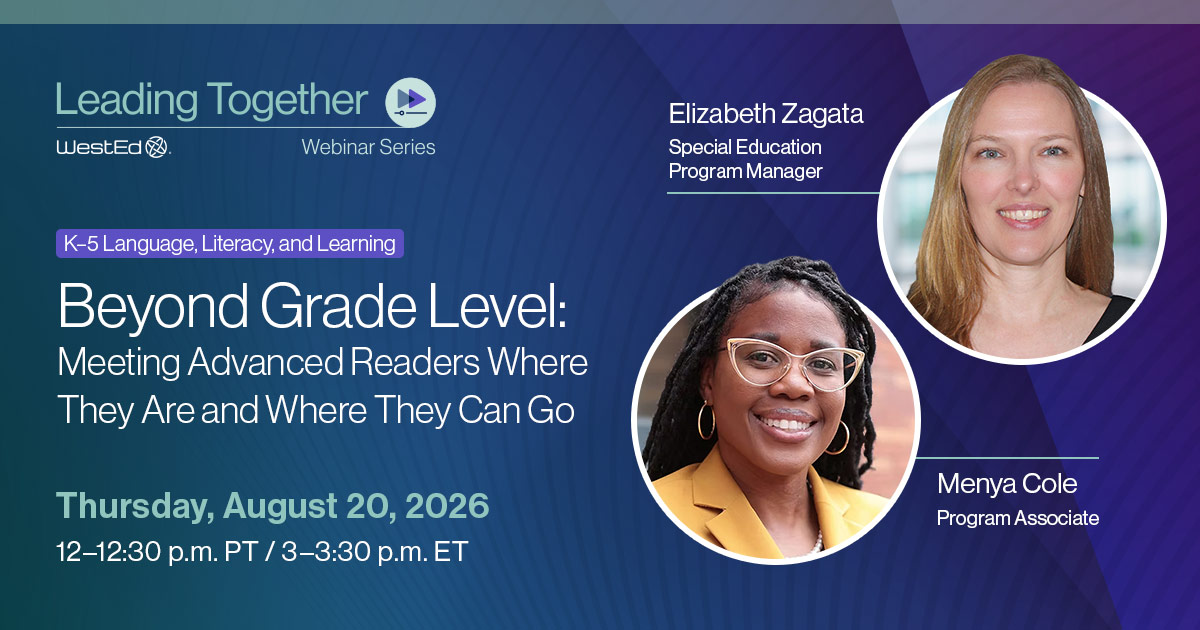
Advanced readers bring sophisticated language skills, broad knowledge bases, and a capacity for complex inferential thinking, and they deserve instruction that meets and extends those strengths.
Date: Thursday, August 20, 2026
Time: 12–12:30 p.m. PT / 3–3:30 p.m. ET
This 30-Minute Leading Together webinar examines what the research tells us about reading development at the upper end of the continuum: why advanced readers still benefit from explicit instruction, how comprehension deepens through disciplinary reading and critical analysis, and what it looks like to design experiences that genuinely stretch capable readers.
Drawing on the series’s core themes of knowledge building, language, writing, and comprehension as a multidimensional process, participants will explore practical strategies for extending comprehension instruction without simply adding more text or harder tasks. The goal is breadth, depth, and genuine intellectual growth.
Who Should Attend?
- District and site leaders
- Instructional coaches and literacy specialists
- K–5 classroom teachers
Session Discussion Topics
- What Advanced Readers Actually Need: unpacking the myth that strong readers are “fine on their own”: why high-level decoding and fluency don’t automatically produce deep comprehension, and what the research says about ceiling effects in reading development
- Depth Over Difficulty: Designing Richer Comprehension Experiences: moving beyond “more pages, harder text” to instruction that builds genuine interpretive depth, treating text complexity as a tool for thinking rather than a measure of assignment toughness
- Disciplinary Reading as an Extension Strategy: how reading like a historian, scientist, or literary critic gives advanced readers new frameworks for meaning-making across content areas, connecting directly to the series’s emphasis on knowledge building and academic language
- Writing as a Comprehension-Ceiling Raiser: revisiting the writing–reading connection from earlier in the series: how argument, analysis, and discipline-specific writing push advanced readers toward more precise, nuanced comprehension
- Classroom Structures That Serve Every Reader: practical approaches to differentiated text experiences, Socratic discussion, independent inquiry, and tiered questioning that extend capable readers within the same classroom without creating two separate curricula
Featured Speakers

Elizabeth Zagata is dedicated to enhancing educational outcomes for students with disabilities. Her research centers on literacy, assessment, and special education policy and law. Currently, Zagata leads the Effective Instruction priority areas for the National Center for Systemic Improvement. She holds certifications in special education, elementary education, and gifted education, and she is also a certified dyslexia practitioner. She currently serves as an adjunct faculty member, teaching diagnostic assessment and special education law.

Menya Cole is a program associate in Literacy at WestEd working with the Reading Apprenticeship and Writing Apprenticeship teams. She brings more than 15 years of experience as a teacher and literacy coach with a focus on curriculum design, disciplinary literacy, and structured literacy. Cole supports teachers and leaders in implementing evidence-based literacy practices across content areas and has coached educators at both the elementary and secondary school levels to strengthen instructional outcomes.