

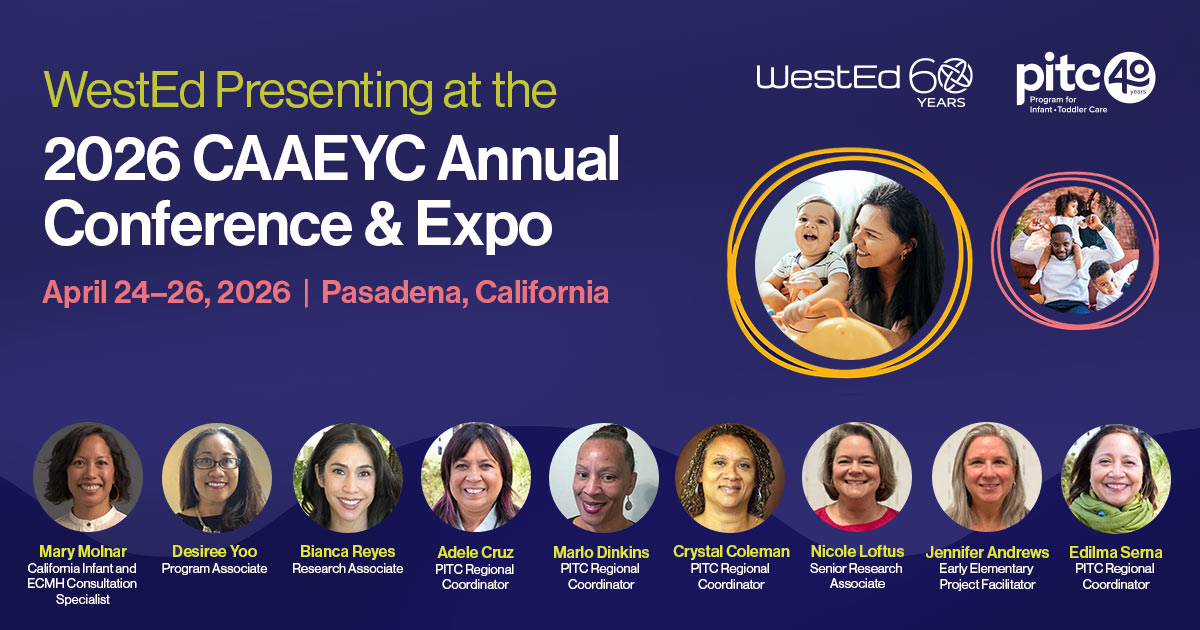
Join WestEd’s early childhood development experts from the Infant and Early Childhood Mental Health Consultation (IECMHC) Network and the Program for Infant/Toddler Care (PITC) team, who will present at the 2026 California Association for the Education of Young Children Annual Conference & Expo at the Pasadena Convention Center, April 24–26, in Pasadena, California.
This year’s theme is “Cultivating Relationships: Children, Families & Educators in Community.”
This year, PITC is celebrating 40 years of advancing respectful and relationship-based care for infants and toddlers. Be sure to visit us in the CAAEYC Exhibit Hall at Booth #111 to meet our Program for Infant/Toddler Care (PITC) staff and learn about their work.
Exhibit Hours:
- Sunday, April 26 from 9:30 a.m. to 1:30 p.m.
- Friday, April 24 from 4:30 p.m. to 6:30 p.m.
- Saturday, April 25 from 11:30 a.m. to 6 p.m.
WestEd Presentations
Friday, April 24
Deepening Connections: Pivoting From Trauma-Informed Practices to Healing-Centered Engagement in Early Childhood Settings
Time: 8:30–10 a.m. (PT)
Presenters: Mary Molnar (WestEd) and Desiree Yoo (WestEd)
This workshop is designed for direct service providers who work across various early childhood systems. During this workshop, participants will engage in reflective exercises and group discussions to deepen their understanding of trauma-informed practices while considering the possibility of healing-centered engagement as a pathway to strengthening connections with families. Participants will use a vignette to begin understanding how healing-centered engagement and practices can improve the provider–family relationship and support meaningful collaboration.
PITC PARS: A Tool for Learning, Observing, and Reflecting on Quality Practices in Infant/Toddler Group Care
Time: 3:45–5:15 p.m. (PT)
Presenters: Bianca Reyes (WestEd)
This session will introduce the Program for Infant/Toddler Care Program Assessment and Reflection System (PITC PARS) and how to use the quality measures as resources for learning about, exploring, and understanding program quality indicators. The PITC PARS, developed by WestEd, supports quality improvement for both family child care and center-based programs and across the whole infant/toddler age range. The PITC PARS includes essential quality indicators emphasizing relationships with families, inclusion, and culturally responsive care. It is presented in a way that is both approachable and doable. During this session, participants will be guided to explore specific indicators and walk away with strategies they can implement as they continue to refine their practice. This engaging session is appropriate for all audiences and levels of experience who are interested in providing high-quality infant/toddler care.
Saturday, April 25
Cultivating Trust: Protective Urges and Meaningful Partnerships With Families in Infant/Toddler Care
Time: 8–9:30 a.m. (PT)
Presenters: Adele Cruz (WestEd) and Tal Ben-Ami (WestEd)
Every gardener knows that while thorns protect, they can also pierce the very hands that nurture growth. In the same way, protective urges—whether they be those of parents or infant/toddler care educators—can both safeguard and strain the delicate relationships that babies depend on most. This workshop invites infant/toddler care educators to gently acknowledge those protective urges and discover how they can be guided toward connection rather than distance. Together, we will explore how care educators can show families the qualities they treasure most—understanding, competency, and honesty—while cultivating spaces that feel welcoming. Participants will be introduced to strategies for self-reflection while noticing their own emotional responses as opportunities for growth. With a balance of reflection, dialogue, and practical tools, this session encourages infant/toddler care educators to nurture authentic partnerships that blossom into resilient communities where children, families, and infant/toddler care educators can thrive side by side.
Sunday, April 26
CA Teaching Pyramid: Our Journey Bringing the Framework to Elementary for Children in Transitional Kindergarten Through 2nd Grade
Time: 10–11:30 a.m. (PT)
Presenters: Nicole Loftus (WestEd) and Jennifer Andrews (WestEd)
The CA Teaching Pyramid framework, well known across California in Early Childhood Education for its evidence- and research-based professional development opportunities for preschool, family child care, and infant/toddler programs, ventured into early elementary education in January of 2022. In response to the demand and increased need for supporting children with learning social and emotional skills and decreasing challenging behavior, we have trained more than 500 Transitional Kindergarten through 2nd grade teachers in 11 districts/counties. We describe what we learned along the way and share our on-the-ground experience with teachers and administrators across California. With the expansion of Transitional Kindergarten and the resulting impact on the workforce, we share our experience with supporting elementary teachers with developmentally appropriate practice that allows for all young children to flourish in supportive, responsive environments, as well as with paraprofessionals who have joined the workforce as a result of the expansion.
Everyday Routines That Enhance Infant and Toddler Learning and Development
Time: 10 –11:30 a.m. (PT)
Presenters: Marlo Dinkins (WestEd) and Crystal Coleman (WestEd)
More than just routines! Routines, such as mealtimes, playtime, and resting, provide young children with opportunities to learn. Through responsive caregiving routines, relationships are established between infant care educators, children, and families. As infants and toddlers grow, they learn to participate in daily routines and demonstrate emerging independence. Join us to explore how respectful, responsive relationships can facilitate children’s learning across developmental domains, including social–emotional development, approaches to learning, and cognitive development.
The Benefits of Creating Partnerships With Families During the First 3 Years
Time: 1–2:30 p.m. (PT)
Presenters: Edilma Serna (WestEd), Monica Hernandez, and Taylor Barrington
Creating partnerships with families begins when families and care educators value the perspectives and contributions of one another and share a common goal that impacts the communities they live in. We’ll explore how to communicate with empathy, navigate difficult conversations, and set up proactive systems that empower families as partners in their child’s learning journey. Infant care educators will leave with concrete strategies for building trust, fostering honesty, and establishing clear expectations. Successful partnerships with families of infants and toddlers strengthen child development, enhance community health, and provide families with vital support and resources.
More Related to This Event
Blogs & Podcasts
Research insights and stories designed to inform, engage, and inspire.


Resources
Browse our high-quality publications and resources designed to inform and engage professionals in a variety of fields including K–12 education, early childhood, and health and justice.