

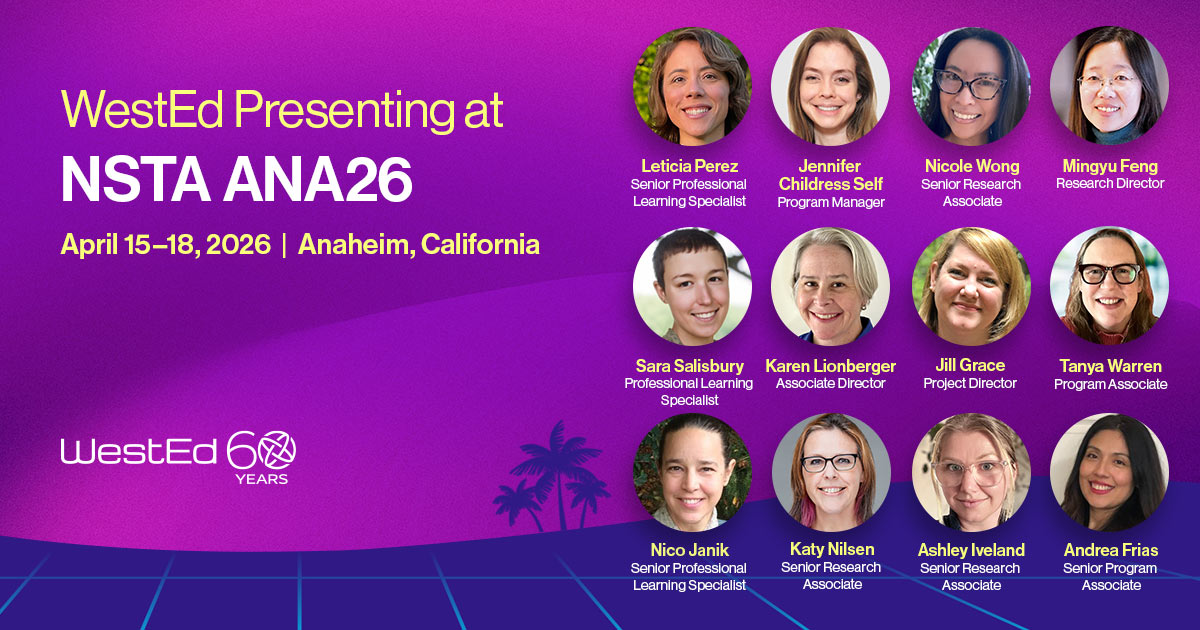
WestEd will present at the National Science Teachers Association (NSTA) 2026 Annual Conference, held April 15–18, 2026, at the Anaheim Convention Center.
NSTA ANA26 is the premier national professional learning event for science and STEM educators, bringing together teachers, curriculum leaders, instructional coaches, and district administrators for 4 days of learning and collaboration.
This year’s theme is “Growing Together: Collective Insights for Lifelong Learning.”
In alignment with the conference theme, WestEd’s science education experts will focus on a range of topics, including
- science curricula,
- integration of data into science instruction,
- artificial intelligence,
- Next Generation Science Standards, and
- support for Multilingual Learners.
Additionally, in collaboration with WestEd, ECUITY project teams will present three sessions highlighting the transformative three-dimensional teaching, learning, and assessment of their project-based instructional units. Project teams will share key learning and implementation guidance.
Follow us on LinkedIn and Facebook and share your insights from the conference.
WestEd Presentations
Thursday, April 16
Raising the Bar for Culturally Responsive Curricula: Making It a Reality in STEM Education
Time & Location: 8–9 a.m. / Anaheim Convention Center – 208 B
Speakers: Jennifer Childress Self (WestEd), Joi Merritt (James Madison University), and Shannon Wachowski (EdReports)
This session will explore the current state of culturally responsive STEM curricula and lessons learned from the field to increase the use of materials that empower all students. Breakout discussions will allow participants to explore opportunities for overcoming common challenges in implementing culturally responsive curricula. Discussion will focus on integrating instructional practices that support culturally responsive instruction across materials that embody the vision of the NRC Framework.
Amplify Language Learning Through Engineering Design
Time & Location: 2:20–4:20 p.m. / Anaheim Marriott – OC Ballroom Salon 2
Speaker: Nico Janik (WestEd) and Tanya Warren (WestEd)
Engineering in K–5 classrooms creates rich, authentic opportunities for students to communicate and make meaning. In this hands-on workshop, you will experience an engineering design challenge that optimizes opportunities for language learning and sense-making. You will discover how engineering can surface students’ assets and connect to their community and lived experiences—and how it naturally encourages all students to communicate. We will share tools to support multilingual students that include and go beyond scaffolding. You will then apply these insights to your own work and context by modifying and adapting your existing curriculum materials, or by creating your own activities, to amplify opportunities for sense-making in engineering. This session will build on work done in collaboration with teachers in the San Diego Unified School District as a part of the Elevating Engineering With Multilingual Learners (EEMLs) research project.
Sketch, Revise, Learn: Transforming Science Modeling With AI Feedback
Time & Location: 2:20–3:20 p.m. / Anaheim Convention Center – 252 B, North Building
Speakers: Nicole Wong (WestEd) and Mingyu Feng (WestEd)
This will be an interactive workshop introducing ScienceSketch, a free AI-powered tool (developed by North Carolina State University and WestEd) that provides real-time feedback on student hand-drawn science models. Participants will create models, receive AI feedback, and compare evaluations with student work. The session will also invite educator input on usability and future enhancements. Takeaway: Learn practical strategies for incorporating AI-supported modeling into elementary science instruction.
My School Is a Wildlife Corridor? 8th Graders Transforming Their Communities
Time & Location: 2:20–3:20 p.m. / Anaheim Convention Center – 258 A, North Building
Speakers: Brian Learn (Los Angeles Unified School District), Diana Tafoya (Los Angeles Unified School District), Jeremiah Potter (San Diego Unified School District), and Graham Montgomery (The Institute for Bird Populations)
This session features an 8th grade unit designed to connect science learning with students’ local community. Anchored in the importance of biodiversity for humans and of the flourishing of other species, the storyline invites students to ask what impact access to nature and biodiversity has on our mental health and how we can make biodiversity accessible to everyone. Participants will engage in select lessons that show how teachers can launch learning with student questions and investigations that ultimately build toward an understanding of the influence of environmental conditions on trait frequencies and the importance of green space corridors serving as wildlife bridges for species. Effective field experiences inspire students to take action and implement design solutions in their community that expand the benefits of biodiversity and ecosystem services, illustrating how careful classroom design can link three-dimensional science learning with meaningful opportunities for action.
Building Data-Rich Classrooms: Strategic Entry Points for Integrating Data Into Existing Science Instruction
Time & Location: 2:20–4:20 p.m. / Anaheim Marriott – Grand Ballroom J/K
Speakers: Sara Salisbury (WestEd) and Karen Lionberger (WestEd)
Data-rich instruction is central to modern science learning—but for many schools, integrating larger data sets and data tools into lessons remains challenging. This session will support science educators, instructional coaches, and district leaders who are helping teachers build data fluency within existing curricula. Drawing on insights from projects funded by NSF and NASA, we’ll uncover common roadblocks to bringing real data into classrooms and explore practical tools, data sets, and instructional strategies that promote equity-centered data access. Participants will examine professional learning approaches, scaffolds, and leadership moves that make data experiences meaningful, sustainable, and aligned with evolving STEM goals. Walk away ready to use data as a bridge for authentic collaboration across disciplines—building shared ownership of student learning and strengthening a culture of inquiry across classrooms and systems.
Friday, April 17
Empowering Changemakers: Urban Biodiversity Initiative for Teachers and Youth
Time & Location: 8–9 a.m. / Anaheim Marriott – Grand Ballroom J/K
Speakers: Susan Gomez Zwiep (BSCS Science Learning) and Jill Grace (WestEd)
Discover how teachers, students, and scientists can team up to address local biodiversity challenges through NGSS storylines—sparking student voice, community action, and powerful learning.
Cooler Communities: 6th graders Transforming Their Communities
Time & Location: 9:20–10:20 a.m. / Anaheim Convention Center – 256 B, North Building
Speakers: Karen Duenas (Multicultural Learning Center), Dave Tupper (Lakeside Union School District), and Susan Gomez Zwiep (BSCS Science Learning)
This session features a 6th grade unit intentionally designed to connect science learning with students’ lived experiences. Anchored in the urban heat island effect, the storyline invites students to ask why some neighborhoods are hotter than others. Participants will engage in select lesson routines that show how teachers can launch with local maps and data, guide investigations of heat absorption, and support students in building models that explain differences across communities. The design emphasizes strategies for broadening participation and highlighting how access to trees, green space, and building materials can shape daily life. The sequence concludes with students proposing community-based solutions, illustrating how careful classroom design can link three-dimensional science learning with meaningful opportunities for action.
Cards on the Table: Amplifying Card Sorts for Scientific Sense-Making
Time & Location: 10:40–11:40 a.m. / Anaheim Convention Center – 253 B, North Building
Speakers: Tanya Warren (WestEd)
Sorting tasks in science create opportunities for students to engage in science practices as they recognize patterns, categorize, hypothesize, generalize, and make connections through multiple modalities. Yet students often engage in “silent shuffles” with little opportunity for sense-making. When designed with intentional purpose and specific steps that structure both the process and language for interaction, card sorts create opportunities for all students to fully participate in making sense of science ideas through language. Participants will engage with a variety of sorts and explore how they can be structured and sequenced within a lesson to support sense-making for Multilingual Learners.
Supporting Multilingual Learners’ Data Literacy: Leveraging Students’ Language Assets During Data Investigations
Time & Location: 10:40–11:40 a.m. / Anaheim Convention Center – 260 A, North Building
Speakers: Nico Janik (WestEd) and Karen Lionberger (WestEd)
Explore how Multilingual Learners students’ linguistic and cultural assets can strengthen data literacy instruction. Through hands-on data investigations and pedagogical reflection, participants will learn to design equitable data analysis experiences that leverage Multilingual Learners students’ full multimodal repertoires for scientific sense-making. Participants will first engage as learners in data-rich activities featuring explicit scaffolds that support analyzing, visualizing, and interpreting scientific data. These activities model how translanguaging, visual representations, and collaborative discourse structures can make complex data accessible while honoring students’ linguistic diversity. After experiencing these supports firsthand, participants will examine the pedagogical principles behind effective data literacy instruction for students and work collaboratively in small groups to modify existing data analysis tasks to incorporate into their own classrooms with their students.
Place-Based Data Literacy: Using NASA Data to Connect to Local Phenomena
Time & Location: 2:40–4:40 p.m. / Anaheim Marriott – Platinum Ballroom 5
Speakers: Leticia Perez (WestEd), Sara Salisbury (WestEd), and Karen Lionberger (WestEd)
Discover how NASA data can meaningfully connect global data with locally relevant phenomena investigations (e.g., wildfires, drought, sea-level rise). This hands-on workshop will demonstrate how educators can leverage place-based learning principles to design lessons with NASA data and supporting resources to catalyze students’ data literacy. Participants will experience data-driven investigations connecting their local environment to global Earth systems, exploring how to guide students in analyzing multiple data types (categorical, numeric, geospatial, temporal) and representations (graphs, maps, tables). Participants will work in small groups to critically examine and plan for implementation of pedagogical strategies for place-based data investigations that honor students’ lived experiences while building data literacy skills.
Saturday, April 18
Classroom Integration of Game-Based Learning Platform: Challenges and Opportunities
Time & Location: 8–8:30 a.m. / Anaheim Marriott – Grand Ballroom G/H
Speakers: Jennifer Childress Self (WestEd) and Katy Nilsen (WestEd)
Our project studied the implementation of an online, standards-aligned, game-based learning platform across various classroom contexts. The platform contains both (a) assignments comprising games, videos, and assessments and (b) an immersive educational world in which students engage with science content. Fifth grade teachers and their students used the platform for 6 weeks in early 2025. Observed teachers demonstrated little to no integration of the platform into their existing curriculum. Most frequently, teachers simply transitioned students into using the platform without providing an introduction beforehand or a debriefing afterward to explicitly connect the platform’s content with their class curriculum. Teachers may be best supported in making those connections through teaching guides that provide recommendations for classroom integration of the platform in tandem with district pacing guides and through professional learning that explains these guides and details specific classroom strategies.
Reflecting on Growth in Engineering and Language: Teacher Tools and Processes From the EEMLs Project
Time & Location: 8–8:30 a.m. / Anaheim Convention Center – 256 A, North Building
Speakers: Nico Janik (WestEd) and Ashley Iveland (WestEd)
The Elevating Engineering With Multilingual Learners (EEMLs) PL model integrates both NGSS-aligned disciplinary content and pedagogical practices—as well as NGSS-aligned science AND support for Multilingual Learners students. This session will share strategies for teachers to get to know their students and engage in rigorous reflection with an eye toward how to support Multilingual Learners in science and engineering. Specifically, we will share the documents and resources that teachers in EEMLs used to track and reflect on their students’ progress over the year. We will share protocols that teachers used during plan-teach-reflect cycles during the school year, where they collaboratively worked on implementing engineering lessons that support English Language development. These documents were a part of teachers’ culminating portfolio of teaching and final presentations (which will also be shared) that highlighted their own and their students’ growth over time in both engineering and English Language development.
Building a Vision for Opportunity and Sustained Interactions for Multilingual Learners
Time & Location: 8–10 a.m. / Anaheim Convention Center – 210 B
Speakers: Tanya Warren (WestEd)
Teaching Multilingual Learners in science classrooms involves intentional planning that integrates language learning with phenomena-based three-dimensional science instruction. Even when schools and districts adopt high-quality instructional materials, teachers often modify lessons to meet the needs of their Multilingual Learners, particularly newcomers. Participants will immerse themselves in curriculum-based professional learning to learn about adapting science lessons and units to leverage Multilingual Learners’ linguistic assets. Using the Quality Teaching for English Learners (QTEL) approach, participants will analyze ways to scaffold language learning, engage in academic conversations, and drive learning using students’ funds of knowledge. Takeaway: Educators will leave with the knowledge and tools to adapt science lessons, scaffold language, and leverage Multilingual Learners’ assets to increase learning opportunities in their science classrooms.
Place-Based Approaches to Connecting School Science to Home and Community
Time & Location: 8:45–9:15 a.m. / Anaheim Marriott – Grand Ballroom G/H
Speakers: Ashley Iveland (WestEd), Sara Salisbury (WestEd), and Katy Nilsen (WestEd)
Science education initiatives such as the Next Generation Science Standards explicitly recommend connecting school science to home and community (see Appendix D; NGSS Lead States, 2013). Our project provided opportunities for teachers to educate middle school students about place. During the project, problem-based learning sequences (LSs)—short units of instruction—were developed for each middle school grade level (6–8) and were customized for the local urban area. Teachers implemented these sequences in their classrooms and reported shifts in science and engineering instructional practices that are connected to place. When asked about how the project influenced their instructional practices, a number of teachers shared about their interest in drawing on students’ lived experiences, funds of knowledge, life outside of school, and real examples of data and phenomena in their instruction because they felt these could be useful for exploring issues in their local community.
Fostering Student Agency Through Place-Based, Community-Centered Problem-Solving
Time & Location: 9:30–10 a.m. / Anaheim Marriott – Grand Ballroom G/H
Speakers: Katy Nilsen (WestEd), Ashley Iveland (WestEd), and Sara Salisbury (WestEd)
For each middle school grade level (6–8), our project developed problem-based learning sequences (LSs)—short units of instruction—that were customized for the local urban area. Teachers participated in PL that covered topics like local biodiversity, the NGSS, and community-centered science learning for students and then taught their LS. During the 7th grade LS, students learned about the biodiversity in their community and on their school campus that culminated in a project in which students were given agency to design a plan that would increase biodiversity on their campus. Students surveyed their campus and potential areas for improvement. Students expressed care and consideration for the school community, biodiversity on campus, and other constraints they needed to work within when creating their plans, including (a) noting existing species in determining how to create a more balanced campus ecosystem and (b) refraining from planting mushrooms to avoid health risks to younger students on campus.
The Interplay of Three-Dimensional Instruction and Assessment as Students Engineer for Ecosystems
Time & Location: 10:20–11:20 a.m. / Anaheim Convention Center – 256 B, North Building
Speakers: Laura Griffith (Los Angeles Unified School District), Stacey Vigallon (Nature Nexus Institute), and Andrea Frias (WestEd)
Participants will gain insight into the interplay of three-dimensional learning and assessment by diving into a 7th grade learning sequence anchored in the phenomenon of a global biodiversity hot spot. Participants will engage with key instructional and assessment moments to learn how students (a) study the challenges species face and (b) use engineering design to enact a solution that protects and enhances biodiversity in their community.
More Related to This Event
Resources
Browse our high-quality publications and resources designed to inform and engage professionals in a variety of fields including K–12 education, early childhood, and health and justice.