


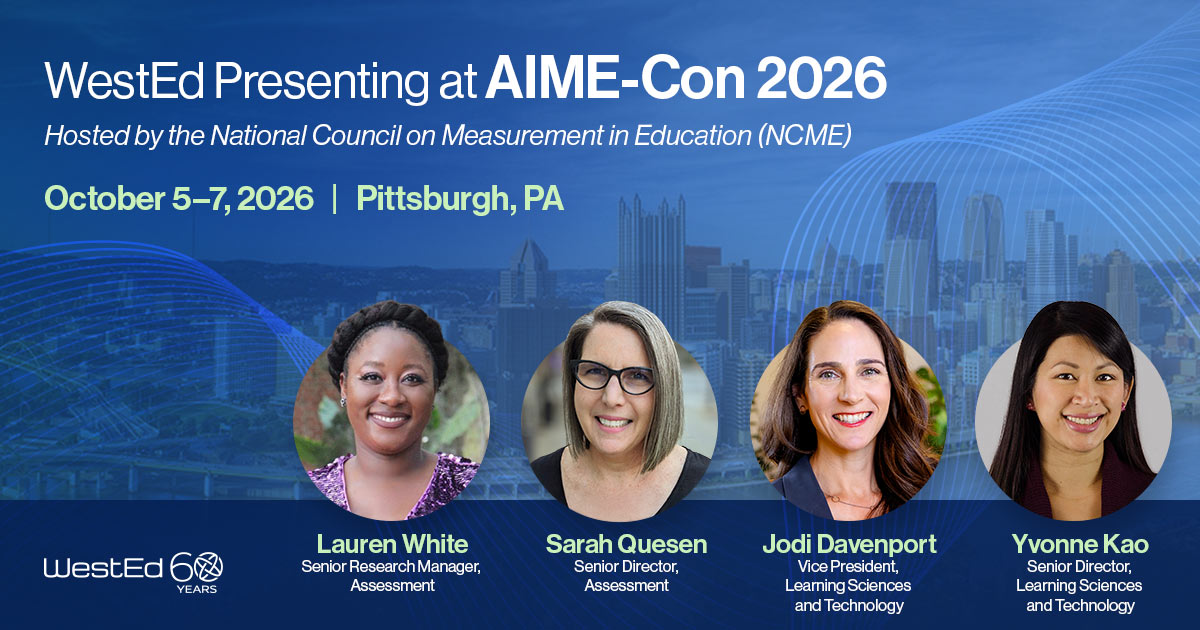
WestEd researchers and colleagues will share insights and new research findings at the 2026 Artificial Intelligence in Measurement and Education (AIME) Conference, October 5–7 in Pittsburgh, Pennsylvania. This year’s conference theme is “Measurement Science in AI-Integrated Assessment and Pedagogy.”
Our sessions will examine such topics as reducing bias in Language Learning Models (LLMs) and AI literacy in assessment.
Add our sessions to your conference agenda to learn more about our work.
WestEd Sessions
Tuesday, October 6
Individual Paper Session
Do This, Not That: Can Proscriptive Prompting Reduce LLM Bias?
Time & Location: 11a.m.–12:30p.m. / Brigade
Authors: Lauren White (WestEd), Sarah Quesen (WestEd), and Michael Chajewski (Pearson)
This study extends prior work on structural bias in LLM-generated educational content. Three models, Claude, GPT, and Gemini, responded to scaffolded prompts about achievement gaps under two conditions: prompts alone and prompts paired with a justice-oriented, bias-reducing rubric. Generated responses were evaluated against the same rubric.
Wednesday, October 7
Panel Session
Interweaving Assessment: A Field-Generated R&D Agenda for AI and Measurement
Time & Location: 9:15–10:45a.m. / Commonwealth 2
Moderator: Britte Haugan Cheng (Menlo Education Research)
Panelists: Susan Lyons (National Council on Measurement in Education), Temple Lovelace (Assessment for Good, AERDF), Lauren Deters (Khan Academy), Lauren White (WestEd), and John Whitmer (Learning Data Insights)
This panel presents findings from Interweaving Assessment: AI, Assessment, and Accountability in Responsive Education, a three-part initiative funded by the Gates Foundation and facilitated by Menlo Education Research. Drawing on structured input from over 150 researchers, practitioners, policymakers, and technology developers, the project produced an integrated research and development agenda organized around three clusters: innovating measurement, tools to support educational leaders, and datasets as a public good. Three cross-cutting themes, codesign, data sovereignty, and human-centered design, ran across all priorities.
Panelists will present the substance of the agenda, describe the role of measurement scientists as necessary partners in its implementation, and announce a proof-of-concept grant program designed to support the highest-priority work. The session will close with structured audience engagement in which participants can provide input about priorities to those developing the grant program.
Individual Paper Session
Measuring What Matters: Construct Coverage in AI Literacy Assessment
Time & Location: 11a.m.–12:30p.m. / Ft. Pitt
Authors: Jodi Davenport (WestEd), Yvonne S. Kao (WestEd), and Sarah Quesen (WestEd)
AI literacy assessments have proliferated, but what do they measure? We analyzed construct coverage across 13 assessments and 14 frameworks along five flourishing-derived dimensions. Preliminary results showed systematic underrepresentation, with human connection absent throughout. We framed these gaps as validity threats and proposed an agenda for next-generation measurement.