


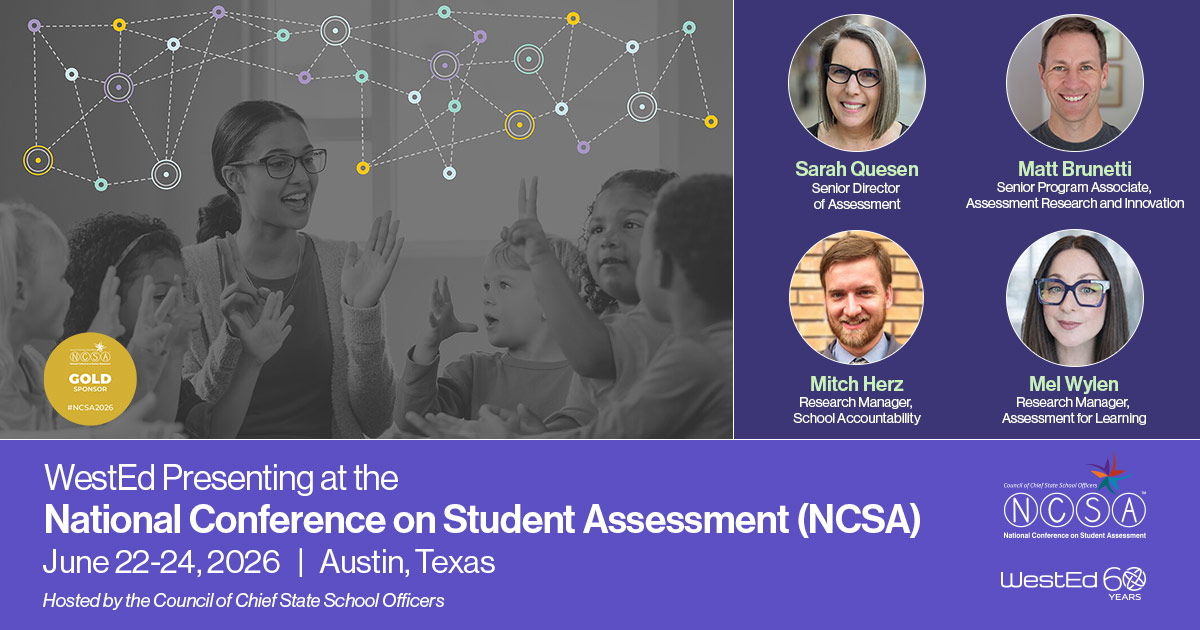
WestEd assessment experts will present at the 2026 National Conference on Student Assessment (NCSA) in Austin, Texas, June 22–24, 2026.
This conference, hosted by the Council of Chief State School Officers (CCSSO), brings together education leaders and policymakers to explore the theme Connecting the Dots: Building Coherent Systems to Support Student Success.
WestEd will lead or colead four sessions, drawing on more than 20 years of experience designing, developing, researching, and innovating assessment instruments. Our sessions will highlight evidence-based practices that focus on
- early literacy screener implementation,
- accountability and school improvement systems,
- artificial intelligence (AI)–based difficulty prediction, and
- cutting edge R&D for Generative AI implementation.
Our copresenters include experts from state departments of education, assessment development organizations, and others.
Don’t miss out on these important conversations! Follow us on LinkedIn and Facebook and share your insights from the conference, and access our NCSA resource collection.
WestEd Presentations
Monday, June 22
From Policy to Practice: A Multi-State Symposium on Early Literacy Screener Implementation
Time: 2:30–3:30 p.m.
Location: Breakout (Brazos, L2)
Speaker: Matt Brunetti (WestEd), Darian Foster (Indiana Department of Education), Bonnie Garcia (California Department of Education), and Hope Worsham (Arkansas Department of Education)
This symposium examines early literacy screener implementation across three states with differing approaches. Since most states now mandate early literacy assessments, understanding how policy translates to practice is important. State presenters will share their approach to implementation and lessons learned. Arkansas will discuss their ATLAS system, while two additional states will present approaches to approved assessment menus. Each will highlight promising practices for connecting assessment to instruction and supporting diverse learners. The discussant will synthesize crosscutting themes, facilitate audience discussion, and identify actionable principles for strengthening early assessment systems. Attendees will gain comparative insights into policy, practice, and implementation strategies.
Tuesday, June 23
Connecting the Dots: Building Linkages Between Accountability and School Improvement Systems
Time: 1–2 p.m.
Location: Breakout (205, L2)
Speaker: Benjamin Boer (EdSystems), Mitch Herz (WestEd), and Mel Wylen (WestEd)
This session explores connections between accountability system redesign and school improvement by identifying important lessons learned from past state efforts to build linkages between these systems. WestEd researchers will present a model for statewide school accountability systems that connects accountability system design principles to school improvement actions, highlighting tensions that create challenges in implementing this model. Then, EdSystems researchers will present Chicago Public Schools’ new accountability system, detailing the system’s implementation and implications for future accountability redesign efforts.
Wednesday, June 24
AI-Powered Item Difficulty Prediction: Helping States Reduce Costs Without Compromising Quality
Time: 10:30–11:30 a.m.
Location: Breakout (203-204, L2)
Speaker: Sue Lottridge (Pearson), Sarah Quesen (WestEd), Frank Rijmen (Cambium Assessment), and Christine Rozunick (Texas Education Agency)
Artificial intelligence can now predict item difficulty before students respond, potentially reducing pretesting costs and accelerating item development. But when should states trust these predictions, and what risks require management? This panel brings together assessment researchers and vendors to discuss practical realities of AI-based difficulty prediction. A state assessment director will moderate, focusing on questions state leaders face when evaluating AI solutions: validation requirements, fairness concerns, appropriate applications, and cost–benefit tradeoffs. Participants will learn what these tools actually do today, what questions to ask vendors, and how to decide when AI predictions are trustworthy versus when traditional methods remain essential.
Cutting Edge R&D for Implementing Generative AI in International, National, and State Assessment Programs: Applications and Practical Uses (2025–26)
Time: 2:15–3:15 p.m.
Location: Breakout (JW Grand 3, L4)
Speaker: Peggy Carr (University of Maryland), Walt Drane (Caveon Test Security), Jason Nagaoka (Hawaiʻi State Department of Education), John Olson (OEMAS., Assessment Solutions Group [ASG]), and Sarah Quesen (WestEd)
Innovative AI approaches are transforming educational testing and impacting states in areas like item development, pilot testing, and psychometrics. States, vendors, and researchers are busy sharing information on ethical guidelines and their research on what works with GenAI, resulting in best practices that leverage technological innovations to improve state assessments while reducing costs. In this session, four AI experts present information on how Gen AI is greatly helping international, national, and state assessment efforts.

Ready to Strengthen Your Assessment Systems to Support All Learners?
Connect with our WestEd experts.
"*" indicates required fields
More Related to This Event
Blogs & Podcasts
Research insights and stories designed to inform, engage, and inspire.


Resources
Browse our high-quality publications and resources designed to inform and engage professionals in a variety of fields including K–12 education, early childhood, and health and justice.