

June 29, 2026
High school Calculus is a key course for students who wish to pursue STEM careers. Yet many students face barriers to advanced math coursework that limit their access to STEM opportunities in college and the workforce. As educators, what strategies can we use to help more students enter, stay in, and succeed in Calculus?
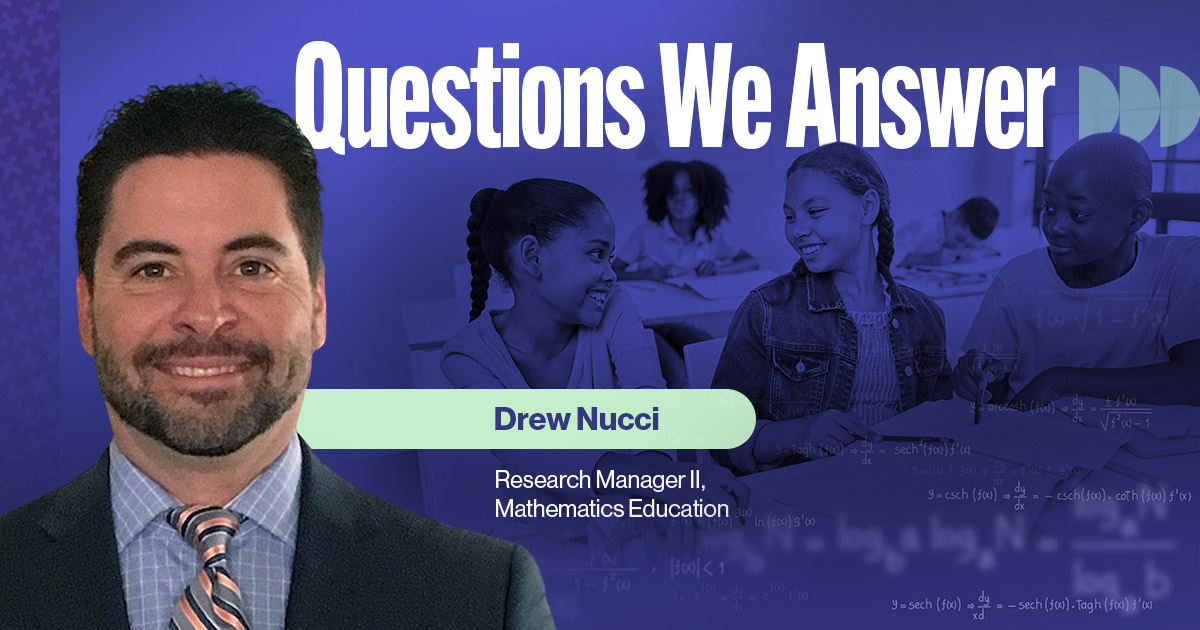
Welcome to Questions We Answer, our series in which WestEd’s mathematics experts respond to common questions from the field with practical tips and insights for educators and leaders. We posed this question to Dr. Drew Nucci, a research manager II in mathematics, science, and education at WestEd. In 2024, Nucci led a literature review and interview series to understand efforts to improve pathways to Calculus. That work informs his following response.
States, districts, and schools can build flexible trajectories, automatic enrollment, and robust student supports.
Although more schools are exploring statistics, quantitative reasoning, and data science pathways, high school Calculus remains an important preparation for many STEM fields. Taking the course in high school is associated with stronger performance in postsecondary STEM coursework and continued pursuit of STEM opportunities.
However, the traditional route to the course has been rigid and problematic. Calculus typically requires Algebra 1, Geometry, Algebra 2, and PreCalculus as prerequisites. These five courses are difficult for students to manage in 4 years, and as such a student’s road to high school Calculus best begins in the 8th grade to provide an extra year. However, most secondary school course trajectories offer students few on-ramps with little flexibility across trajectories. If students miss the 8th grade Algebra 1 on-ramp, they can struggle to reach Calculus in high school. This rigidity makes 8th grade Algebra 1 a gatekeeper to reaching Calculus.
Because a student’s access to 8th grade algebra depends on the school identifying them as ready, the field has grappled with fair and accurate ways of identifying students as algebra ready and providing access to high school Calculus for students who do not take 8th grade Algebra 1.
We present three promising approaches that state, district, and school leaders can take to address these issues.
Modernize Current and Inflexible Course Sequences
One promising approach is to redesign the course trajectories themselves. For example, in 2021, the Utah State Board of Education consolidated its high school sequence into three integrated courses before Calculus instead of the typical four. Each is offered at a foundational or extended level. Students can opt in to the extended track in any of the 3 years, with just-in-time tutorial support from Calculus teachers for late entrants. The structure affords students access to the course without requiring Algebra 1 in 8th grade and without students having to double up on courses in high school while preserving rigor for those continuing into advanced coursework.
Develop Auto-Enrollment Policies
Auto-enrollment policies can broaden participation in advanced math trajectories. For example, some states, like Texas and North Carolina, now use students’ state standardized test scores to automatically place students in advanced math courses. Instead of asking parents to opt in to such courses for their students, they must instead opt out. These policies have resulted in broader participation in advanced mathematics in middle school, providing students with not only access to but also readiness for 8th grade Algebra 1. Studies have shown how this has expanded access to and participation in 8th grade Algebra 1 with similar pass rates to prior enrollment strategies.
Build Proactive Student Supports
In addition to the above structural levers, programs have been developed to strengthen students’ readiness for algebra and Calculus by attending to their mathematical learning and identities. For example, the Calculus Project initiative aims to increase the number of students of color and students from low-income households who complete AP Calculus in high school.
The Calculus Project provides students with summer academies, year-round tutoring, and explicit attention to student identity and belonging as they move through the Calculus trajectory. The program also provides supports to teachers, including professional development to help them establish and maintain high expectations for all students, and they work with districts to schedule students in the summer academies in the same math classes the following year.
While each of these three solutions is promising on its own, to improve students’ readiness and access to both 8th grade algebra and high school Calculus, states, districts, and schools should design a coherent approach that attends to both the systems level and high-quality teaching and learning.
Support for Redesigning Pathways and Policies for All Learners
WestEd partners with states, districts, and schools to design and implement coherent math pathways that expand access while maintaining rigor. We support education leaders by
- redesigning course sequences to create pathways that are more flexible and accessible;
- developing enrollment policies that broaden access to advanced mathematics;
- strengthening instructional supports and professional learning to build student readiness; and
- evaluating the impact of course trajectories, materials, and policies over time.
We engage school communities throughout this process, helping leaders connect research to practice so they can make informed decisions and sustain improvement.
Contact us to learn how we can support your efforts to expand access to advanced mathematics through pathway redesign, policy development, and systemwide implementation support.

Ready to Support Your Thriving Learners and Empowered Communities?
Connect with our WestEd experts.
"*" indicates required fields
More Related to This Post
Blogs & Podcasts
Research insights and stories designed to inform, engage, and inspire.
Events
Research insights and stories designed to inform, engage, and inspire.
Resources
Browse our high-quality publications and resources designed to inform and engage professionals in a variety of fields including K–12 education, early childhood, and health and justice.