

April 7, 2026
By Sarah Quesen and Andy Latham
A recent analysis suggests that education research may be drifting away from the priorities that matter most to classrooms. After examining more than 25,000 presentations from recent American Educational Research Association (AERA) conferences, the analysis found that some topics received far more attention than others, while issues teachers often raise—including student behavior, mental health, literacy, technology, and retention—received comparatively less attention.
The analysis, which NPR covered, raises a critical question: If research priorities shifted, when did that shift begin, and what drove it? The analysis looked at AERA conference presentations from 2021 through 2025. But that window doesn’t provide a baseline for comparison.
To explore this idea more fully, WestEd researchers analyzed AERA conference programs from two periods—2005 through 2014 (when NAEP scores were generally rising) and 2022 through 2025 (when scores were stagnant or declining)—to track key terms.
Table 1. Change in Research Term Frequency Between Eras
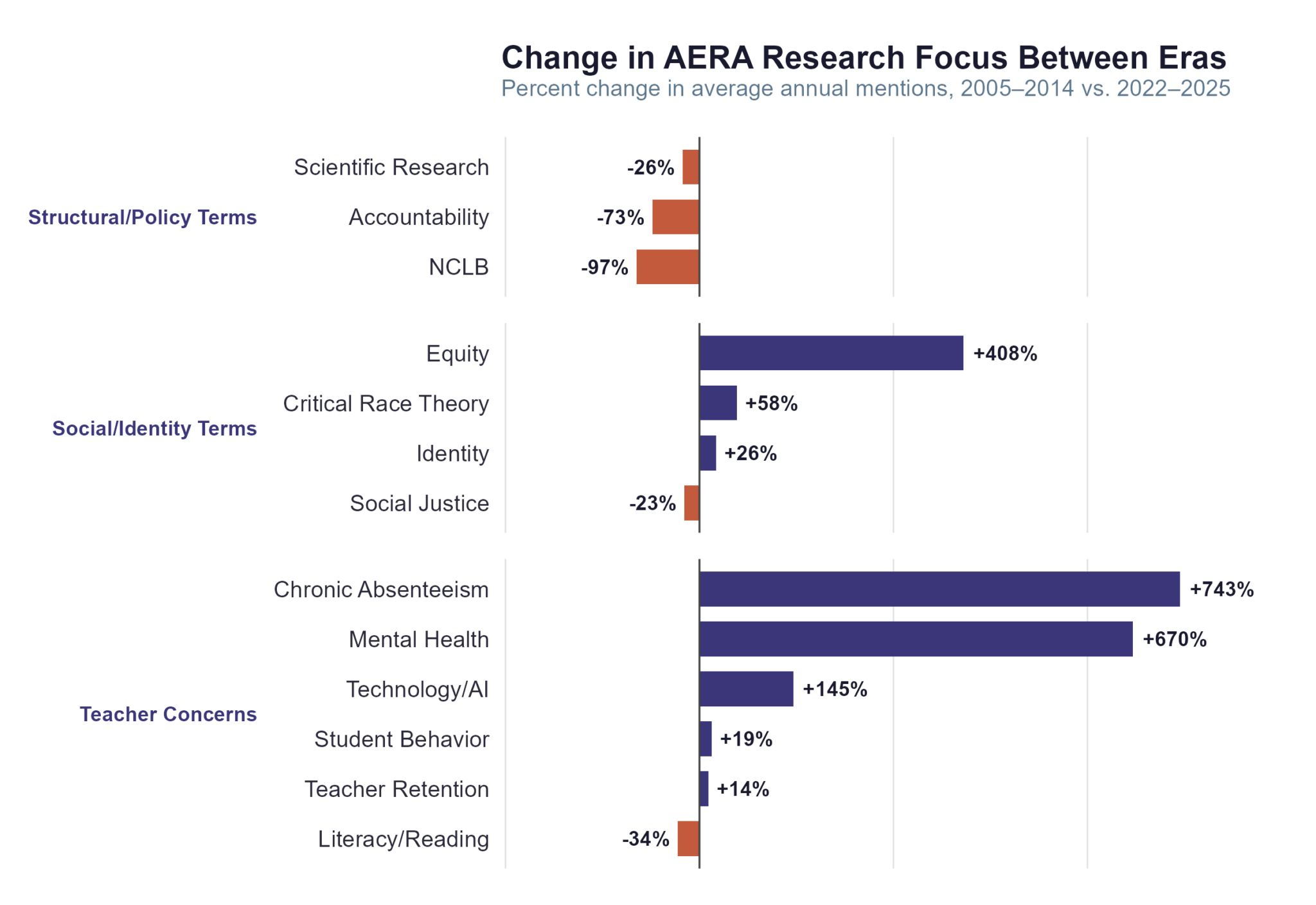
Note. Change represents the percent difference in average annual mentions between the 2005 through 2014 era and the 2022 through 2025 era.
What the Data Show About Teacher Concerns
Our findings challenge the idea that research has lost touch with classroom needs. Five of the six teacher concerns we tracked increased between eras, some of them dramatically.
Mental health research increased 670 percent, from an average of 24 mentions per year in the earlier era to 188 per year in the recent one. Technology and AI research more than doubled. Chronic absenteeism, which barely registered before the Every Student Succeeds Act (ESSA) required states to report it, increased 743 percent. Both student behavior and teacher retention research grew modestly.
The one teacher concern that moved in the wrong direction was literacy. Reading and literacy research declined 34 percent between eras. This gap between a clear teacher priority and declining research attention merits further exploration.
Literacy mentions peaked at 87 in 2009 and then declined before the large increase in equity-focused research, closely tracking the end of the federal Reading First initiative, a program defunded in 2009 after an evaluation found no measurable impact on reading comprehension. When the financial support ended, so did the research.
Education Research Follows Policy and Funding
The literacy pattern is not unique. Research priorities track policy changes and funding shifts more than any single ideological trend.
Accountability research declined 73 percent after ESSA replaced No Child Left Behind (NCLB) and eased testing mandates. Mentions of NCLB fell 97 percent because the law no longer existed. Equity research increased 408 percent after 2020, following new federal funding priorities, while chronic absenteeism emerged only after ESSA’s reporting rules generated usable data.
During the NCLB era, the Institute of Education Sciences (IES) prioritized scientifically based research and accountability studies. Researchers responded. In subsequent years, federal priorities emphasized equity-focused work. Researchers again responded. This pattern is consistent across administrations.
When Did NAEP Scores Actually Start Falling?
Some analyses link identity-focused research to achievement declines. However, NAEP scores began declining around 2015, the year ESSA passed. The large equity research increase came after 2020, 5 years into the decline. If research priorities had caused achievement trends, we would need to explain why scores dropped years before the research shift occurred.
Plausible explanations include ESSA’s weakened accountability, instructional disruption during Common Core implementation, postrecession budget constraints, and pandemic-related learning loss.
Why Federal Research Infrastructure Matters Most
Regardless of research priorities, everyone who cares about evidence in education depends on the same federal data systems. NAEP scores, longitudinal surveys, and enrollment tracking are the infrastructure that makes education research possible.
An Education Next analysis found that nearly every one of the 11 most important education studies published since 2002 drew on IES data infrastructure. Without NAEP, the education community loses the only consistent national measure for tracking achievement trends. Without longitudinal surveys, we cannot track outcomes over time. These systems serve research across the ideological spectrum. Stable, nonpartisan, independent research infrastructure benefits everyone who cares about evidence in education.
Where WestEd Stands
WestEd’s mission centers on bridging research and practice. That bridge requires relevant research and reliable data. We encourage protecting federal data infrastructure that makes evidence-based educational policy possible, continued attention to teacher-identified needs, and transparent methodology in research critiques.
Learn more about WestEd’s assessment work and partner with us.
About the Authors
Sarah Quesen is an expert in statistics and psychometrics with a keen interest in emerging technologies. As Senior Director of Assessment at WestEd, she leverages her understanding of assessment systems to lead rigorous, transformative research and provide evidence-based technical assistance to states, districts, and commercial organizations.
Andy Latham is Vice President of Mobility and Measurement at WestEd, where he focuses on strengthening interconnected systems that support human development and opportunity across the lifespan. He uses rigorous assessment, evaluation, and data analytics to develop aligned pathways that promote safety, well-being, economic mobility, and opportunities for all learners and community members.

Ready to Strengthen Your Assessment Systems to Support All Learners?
Connect with our WestEd experts.
"*" indicates required fields
More Related to This Post
Blogs & Podcasts
Research insights and stories designed to inform, engage, and inspire.






Events
Research insights and stories designed to inform, engage, and inspire.
Resources
Browse our high-quality publications and resources designed to inform and engage professionals in a variety of fields including K–12 education, early childhood, and health and justice.