November 2, 2026
If you only had three questions to understand how to help a young person, what would you ask?
At the Bench Mark Program in Lancaster, Pennsylvania, mentors for youth identified as “at risk” by local high schools and community organizations start with three: What are you dreaming about? What are you struggling with? And what do you need right now?
Founded in 2014, the Bench Mark Program is a nonprofit organization that uses weightlifting, fitness, academic support, mentoring, and career development to support youth ages 14 to 24.
“We teach our mentors and student leaders to build conversations around those three questions because you get follow-ups, you get immediate action steps, and you get thoughtful conversations about challenges,” said Will Kiefer, the program’s Founder.
Those challenges can be as broad as the supports at the program itself, ranging from justice-system involvement; school disengagement, such as chronic absence and suspension; trauma and disconnection, unstable housing; and adult-life transition challenges such as employment barriers.
Kiefer said that the challenges rarely show up one at a time—they compound—and what kids need most isn’t a single fix but rather people and a place that stay consistent long enough to help them work through all of it over years, not months.
“Think about how many resources and people and mentors and coaches that you needed during those 10 years of your life,” Kiefer said. “What we’re trying to do is succeed in building a continuum of care during that time, so that a kid might go through five different programs, but they’re still at Bench Mark.”
Turning Challenges Into Opportunities for Change


Photo courtesy of the Bench Mark Program.
Bench Mark started with a simple idea.
As a college student at Franklin & Marshall College, Kiefer wanted to be of service and help young people in his community, but he couldn’t find any programs that served youth facing significant challenges. He also knew he liked the fitness space and thought it could help young people, so he started a fitness program at the YMCA that has since grown into the Bench Mark Program, with 12 initiatives providing wraparound support for youth; but the gym remains at its center.
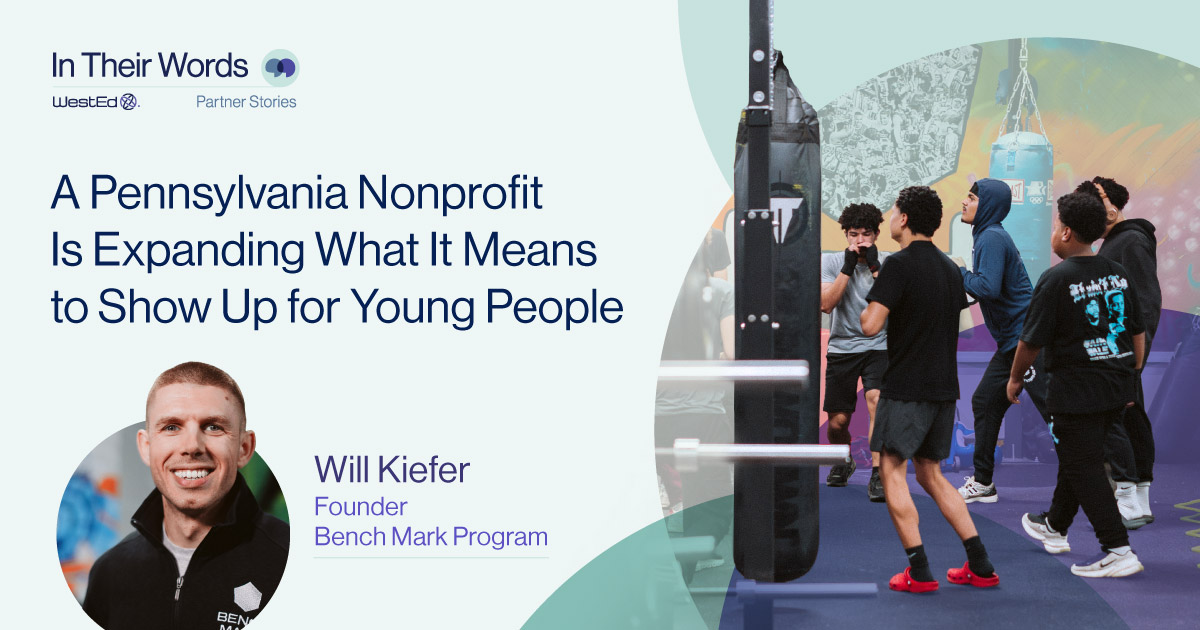
Bench Mark’s facility includes a large weight room on the first floor and a boxing club upstairs—an environment intentionally designed to not feel like a traditional mentoring program.
Kiefer said young people often refer to Bench Mark staff as “coaches” rather than mentors.
“The original vision was to create a space for older at-risk youth so that it doesn’t feel like a mentoring program,” he said. “I’m very comfortable saying we’ve accomplished that.”
Over time, Bench Mark began stepping into more parts of young people’s lives. The organization now provides programming in juvenile detention, receives referrals from juvenile probation officers and children and youth caseworkers, works inside local schools, and offers workforce development opportunities.
Its suspension alternative program, for example, gives students who would otherwise be sent home for an out-of-school suspension a way to remain in school. Instead, they spend that time in a Bench Mark–run classroom inside the high school, where staff provide mentoring and work with teachers to help students stay current on their coursework.
“If a student completes a five-day suspension alternative program with us, the school district doesn’t put a suspension on their record,” Kiefer said. “That’s been incredibly powerful for the district, which can now show that it’s using a community resource to address disproportionately high rates of out-of-school suspensions, which have since plummeted.”
Bench Mark’s work inside the school led them to discover students who were chronically absent or physically present in the building but disengaged from class.
Kiefer said the organization began asking whether the same one-on-one mentoring and case management it used in other programs could help students who were missing school. That idea led to a 3-year grant supporting a chronic absenteeism initiative.
Bench Mark worked with school administrators, home and school visitors, and the local magisterial district judge to define which students the program would serve, what progress would look like, and how the organization could complement existing school supports. When school staff can’t reach a student or provide intensive support, they can refer the student to Bench Mark.
From there, Bench Mark staff work to identify what may be keeping the student from attending or engaging in school. That can mean checking whether a family needs transportation, groceries, or another form of support that hasn’t been addressed yet.
Starting With Curiosity
Underlying Bench Mark’s programs is a philosophy that Kiefer says is simple: Be curious about young people before trying to change their behavior.
He recalled one student in Bench Mark’s programming who refused to speak to staff, his probation officer, or even the judge handling his case. He said no one was really curious about him; they were just mad that he wouldn’t talk.
Then one evening at Bench Mark, the student approached Kiefer to play the game Connect 4®. He beat Kiefer every time, and as they played, Kiefer noticed he was watching videos about stoicism on his phone, a subject Kiefer was also interested in, so he asked him about it.
The student began communicating with Kiefer and asking questions and talking through ideas. What appeared on the surface to be disengagement masked an introspective young person.
“He is one of the most thoughtful kids I have run into in programs,” Kiefer said. “Even after he’s done with his mandatory programming, he comes back at night to play Connect 4 and talk about stoicism. We’ll get to the other lessons,” he added, “but right now, that’s our mentorship. He has someone he can talk to about the things that interest him, and I think that’s going to make his life better.”
Kiefer said that in more than a decade of working with young people, he has never met a student who truly cares about nothing. More often, he said, they need something they aren’t receiving or an adult willing to take the time to discover what matters to them.
Creating Pathways, Not Just Programs
That relationship-based approach extends into Bench Mark’s workforce and leadership programs too.
Through its Student Leadership Program, young people who have progressed through Bench Mark can receive leadership development and work as paid peer mentors in the organization’s evening open gym. From there, they can move into part-time and eventually full-time positions as opportunities become available. Some former Bench Mark participants now hold staff and leadership roles within the organization.
Other young people find pathways outside Bench Mark.
One young woman first came to Bench Mark at age 14 and said she wanted to be a dentist. Over the next decade, she remained connected to the organization as she completed an accelerated dental assisting program, entered the workforce, became a mother of three, and navigated family challenges while she focused on her goal of becoming a dentist.
Bench Mark is not a college-access program, which typically helps high school students prepare for college, but when this young woman began exploring colleges, she wanted Bench Mark staff to help her review financial aid options and make sense of the choices in front of her. She is now in her first semester and commuting by train, working on days she doesn’t have class, and continuing toward her goal.
“This is a kid who was on juvenile probation and barely made it through high school,” Kiefer said. “She’s doing very well in college.”
Bench Mark’s long-term approach means that relationships don’t end when a program does. Young people may make progress, face setbacks, leave, and return years later. When they do, the same people and support are often still there.
“It happens every week. A kid needs something, and they know that this is a place to come back to,” Kiefer said. “Of the things I’m most proud of, that’s it, that they’ve got this place.”
Adding Structure to a Grassroots Model With WestEd
By 2021, Bench Mark had been operating for 7 years and had recently received its first major state violence intervention and prevention grant through the Pennsylvania Commission on Crime and Delinquency (PCCD).
Kiefer felt confident in what the organization had built, but the grant also introduced them to technical assistance from WestEd and raised questions that the organization had not fully addressed.
How should Bench Mark evaluate its programs? How could staff measure whether their work was having the intended effect? What research and evidence should inform new interventions? How could the organization turn an approach built largely through experience and relationships into a stronger, more structured model?
WestEd serves as the technical assistance (TA) provider for PCCD’s violence prevention grant programs, supporting grantees across Pennsylvania, including the Bench Mark Program.
“If it were not for WestEd, we would’ve been wandering in the dark,” Kiefer said.
WestEd’s Justice and Prevention team provides tailored training and TA to help government agencies and community organizations implement evidence-based programs, strengthen systems, and address real-world challenges.
Kiefer said that early conversations with WestEd included developing pre- and post-program evaluations and thinking more intentionally about measurement. WestEd staff also introduced Bench Mark to Roca’s Rewire cognitive behavioral therapy (CBT), an approach that its staff now use as one of the structured practices underlying the mentoring work.
“We were an absolute diamond in the rough, and WestEd would be the diamond cutters to clean off those rough edges,” he said. “Everything that I could point to that is actual structural organizational development work was pointed to us by WestEd.”
Bench Mark and WestEd’s partnership has spanned nearly 5 years, with regular meetings to discuss progress, challenges, and what the organization wants to build next.
When Bench Mark began exploring how to address chronic absenteeism, Kiefer brought the idea to WestEd. The team helped investigate how other organizations were approaching the issue, identify relevant practices, and think through the program’s structure. Bench Mark then took those ideas into conversations with school administrators and community partners before bringing what it learned back to WestEd.
“Years later, it’s very weird to think that we wouldn’t be talking to WestEd’s team on a monthly basis, which we do, because they’ve helped us move through all these big organizational phases,” Kiefer said.
Building on What Works
Bench Mark continues to look for ways to support young people as they move into adulthood.

Photo courtesy of the Bench Mark Program.
Kiefer describes the organization’s mentoring, educational, and personal-development work as the “first 50%,” helping young people get their lives to where they want them to be. Now Bench Mark is thinking about the second half—the ability to build a career, support a family, achieve financial stability, and eventually retire.
One effort is Bench Mark Unlimited, a separate employee-owned company connected to the nonprofit that provides work in junk removal and waste management. Kiefer envisions a path in which a young person might first meet Bench Mark staff while in juvenile detention, move through mentoring and education programs, enter the workforce, and eventually have an opportunity to build ownership in a company.
“We should be able to say that we have created a 40-year career path with employee ownership for these same kids who we met way back when they were in detention,” Kiefer said.
Bench Mark is also exploring how lessons from its model might help other communities, not by replicating the organization itself, but by helping local leaders identify and support grassroots solutions suited to their own young people and community needs.
Throughout the program’s growth, young people can still walk through Bench Mark’s doors and begin with three questions to help them reimagine their dreams, identify where they need help, and express their needs.
“You could spend all day with Bench Mark if that was something that you wanted to do as a young person,” Kiefer said. “We’re having a lot of fun innovating in that way.”

Will Kiefer is the Founder of the Bench Mark Program. He launched the program in 2014 while finishing his degree at Franklin & Marshall College, aiming to reach older youth not engaged by traditional services. Today, Bench Mark supports over 100 youth daily, employing 31 staff—including several program graduates—across schools, detention centers, and the community.
With an average student engagement of 38 months, Bench Mark partners with local agencies and operates on a $2.1M+ annual budget funded through diverse streams. Kiefer has secured multiple state grants, and in 2024, he testified before Congress on Bench Mark’s mentoring model. That same year, the Juvenile Court Judges Commission honored the program as Community-Based Provider of the Year. Kiefer lives in Lancaster, Pennsylvania, with his wife, Karla, and their son, Kenny.

Strengthen Your Youth-Serving Programs
Connect with our WestEd experts.
"*" indicates required fields
More Related to This Post
Blogs & Podcasts
Research insights and stories designed to inform, engage, and inspire.



Resources
Browse our high-quality publications and resources designed to inform and engage professionals in a variety of fields including K–12 education, early childhood, and health and justice.