


September 29, 2026
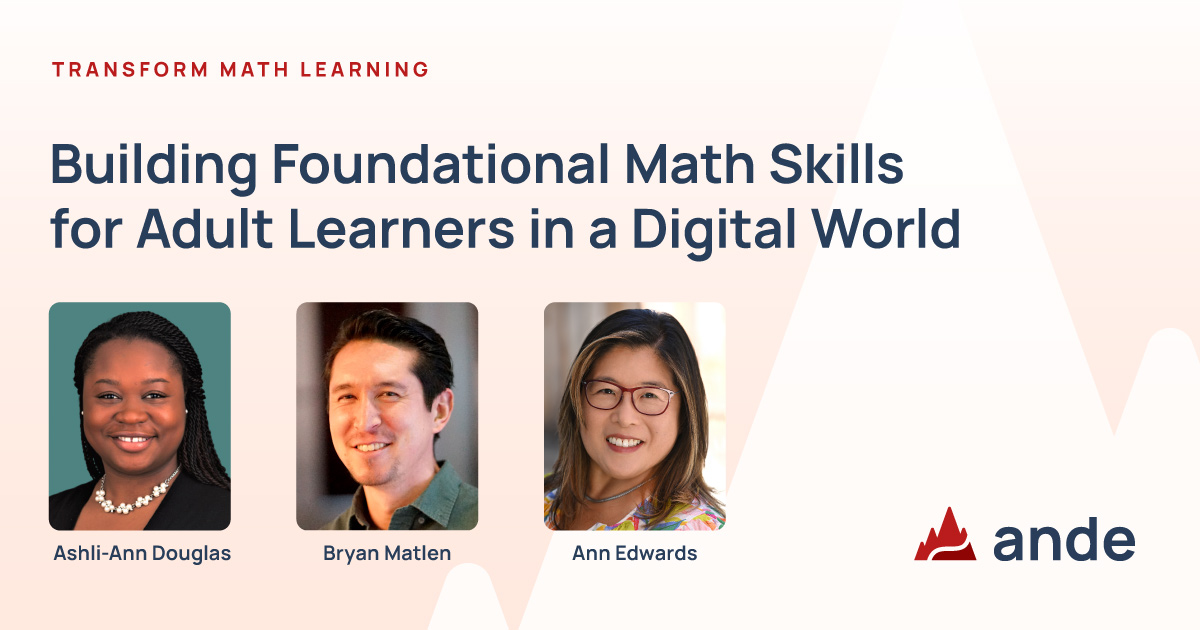
By Ashli-Ann Douglas, Bryan Matlen, and Ann Edwards
For many adults, math is more than a school subject. It affects everyday decisions—from preparing for a high school equivalency exam and understanding workplace data to managing a household budget. Yet nearly one third of adults in the United States struggle with the numeracy skills needed for daily life. Adult basic education (ABE) programs support adults seeking to strengthen foundational skills, earn a high school equivalency credential, prepare for postsecondary education, or advance their careers. These programs play a critical role in addressing this challenge, but ABE educators have limited access to research-based tools designed specifically for adult learners.
Adult learners bring unique strengths and needs to mathematics learning. Compared with traditional K–12 or college students, many balance education with work, family, and other responsibilities, and some may return to the classroom after years away from formal schooling or following previous negative experiences with math. At the same time, adult learners bring valuable real-world experience using mathematics in their daily lives, workplaces, and communities. These experiences highlight the importance of numeracy instruction that is relevant, flexible, and responsive to learners’ existing knowledge, goals, and lived experiences.
A new WestEd study offers encouraging evidence that technology-enabled instruction built around real-world math applications, personalized learning pathways, and collaborative problem-solving can help ABE programs deliver numeracy instruction that is responsive to adult learners’ needs while building on their strengths and experiences.
A New Approach to Math Instruction in ABE
To strengthen numeracy instruction in adult education settings, WestEd developed Adult Numeracy in the Digital Era (ANDE), a technology-enabled numeracy course designed specifically for adult learners. ANDE combines research-based teaching strategies with adaptive technology that provides personalized learning pathways and feedback based on learners’ performance, helping them to build foundational math skills while providing support tailored to their learning needs.
The course is built around three key principles:
- Connecting math to real-world situations that adults encounter in their daily lives, workplaces, and communities
- Providing step-by-step support that helps learners build new skills from what they already know
- Using adaptive technology to personalize learning and provide timely feedback
Together, these features are designed to help adults develop the mathematical knowledge, problem-solving skills, and confidence needed to succeed in education, work, and everyday life.
Why This Matters
Adult numeracy remains one of the least researched areas in education. While many digital learning tools exist, few have been rigorously evaluated for adult basic education programs. WestEd partnered with the Pennsylvania Department of Education to pilot ANDE across a variety of ABE programs, including urban and rural sites and in-person, hybrid, and online learning environments. The study explored whether ANDE could improve learner outcomes compared with traditional math instruction.
The findings suggest it can.
What the Pilot Study Found
The study involved adult learners in either spring or fall 2025. Researchers compared learners who participated in ANDE with learners receiving business-as-usual mathematics instruction.
The strongest finding was clear: Learners who participated in ANDE demonstrated significantly greater gains in math achievement than learners in comparison classes.
The improvement was meaningful, especially considering that the study evaluated only the first portion of the course sequence. These early modules focused on foundational concepts such as number systems, operations, ratios and percentages, and proportional reasoning. These skills are the building blocks for more advanced mathematics and are critical for high school equivalency preparation, workforce training, and everyday quantitative reasoning. As adult education programs increasingly support learners’ workforce and career goals, strong quantitative reasoning skills are essential for interpreting workplace data, solving problems, making informed decisions, and navigating technology-rich work environments.
Learners who participated in ANDE demonstrated significantly greater gains in math achievement than learners in comparison classes.
Within the one-semester pilot period, the study did not find significant changes in learners’ math beliefs, confidence with technology, or course persistence. Nevertheless, the improvement in math achievement alone is noteworthy in a field where rigorous evidence is scarce.
Early Evidence of Stronger Benefits for Learners With Lower Math Skills
One of the most promising findings involved learners entering programs with lower levels of math proficiency.
Researchers found evidence that ANDE’s impact was greatest for learners who entered the course with beginning basic and low intermediate math skills (educational functioning levels 2 and 3). These learners often need additional support in developing foundational concepts before they can tackle more advanced mathematical thinking.
The course’s structured learning sequence, contextualized problems, and adaptive supports appear particularly well-suited to helping these learners build a stronger foundation. This finding highlights an important opportunity for adult education programs that are seeking effective ways to support learners who face the greatest barriers to academic success.
What Makes ANDE Different?
The study also explored how implementation affected outcomes.
Researchers found that stronger learner outcomes were associated with the following:
- Greater participation in ANDE instructor professional learning
- Higher levels of engagement with the ANDE digital platform
- Opportunities for learners to explain how they solved problems and discuss their reasoning with others in line with ANDE guidelines
- Completion of ANDE online learning activities
These findings reinforce what research has long suggested: Successful math instruction involves more than content delivery. Learners benefit when they actively engage with ideas, discuss their reasoning, receive support from well-prepared instructors, and have opportunities for individualized practice.
ANDE was designed with these principles in mind, combining technology with structured instructional practices rather than relying on digital tools alone.
Lessons for the Field
The pilot also highlights both the promise and complexity of conducting research in adult education settings. Adult learners often enter and exit programs throughout the year, balance competing work and family responsibilities, and participate in a wide variety of learning environments.
Despite these challenges, the study demonstrated that meaningful evaluation is possible when researchers, educators, and state partners work closely together.
For practitioners, the findings point to several practical lessons:
- Invest in sustained professional learning and instructional resources for instructors.
- Encourage ongoing use of adaptive learning tools.
- Create opportunities for learners to explain and discuss their thinking.
- Focus on foundational numeracy skills that support long-term success.
Importantly, the ANDE course materials are now available at no cost as an open educational resource, making it easier for adult education programs to access and implement evidence-based numeracy instruction. Professional learning and implementation support are also available.
Looking Ahead
The ANDE pilot provides encouraging early evidence that a research-based, technology-enabled math course can improve adult learners’ math achievement.
While additional research is needed—including evaluation of the full course sequence and longer term outcomes—the results suggest that thoughtfully designed digital tools can play an important role in expanding opportunities for adult learners.
As adult education programs continue seeking effective ways to support diverse learners, ANDE offers a promising example of how research, technology, and partnership can come together to strengthen numeracy learning and help adults achieve their educational and career goals.
At WestEd, we are committed to working alongside educators, agencies, and communities to develop and evaluate solutions that improve outcomes for adult learners. The ANDE pilot study represents one step toward expanding access to effective, evidence-based numeracy instruction for adults nationwide.
About the Authors
Ashli-Ann Douglas, Research Associate II with WestEd’s Mathematics, Science, and Engineering team, conducts research and evaluation focused on mathematics learning across preschool, K–12, and adult basic education settings. Dr. Douglas draws on expertise in developmental science and mixed-methods research, with particular interests in early childhood education, family math engagement, math mindsets, and culturally responsive and sustaining learning opportunities.
Bryan Matlen,Senior Researcher with WestEd’s Learning Sciences and Technology team, studies how strategies based on cognitive science can be applied to support learning and inform instructional decision-making. Dr. Matlen also leads both formative and summative evaluations of early-stage educational technology products to improve their readiness for classrooms and is a senior methodologist for several large-scale efficacy studies at WestEd.
Ann Edwards, Senior Director of Mathematics, Science, and Engineering at WestEd, is a nationally recognized leader in mathematics education with over 30 years of experience in research and development in mathematics learning, instructional practice, teacher learning, curriculum development, and policy.

Ready to Support Your Thriving Learners and Empowered Communities?
Connect with our WestEd experts.
"*" indicates required fields
More Related to This Post
Blogs & Podcasts
Research insights and stories designed to inform, engage, and inspire.



Resources
Browse our high-quality publications and resources designed to inform and engage professionals in a variety of fields including K–12 education, early childhood, and health and justice.


