October 7, 2026
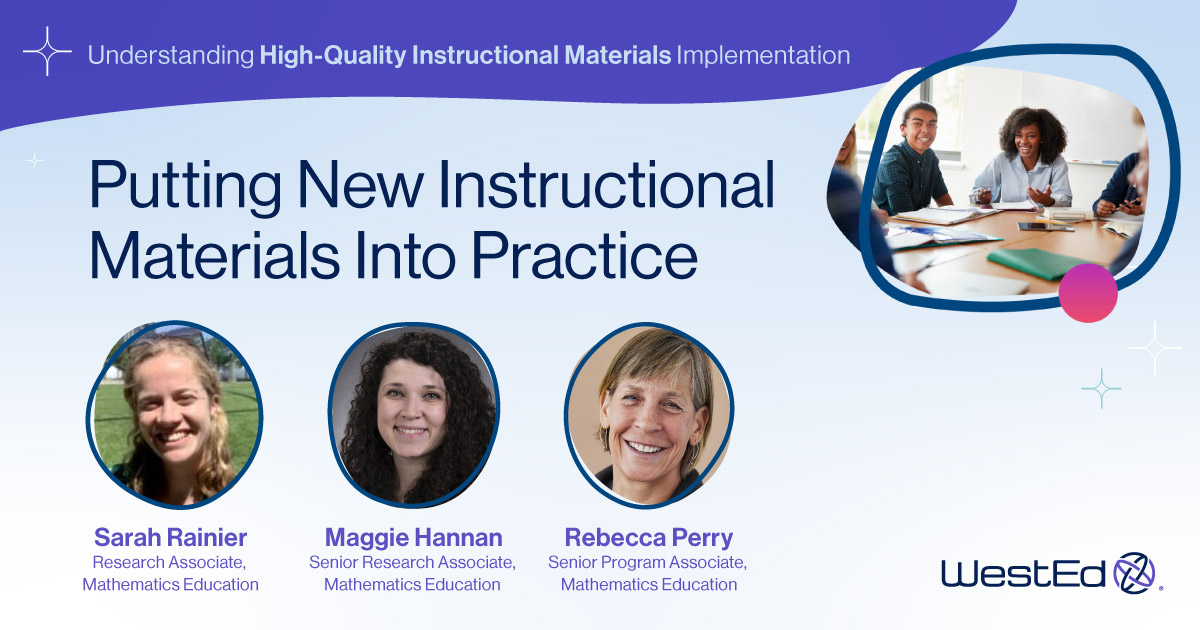
By Sarah Rainier, Maggie Hannan, and Rebecca Perry
Key Takeaways
- Teachers implementing new instructional materials may be learning new routines and instructional approaches while using them with students.
- Teachers and coaches emphasized the importance of classroom community and student discourse when putting new instructional materials into practice.
- Coaching, co-planning, modeling, and opportunities to learn incrementally can support teachers as they become familiar with new materials.
Useful for: Teachers, instructional coaches, school and district leaders, policymakers, researchers, and technical assistance providers involved in implementing or supporting new instructional materials.
When a new curriculum is adopted, teachers are often tasked with learning the curriculum while teaching it. Teachers are learning new routines and instructional approaches in real time, while instructional leaders are figuring out how best to support them.
This third post in WestEd’s five-part series on high-quality instructional materials (HQIM) turns to the experiences of educators putting new materials into practice. WestEd researchers spoke with teachers and instructional coaches in a medium-sized urban school district in the western United States about their experiences using Illustrative Mathematics (IM), a mathematics curriculum that emphasizes problem-solving and student discourse.
Their experiences highlighted several aspects of implementation, including building classroom community, centering student thinking, learning the curriculum incrementally, and creating opportunities for teachers to learn together.
Building a Math Community
Educators described IM as a significant change from traditional ways of thinking about math teaching and learning. Further, the curriculum may differ significantly from teachers’ past training and experiences, which can be challenging for new and veteran teachers alike.
Coaches emphasized the importance of establishing a “rough draft thinking vibe” to create an environment in which learners can share their mathematical thinking and build on one another’s ideas. This kind of community can also support teachers in moving away from the “sage on the stage” model of teaching and learning that has long been out of fashion but persists in many hearts and minds.
Educators also described the math classroom itself as a community that must be intentionally developed. For learners to flourish in an inquiry-based program like IM, they need to be able to “say something about themselves as math thinkers.”
Establishing “norms that encourage students to share incomplete ideas and build on one another’s thinking” can lead to discussion-rich instruction.
Gathering, Sharing, and Centering Student Thinking
IM is designed around specific classroom routines that create opportunities for student discourse. Even for middle and high school students, teachers agree that classroom management is the nonnegotiable foundation upon which IM builds. Adopting simple classroom routines can help teachers (and other professionals in complex settings) be more responsive to their dynamic environment as they learn to use a new curriculum.
For IM uptake, educators recommended starting teachers with a few lower stakes routines and helping teachers learn the physical and mental moves needed to lead an inquiry-focused classroom. Routines like “notice and wonder” and “which 3 go together,” embedded in the IM curriculum, were offered as examples of strong starting routines; they are straightforward to adopt and use for the teacher, and they establish the kinds of discourse moves that are necessary for inquiry-based instruction in a classroom community. Teachers and coaches also shared the importance of deeply engaging with student work in real time by walking around the room and taking notes on what students are writing and thinking during the lesson.
Maintaining transparency, sharing the “why,” and valuing student thinking were also key aspects of effective instruction with IM. The educators we spoke with shared the importance of telling students why they do things, which can help establish an open community setting. By engaging deeply with student work during the lesson and then sharing what they saw, teachers can also vocally and publicly value student thinking (not necessarily student correctness) and help to establish the community norms.
Teaching While Learning
In addition to requiring the learning of intricate and rigorous math material, IM asks many teachers to rethink their previous ideas about what math instruction looks like. Learning IM can feel overwhelming to teachers. Educators recommended specific approaches to goal setting in which teachers try the material for 2 or 3 weeks, get their feet wet, and then select what they want to work on for their (required) SMART goals with a coach.
Educators also talked about the importance of understanding the arc of the curriculum—and the way each piece builds on the last—and helping teachers internalize that structure. One coach described co-planning activities with teachers to help them see the interdependence of the various activities in the materials: “Let’s just plan one activity well—launch, activity, synthesis—because [full] unit internalization could take 3 hours if [the teacher is] new.”
Much like the “rough draft vibes” that are essential to the student experience of IM, educators emphasized that teachers need to try out various parts of the curriculum with the support of an expert leader who can help them focus on the most important elements.
Teaching Together
Coaches and other instructional leaders have a variety of powerful ways to support teachers who are learning IM. Educators identified co-planning activities or lessons as practical approaches. Some described IM feeling unattainable until they saw a colleague model a lesson during professional learning.
Educator mindset is also very important, especially because IM is a shift from traditional, passive modes of teaching and learning that still pervade the system. One educator put it this way: “If you actually don’t think math is a collective learning experience, none of this is going to matter … you have to actually believe [it].” These educators really emphasized this aspect of the implementation.
If you actually don’t think math is a collective learning experience, none of this is going to matter … you have to actually believe [it].
Lessons Learned for Putting New Materials Into Practice
- Classroom community and instruction are connected. Establishing “norms that encourage students to share incomplete ideas and build on one another’s thinking” can lead to discussion-rich instruction.
- Start small with routines, then build. The educators interviewed emphasized giving teachers opportunities to become comfortable with a few low-stakes, curriculum-embedded routines rather than trying to master all the elements of the curriculum simultaneously.
- Give teachers room to learn incrementally. Coaching, co-planning, and opportunities to try new instructional approaches can help teachers build familiarity with new materials over time.
- Instructional shifts may require shifts in mindset. The teachers and coaches interviewed emphasized that implementing new materials can involve changes not only in classroom routines but also in the way educators think about teaching, learning, and students’ roles in the classroom.
Helping Schools Make Math Materials Count
A strong foundation in mathematics is a key component of success in school and beyond. WestEd partners with educators and systems to support the effective implementation of HQIM and rigorous mathematics teaching and learning for all students.
About the Authors
Sarah Rainier is a research associate in WestEd’s Center for Teaching and Learning. She studies how teachers use curriculum materials and generative AI tools in their instruction, drawing on qualitative and mixed-methods research approaches.
Maggie Hannan is a mixed-methods researcher focused on understanding and improving how complex initiatives unfold in learning organizations. She has over a decade of experience in STEM education research, evaluation, and technical assistance.
Senior Program Associate Rebecca Perry’s work spans research, evaluation, and technical assistance for initiatives aimed at improving mathematics and science leadership, teaching, and learning.

Ready to Support Your Thriving Learners and Empowered Communities?
Connect with our WestEd experts.
"*" indicates required fields
More Related to This Post
Blogs & Podcasts
Research insights and stories designed to inform, engage, and inspire.





Events
Research insights and stories designed to inform, engage, and inspire.

Resources
Browse our high-quality publications and resources designed to inform and engage professionals in a variety of fields including K–12 education, early childhood, and health and justice.