


September 16, 2026
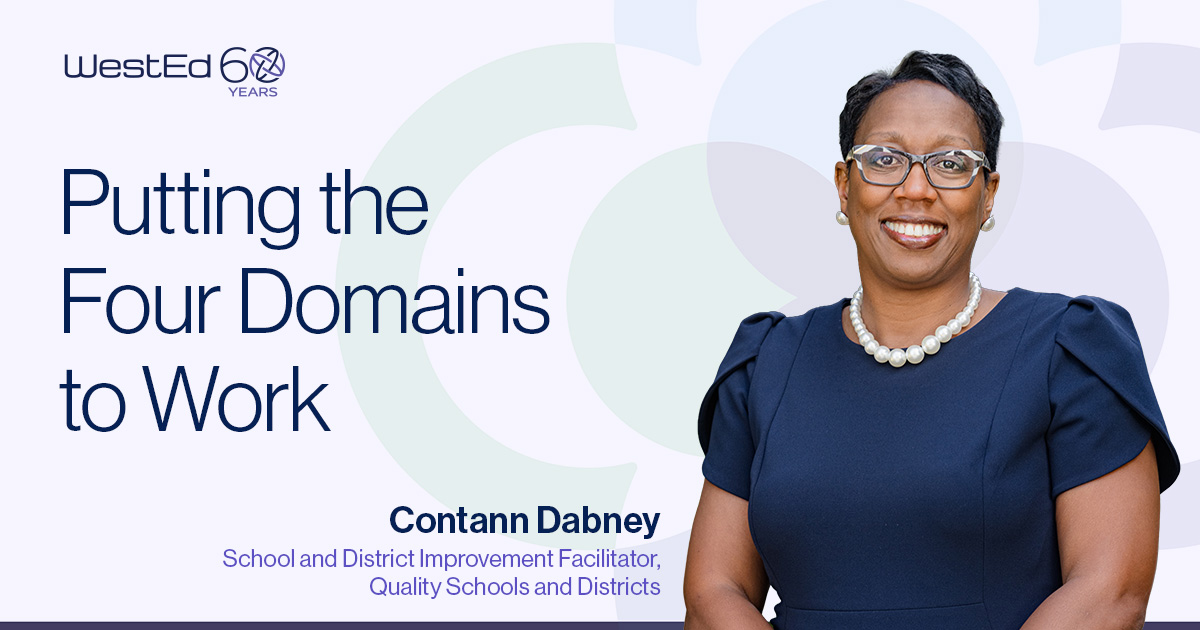
By Contann Dabney
Working alongside school, district, and state leaders across the country, I have learned that at the heart of school turnaround and transformation are the people: the students who come through the doors each day, the educators and staff who support them, and the leaders working to create the conditions in which their school communities can thrive.
I have also learned the importance of context. Every school has its own story, community, experiences, challenges, assets, and aspirations. While schools often enter turnaround and improvement efforts because of identified needs, those needs do not tell the whole story of a school. Understanding the context of the school, recognizing the strengths and capacity that already exist, and seeing the potential of the people within it are also essential to transformation.
Understanding a school’s context and the people within that context is particularly important in school turnaround work. Turnaround work often begins with an identification of a need. Schools may enter the work because of academic outcomes, inequities in student experiences, challenges with attendance or engagement, or other indicators that signal a need for significant improvement. Those challenges matter and require attention, but they should not become the sole identity of the school or the only way we understand the school and its work.
At WestEd’s Center for School Turnaround and Improvement (CSTI), where I am the associate director, we believe transformation requires us to hold both a clear understanding of what needs to change and an equally clear understanding of the strengths, relationships, and potential that can help make that change possible. A strengths-based approach does not mean minimizing need. It means understanding need within the fuller context of a school and recognizing the capacity that already exists and that can be built upon.
CSTI grounds its transformation work in the Four Domains for Rapid School Improvement. The Four Domains include Turnaround Leadership, Talent Development, Instructional Transformation, and Culture Shift. Together, they provide a research-based framework for understanding the practices that support sustainable school improvement.
At CSTI, we use the Four Domains as more than a framework for understanding school improvement. The practices provide a way to work alongside leaders throughout the improvement process. In comprehensive needs assessments, they help us uncover strengths and understand needs. In planning, they help leaders connect goals and strategies to the practices needed to move the work forward. In coaching, they give coaches and leaders a common foundation for examining implementation, strengthening leadership practice, and considering what comes next.
The Four Domains help organize the work, but the framework itself does not create transformation. People, relationships, context, and the capacity of school communities to learn and act together remain at the center.
Through Comprehensive Needs Assessment
A comprehensive needs assessment (CNA) is an opportunity to develop an in-depth understanding of a school. Data are an important part of that process, but they do not tell the entire story. To understand what is happening in a school, we also have to examine the practices, systems, experiences, and relationships that contribute to the outcomes we see.
The Four Domains practices give us a way to do that.
Rather than approaching a CNA primarily as a search for gaps or deficits, applying the Four Domains practices alongside the CNA helps to develop a fuller picture of the school. Where are effective practices already present? What leadership practices contribute to those strengths? What do students and staff experience? Which systems support the work? Where do they need to be strengthened?
While one school might have strong structures for collaboration while struggling with consistent instructional implementation, another might have developed deep relationships with students and families but still need stronger systems for using data to inform instructional decisions. Those strengths are not separate from the improvement work. They are part of the improvement work.
Identifying the strengths gives leaders an opportunity to consider what they can leverage. What practices, relationships, structures, or ways of working contribute to success in one area? What can be learned from those strengths, and how might that learning be applied to an area that needs to be strengthened?
At the same time, the Four Domains practices help uncover needs within leadership, talent, instruction, and culture. The Domains also give leaders ways to consider possibilities and next steps for strengthening those areas.
This gives leaders a more complete picture of their school. They can be clear about what needs to improve while also recognizing what is already working and what they can build on.
Connecting Goals, Strategies, and Practices Through Planning
Understanding a school’s needs through an organized framework, such as the Four Domains, provides a strong foundation for improvement planning.
Schools often begin planning with important goals, such as improving student achievement, strengthening Tier 1 instruction, increasing attendance, improving outcomes for specific groups of students, or strengthening student engagement. From there, teams identify strategies intended to move those outcomes.
But there is an important space between selecting a strategy and achieving a result.
That space is practice.
The Four Domains help leaders connect goals to strategies and strategies to the leadership and organizational practices needed to make them work.
For example, a school may identify strengthening Tier 1 instruction as a priority and select professional learning, collaborative planning, or implementation of high-quality instructional materials as strategies. The Four Domains practices help leaders go further by fostering reflection through questions such as “What structures need to exist for educators to learn together?” or “How will expectations be communicated?”
Reflecting on structures and practices is a core component of the turnaround process. The questions help leaders develop concrete action steps for themselves, their leadership teams, and the broader school community. This creates greater clarity about who is doing what, how the work connects, and what needs to happen to move a strategy from an idea into practice.
It also creates an opportunity to think about sustainability from the beginning. Rather than building improvement work around a particular initiative, program, or individual, leaders can consider how the practices needed for improvement can become part of the systems and routines of the school or organization.
The power of transformation resides in people, their relationships, their understanding of their context, their willingness to learn together, and their belief in what is possible for their students and their school.
Coaching Leaders From Plans to Practice
Transformation requires leaders to make sense of what they are seeing, learn from what is happening, and determine what to do next. That is why coaching is another important way we use the Four Domains practices.
Within CSTI, the practices create a shared language for coaches and leaders to examine implementation and leadership practice together. A coaching conversation explores whether an activity was completed and what is happening as a result. This means thinking through what was learned from implementation, what seems to be gaining traction, and what barriers to the process are. It also considers the experiences of students and staff, the strengths within the team or school, and how the positives can be built upon.
The Four Domains do not provide a script or a single answer. They give coaches and leaders a research-based set of practices they can use together to make sense of the school’s context, consider possibilities, and determine next steps that fit for that school.
Coaching then becomes less about telling leaders what to do and more about helping leaders strengthen their ability to understand their organization, leverage what is strong, respond to what needs attention, and make intentional leadership decisions.
Creating Coherence Across the Work
Using the Four Domains for conducting needs assessments, planning improvements, and coaching educators creates coherence across the improvement work. Determining he needs of a school does not live separately from the improvement plan. The improvement plan does not live separately from coaching. Coaching does not live separately from implementation. The same practices that help leaders understand the current state of their school can inform priorities and then identify the practices needed to support their strategies, guide implementation, monitor progress, and make adjustments along the way.
In this way, the Four Domains support leaders throughout the improvement cycle, from setting the direction and assessing the need to creating and implementing the plan, monitoring the plan, and adjusting the course.
The practices give us a consistent way to approach the work without assuming that the work should look the same in every school. A common framework does not require a common solution. The context of the school, the people within it, the strengths they bring, and the needs they identify all shape how improvement moves forward.
Transformation Begins With People and Possibility
School transformation is complex work. It requires urgency about outcomes without losing sight of the people behind those outcomes. It requires acknowledging challenges without allowing those challenges to become the story of the school. It also requires creating space to understand a school’s context, recognize its strengths, and see its potential.
At the heart of that work are people and relationships.
Students bring strengths, identities, experiences, and aspirations into their schools every day. Educators and staff bring expertise, relationships, knowledge, and commitment. Leaders bring their knowledge of their schools and communities, along with the responsibility to create the conditions in which people can work together toward better outcomes for students.
At CSTI, our role is not to bring transformation to a school. It is to work alongside leaders and school communities to recognize what is already there, deepen their understanding of their systems and practices, and build their capacity to lead and sustain transformation. The power of transformation resides in people, their relationships, their understanding of their context, their willingness to learn together, and their belief in what is possible for their students and their school. Successful school transformation happens when the conditions enable people to transform their schools together.
About the Author
Contann Dabney leads services that support effective school improvement projects within and across schools, districts, and states. With a focus on empowering educational institutions to reach their full potential, Dabney leverages her wealth of experience to help her clients develop effective strategies for driving meaningful change.

Ready to Support Your Thriving Learners and Empowered Communities?
Connect with our WestEd experts.
"*" indicates required fields
More Related to This Post
Blogs & Podcasts
Research insights and stories designed to inform, engage, and inspire.





Events
Research insights and stories designed to inform, engage, and inspire.

Resources
Browse our high-quality publications and resources designed to inform and engage professionals in a variety of fields including K–12 education, early childhood, and health and justice.


