


June 15, 2026
At universities across the country, many college students are opening their dense textbooks or skimming academic articles and finding that the vocabulary is unfamiliar and the structure hard to follow. National college-readiness data suggest that many incoming students are not fully prepared for college-level reading. According to ACT’s 2025 national report, only 39 percent of ACT-tested graduates met the reading college-readiness benchmark for success in their 1st year.
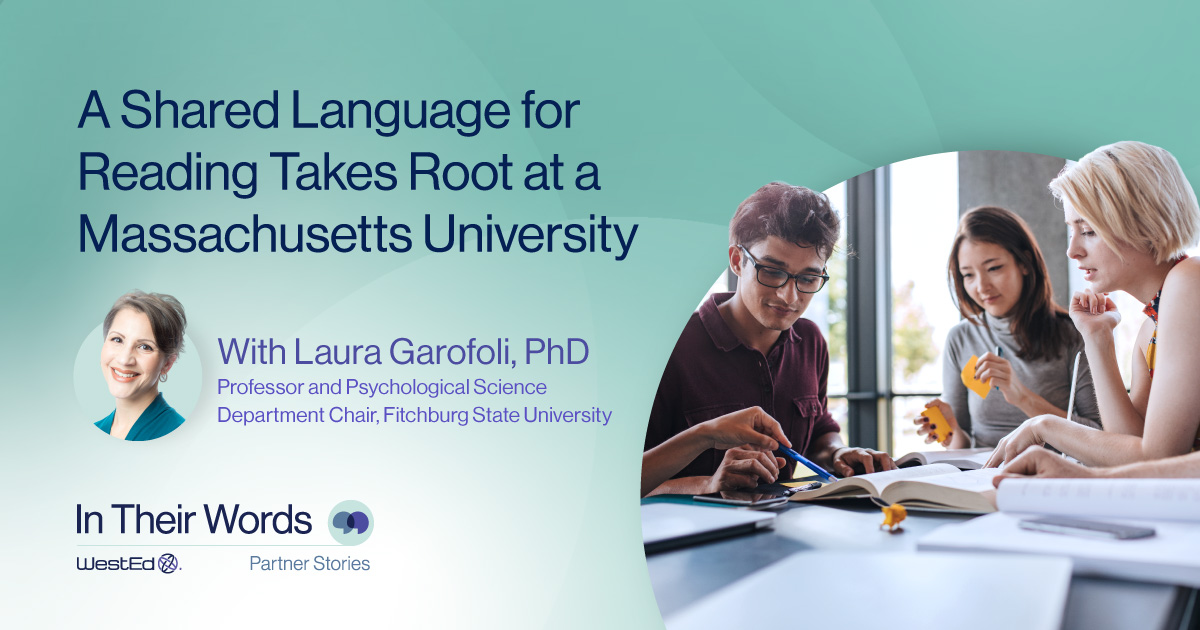
Getting students to read has long been a challenge in higher education, but according to Dr. Laura Garofoli, a professor at Fitchburg State University, it’s infinitely harder now than ever before.
As department chair in psychological science and a former reading disability specialist, Garofoli approaches college reading as more than an academic skill. She sees it as an entry point to belonging, confidence, and success in college-level learning.
At Fitchburg, she noticed that students were struggling with many of the same issues she had seen among younger readers. They lacked strategies for monitoring their comprehension and often held fixed ideas about who they were as learners.
She said students needed motivation to engage with reading. They needed metacognition—the ability to recognize what they did and did not understand. And they needed a mindset that allowed them to see academic success as something they could influence rather than a label they either had or didn’t have.
Finding the Right Framework and Why Professional Learning Matters
Reading Apprenticeship® is an instructional framework and professional development model that helps teachers mentor students in becoming better, more confident readers. Developed by WestEd, it teaches students how to read complex texts, think like disciplinary experts, and improve their critical thinking skills.
Garofoli encountered Reading Apprenticeship after graduate school, while working at a residential preK–12 school as a reading specialist and searching for an approach that could help adolescents and young adults make sense of complex texts.
Years later, when Fitchburg State University began developing its First-Year Experience (FYE) course to support incoming students’ transition to college-level work—and identified reading as a key learning outcome—Garofoli returned to the framework.
She was the only reading specialist on campus, and she knew that the university needed a shared approach to thinking and reading. Faculty needed something flexible enough to work across disciplines but coherent enough to provide consistency for students.
“I remembered Reading Apprenticeship and talked with administration about it, and they were on board,” she said. “They said, ‘OK, if you believe that this is what we should try, then let’s try it.’”
Because Reading Apprenticeship is not a scripted program, Garofoli knew that it wouldn’t require every instructor to teach the same text or follow the same lesson sequence. Instead, it would give faculty a way to make expert reading visible. It would help them name the personal, social, cognitive, and knowledge-building dimensions of reading, with metacognition at the center. That mattered at a university where faculty taught across many disciplines and valued academic freedom.
Garofoli participated in Reading Apprenticeship’s professional learning so she could bring the framework back to her faculty, then created a professional learning institute for those teaching the FYE course. The institute included summer training and yearlong meetings grounded in Reading Apprenticeship and other research-based approaches.
She said that the difference between reading about Reading Apprenticeship’s approach and participating in professional learning is like the difference between reading a recipe and working alongside a trained chef. A recipe can tell you what ingredients to use, but a chef can show you how to hold the knife, how high to set the heat, and what to notice as the dish comes together.
Initially, Garofoli thought Reading Apprenticeship would provide a framework for the reading portion of the course, but it quickly proved to be more than that.
As faculty and librarians worked together, they adapted Reading Apprenticeship routines for research and information literacy, helping students reflect on how they search for, evaluate, and use information. They began to see that they were not only teaching students how to read more effectively but also helping them understand how thinking develops and how readers build knowledge, question assumptions, use strategies, and persist through uncertainty.
Most college faculty have focused expertise in their disciplines but little formal preparation in how to teach students to read, think, and learn within those disciplines. Professors know how to read like psychologists, historians, scientists, or literary scholars, but that expertise doesn’t automatically translate into learning outcomes for students.
That’s where professional learning becomes essential.
“I’m fortunate I have a teaching license, but the vast majority of my colleagues don’t,” Garofoli said. “In the pathway towards my PhD, I was encouraged to teach, but I was given no information about how to teach.”
She said the professional learning program helps faculty do more than understand the framework. It pushes them to explore the personal and social dimensions of learning, model vulnerability, move away from always positioning themselves as the expert, and develop a common language across FYE sections through a community of practice that meets every 2 weeks in the fall.
However, even with strong faculty buy-in, sustaining the work has been difficult. Professional learning requires time, coordination, funding, and a broader group of people who can lead communities of practice, support colleagues, and keep the work moving.
Garofoli’s advice to other higher education institutions on doing this work is clear: “Give release time for faculty to do professional learning that improves their ability to meet students where they are and helps them to be successful, but also helps [instructors] to be successful,” she said. “That’s how you burnout-proof your faculty. You develop that sustainable model, and you give them release time to do good work.”
For Garofoli, sustainability also means treating faculty professional learning as real work and making it visible. She said institutions should celebrate faculty who take it on, invite them to share what they’re learning, highlight how they are supporting 1st-year students, and build the work into the campus culture from the start.
Making Reading and Thinking More Visible
In Garofoli’s classes, Reading Apprenticeship shows up through routines that help students slow down and notice their own thinking. Students use metacognitive logs—taking notes to track their thinking while they read—and they annotate texts with thoughts, feelings, questions, and connections.
“Reading Apprenticeship at the collegiate level is life-altering, it’s practice-altering, and I’ve witnessed it,” she said.
One of her own prereading steps is called “dipping and digging.”
Before students try to read a difficult text from start to finish, they quickly examine it and look for bolded words, charts, headings, familiar concepts, or sections that catch their attention. Then they choose one place to dig in.
According to Garofoli, students do not have to read every text straight through to connect thoughtfully with it. Giving them permission to move around in a text, along with a clear purpose for taking notes, can actually help them read more. Metacognitive logs give students a reason to record their thoughts, feelings, questions, and connections, even when those responses are simple. The point, she said, is to get students activated; once they begin investing in the text in any way, they are more likely to move deeper into the content and approach reading more creatively.
She knows students have access to tools that can summarize texts, generate explanations, and help them complete assignments more quickly. But rather than treating AI only as a threat, Garofoli teaches students to approach it critically.
“I’m trying to teach them how to use AI appropriately,” she said. “They’ll use NotebookLM, for example, and they’ll plug in their notes, and we use all of those metacognitive strategies to interrogate the AI, to ask it, ‘Are you sure about that?’”
Still, Garofoli’s focus remains on students’ own thinking. Instead of having students jump into a difficult academic article, she recently had them build a sequence of texts that helped them develop background knowledge and curiosity.
“I asked them first, ‘What’s your research topic?’ ‘What are we going to get into the library databases for?’” she said. “And then I said, ‘Before we do that, why don’t you try to find a meme that embodies the thing that you’re trying to get at with your question, and let’s see if you need to adjust your question,’ and they had a blast—they were dying laughing.”
From there, students moved to a popular source, such as a blog post, article, or video by someone with relevant expertise. By the time they reached the academic article, they had context, questions, and the motivation to read.
Encouraging Continuity in Reading, Thinking, and Learning
As faculty have engaged with the Reading Apprenticeship approach, the work has begun to spread beyond the FYE course.
Some instructors who initially used the framework in the FYE course have carried the routines into upper-level courses. Faculty in STEM fields, including some who were initially skeptical, have become strong advocates after seeing how the strategies helped students engage with disciplinary texts.
For Garofoli, the work comes back to continuity. She said faculty should share a common language for reading, thinking, and learning so students can carry the strategies they develop in one course into other courses and disciplines.
“Our students deserve the continuity over the course of their academic career,” Garofoli said. “And one of the ways that we can do that as campuses is by adopting a framework like Reading Apprenticeship. It’s the most adaptable framework I’ve ever seen.”

Laura M. Garofoli, PhD, is a tenured professor, chair of the Psychological Science Department, and special advisor to the president at Fitchburg State University, where she leads the Presidential Fellows Program.
As First-Year Experience (FYE) Coordinator for the past six years, Garofoli designs and leads a comprehensive professional learning program grounded in the Reading Apprenticeship Framework for FYE faculty across 15 academic departments.
Her commitment to helping faculty teach with greater intention, impact, and fulfillment—and to ensuring that every student is reached—was honored in 2023 with the Manuel Carballo Governor’s Award for Excellence in Public Service from the Commonwealth of Massachusetts.
Partner With WestEd to Strengthen Academic Literacy
Get started with Reading Apprenticeship®.

Ready to Strengthen Your Assessment Systems to Support All Learners?
Connect with our WestEd experts.
"*" indicates required fields
More Related to This Post
Blogs & Podcasts
Research insights and stories designed to inform, engage, and inspire.


Resources
Browse our high-quality publications and resources designed to inform and engage professionals in a variety of fields including K–12 education, early childhood, and health and justice.

