

July 16, 2026
Writing helps students build their voice, express what they care about, advocate for themselves and their communities, and think critically. It also strengthens their success across disciplines and supports their long-term professional readiness. And for students who may have faced barriers in traditional school settings, writing gives them a way to reengage with learning, build confidence, and make meaning of their experiences.
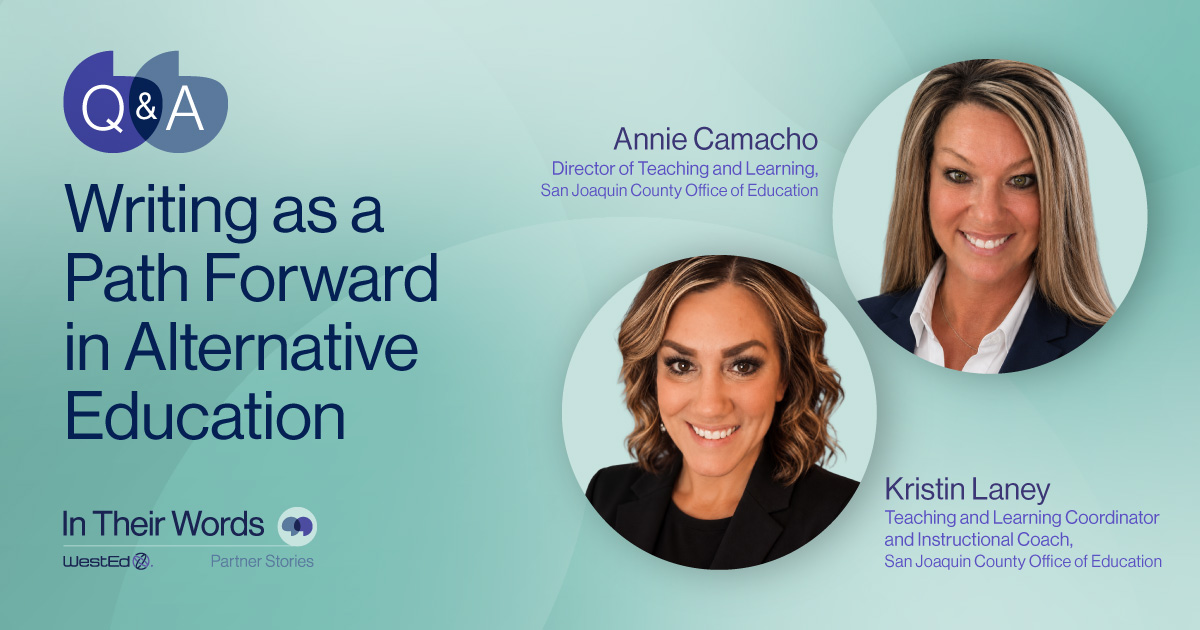
In this Q&A, Annie Camacho, Director of Teaching and Learning, and Kristin Laney, Teaching and Learning Coordinator and Instructional Coach at San Joaquin County Office of Education discuss their first year of implementing WestEd’s Writing Apprenticeship across alternative education programs to strengthen student writing and success.

Kristin: Typically, our program supports students who have all sorts of different challenges—attendance issues, expulsions, or sometimes traditional school just didn’t work for them. That could be due to a variety of environmental or family barriers and backgrounds as well. Watching some of those students get the opportunity to graduate—sometimes as the first in their family, after generations in which no one had received or earned a high school diploma—is really powerful. To experience that and see our work carry through to the end for them, that’s the rewarding part.
Annie: I think our school programs give students the opportunity to rediscover their confidence and potential. They offer a fresh start, meaningful relationships, and individualized support so students can reengage in their learning and education and build a positive path forward.
Annie: We recognized that strengthening student writing could positively impact nearly every other part of student success. So, we formed a programwide writing assessment committee tasked with developing and implementing a common writing assessment, mostly to establish a baseline for student writing performance across schools and programs. The evidence overwhelmingly pointed to a significant need to improve writing instruction. At that point, it became clear that this work was bigger than accountability metrics or dashboard indicators. We knew we had a responsibility to move forward in this direction because strong writing skills are essential for students’ success after high school and college, careers, life, period. And Writing Apprenticeship aligned with our vision because it emphasized reading and thinking and literacy and, most importantly, student voice across all content areas.
Kristin: Annie and I were both teachers. And so, I think we both have the vast understanding that many of our teachers, because it’s alternative education, they’re sometimes teaching outside of their scope. They may be teaching subjects that they normally wouldn’t have taught if they were in a comprehensive setting, or they’re responsible to teach subject matter across the board. We talk about this all the time, that teaching teachers how to teach writing in all the different subjects, not just in an English classroom, is going to be beneficial for them and our students. So that was a big thing too, that this could go across the board to any of our teachers.
Annie: Ten teachers participated in the 3-day summer institute, and that was just a pilot for us. So, we wanted their feedback on whether or not to even move forward with Writing Apprenticeship. But after the 3-day writing institute, it was overwhelmingly positive, and all teachers participating said that this is definitely the right direction for our schools and students. The continuous support from the Writing Apprenticeship coaches helped teachers refine their practice, collaborate with one another, and stay focused.
Kristin: Every time they [Writing Apprenticeship coaches] came out to do individual coaching at the sites, we would end the 3 days with a whole-group session, bringing together all the teachers who had participated. The coaches were really good about pulling it all together—highlighting what different teachers had tried, showcasing work from classrooms, and giving teachers new ideas. As Annie said, this year was kind of a pilot for us, so we only had the 10 teachers. But we brought in sample work, and, as a group, we went through some of those samples together. That’s something we’re going to be really intentional about next year: using WestEd to help tie it all back together and strengthen the work as we move into another group of teachers.
Kristin: For Annie and me, it’s really important that we’re present because it shows that we’re also invested in what we’re asking our teachers to be invested in. If we’re not invested, and we’re not there, then how can we expect teachers to be? Annie and I are both going to take the 3-day [Writing Apprenticeship] institute this summer. We’re going to be students. And I think that’s the intention: if I’m not showing up, engaging, and participating, how would I expect a teacher to do the same?
Annie: We need to know what they’re learning and how to best support them. Part of our role is celebrating bright spots happening across our programs. If a teacher is effectively using Writing Apprenticeship strategies, we need to be able to identify that, be able to recognize that work, provide feedback, and acknowledge the effort they’re putting into improving instruction for students.
Annie: Teachers initially assume that writing instruction belongs only in an English classroom, and they’re not writing teachers, nor do they hold a writing credential. So, one of the most powerful shifts we saw was just that shift in mindset. As teachers engaged in the training and ongoing sessions, their confidence grew, and they began to see that writing was essential across all subject areas and not just English.
Kristin: There were a couple of teachers who stood out. One of them is already a phenomenal teacher, but every time I went into her classroom, I noticed that she was bringing a lot of the lessons back to a writing piece. Even if it was just some type of summary, she was asking students to do a little more critical thinking. Usually, we see a lot more surface-level work—something quick, like, “Tell me how you feel or what you think.” But this was deeper. And I definitely think that came from some of the tools she learned through Writing Apprenticeship.
Annie: I noticed teachers becoming more willing to be vulnerable and try new instructional strategies in front of students, which the coaches encouraged. In turn, our students became a little bit more vulnerable in expressing themselves, advocating for themselves, and communicating more in classrooms.
Annie: Writing instruction is much more than grammar and essays. It helps our students develop confidence and reasoning skills and the ability to advocate for themselves. For many of our students, those skills are life-changing. We would encourage other districts to invest in this work because it supports success across all content areas and prepares students not just for school but also for their careers and participation in the world around them.
Annie: I like that WestEd took the time to understand who we are and the unique needs of our schools and students. Our alternative education programs are very different than traditional school settings, and they need to be because, as Kristen mentioned, traditional settings were often not successful for many of our students. So, from the beginning, WestEd recognized that reality and approached the partnership with flexibility and responsiveness to meet our needs rather than expecting us to fit in a one-size-fits-all model. They worked alongside us to support our teachers and in ways that made sense for our programs and student population.
Kristin: WestEd’s commitment to really understanding the work that we do—our students, our population, our needs, and what we needed in order to make this work—you can’t always find that. That type of partnership and understanding made the work meaningful. Because, again, if what works at a comprehensive school or district worked for our students, they would still be there. And because it didn’t, we have to recognize that our programs, students, and teachers have different needs.
Annie: This work comes much easier when you have the right people in place, including having the partnership with WestEd and having educators that believe in the work and are committed to improving student outcomes. What has made this effort worth it is knowing that strengthening student writing has the potential to positively impact every area of learning and create greater opportunities for students after high school. It’s also about not making it a one-time professional development but staying committed to the long-term vision. It takes time and collaboration and consistency, but in the end, it’s worth it.

Annie Camacho has served the San Joaquin County Office of Education (SJCOE) for more than 18 years, supporting students and educators across a variety of instructional settings, including court schools, community schools, behavior intervention programs, and independent study. Prior to moving into administration, she built experience as an educator, developing a deep understanding of diverse learning needs. She currently serves as Director of Teaching and Learning, where she leads initiatives in curriculum, instruction, professional learning, assessment, and educator development.

With more than 20 years of service at the San Joaquin County Office of Education (SJCOE), Kristin Laney has dedicated her career to supporting students and educators across a variety of roles. Her professional journey has included serving as an Instructional Assistant and Special Education Teacher and, currently, as the Coordinator of Instruction, Data, and Curriculum. She is committed to ensuring equitable access to high-quality educational opportunities that empower all students to achieve success.
Partner With WestEd to Strengthen Writing Instruction and Student Outcomes
Get started with Writing Apprenticeship.

Partner With WestEd to Strengthen Writing Instruction and Student Outcomes
Get started with Writing Apprenticeship
"*" indicates required fields
More Related to This Post
Blogs & Podcasts
Research insights and stories designed to inform, engage, and inspire.