


October 20, 2026
Accelerating rigorous mathematics learning requires giving students opportunities to engage meaningfully with mathematical ideas. High-quality instructional materials can help provide those opportunities, but the materials themselves are only one part of the equation.
In this Spotlight, WestEd experts share insights and research on selecting math instructional materials that fit local needs, supporting their implementation, and examining evidence of their impact on student learning.
Choosing for Quality and Fit
A curriculum can be highly rated and still not be the right fit for every district. In our Questions We Answer series on mathematics education, researchers and practitioners address questions educators face in math teaching and learning.
Jill Neumayer DePiper, Senior Research Associate in Mathematics Education, takes on a consequential one: How can education leaders choose high-quality instructional materials for math teaching and learning?
DePiper offers guidance for making a locally informed selection, including the following:
- Using evidence about student learning and classroom instruction to identify local needs
- Evaluating how well prospective materials align with those needs
- Considering the professional learning that teachers will need to use the materials effectively
Dive deeper: How Can Education Leaders Choose High-Quality Instructional Materials (HQIMs) for Math Teaching and Learning?
Moving From Adoption to Effective Implementation
Adopting high-quality instructional materials doesn’t ensure that their potential will be fully realized in the classroom.
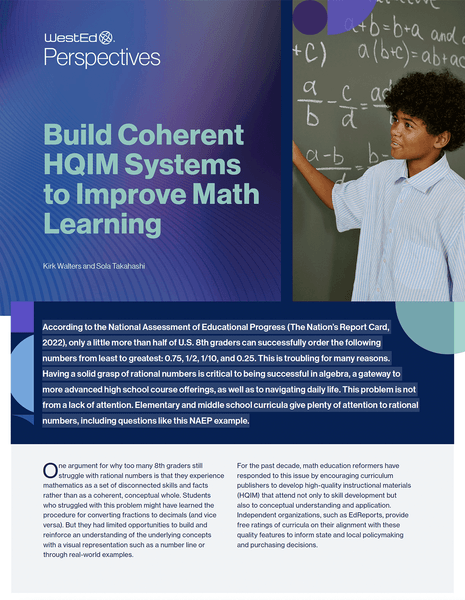
In Do High-Quality Math Materials Improve Learning?, Kirk Walters, Vice President of WestEd’s Center for Teaching and Learning, shares findings from WestEd research that examine how high-quality instructional materials and their implementation affect math teaching and learning.
Among the insights are the following:
- High-quality materials alone are unlikely to produce better student outcomes.
- Effective implementation is critical for realizing the potential benefits of the materials.
Dive deeper: Do High-Quality Math Materials Improve Learning?
Examining Evidence of Impact Over Time
Research can help education leaders understand how instructional materials affect student learning and how those effects may develop over time.
In a recent WestEd study, researchers Mingyu Feng and Kevin Huang examined the effects of a competency-based elementary math curriculum on achievement among students in grades 2 and 3 in two New Jersey districts. Students showed meaningful gains after 2 years of implementation, while no significant effect was found after 1 year.
Accelerating Mathematics Teaching and Learning
Supporting rigorous mathematics teaching and learning extends from the classroom to the systems that surround it. Learn more about WestEd’s research, professional learning, evaluation, and other work in mathematics education.

Ready to Support Your Thriving Learners and Empowered Communities?
Connect with our WestEd experts.
"*" indicates required fields
More Related to This Post
Blogs & Podcasts
Research insights and stories designed to inform, engage, and inspire.





Events
Research insights and stories designed to inform, engage, and inspire.



Resources
Browse our high-quality publications and resources designed to inform and engage professionals in a variety of fields including K–12 education, early childhood, and health and justice.