November 17, 2026
Quick Takeaways
- Participation in advanced coursework may have benefits beyond earning a passing grade.
- Flexible course design can help adult learners stay engaged in meaningful instruction.
- Campus programs may support students’ academic engagement and sense of belonging.
Who Will Benefit: High school and district leaders, college and university leaders and staff, adult education program leaders and instructors, state policymakers, researchers, and community partners working to expand access to postsecondary education and support learner success will all benefit.
This Spotlight highlights three recent WestEd resources—drawing on research, classroom practice, and evaluation—that explore what educators are doing to not only expand access to postsecondary education but also increase the support that helps learners succeed along the way.
Opening the Door Through Dual Enrollment
Research That Explores What Can Happen When Access Expands
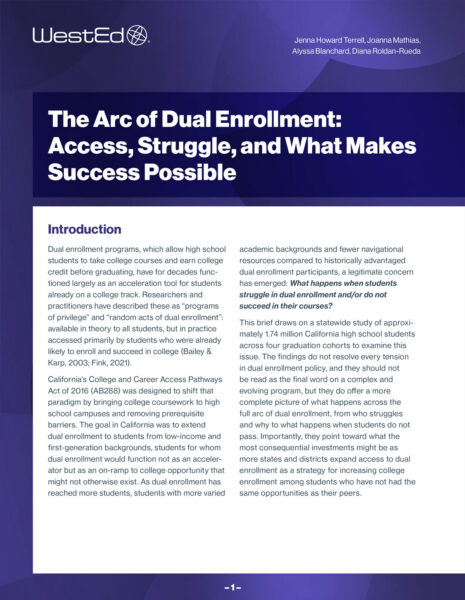
Dual enrollment has traditionally served students who were already planning to attend college. California’s 2016 College and Career Access Pathways Act set out to broaden that access, extending college coursework to students from low-income and first-generation backgrounds.
In The Arc of Dual Enrollment: Access, Struggle, and What Makes Success Possible, Jenna Howard Terrell, Joanna Mathias, Alyssa Blanchard, and Diana Roldan-Rueda draw on a statewide study of approximately 1.74 million California high school students to explore what happens when access expands.
Key findings:
- Students who enrolled but did not pass were still more likely to attend college than peers who never took advanced coursework.
- Building intentional support infrastructure can help expanded access lead to stronger outcomes.
The brief offers guidance for district leaders, state policymakers, and researchers.
Read The Arc of Dual Enrollment:
Designing Flexible Instruction for Adult Learners
Insights for Strengthening Teaching Practice
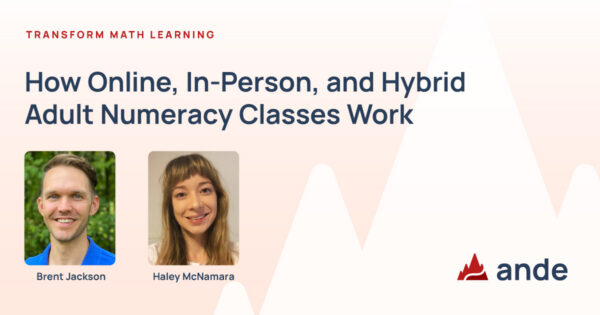
Adult learners often balance work, caregiving, and transportation, so a physical seat in a physical classroom is not always possible. In How Online, In-Person, and Hybrid Adult Numeracy Classes Work, Brent Jackson and Haley McNamara take readers inside three Adult Numeracy in the Digital Era (ANDE) classrooms: one online, one in person, and one hybrid.
Although the settings differ, each class follows the same three-part design:
- individual preparatory work on the ANDE platform
- a collaborative lesson
- a closing practice assignment
Early results from a WestEd study comparing ANDE classrooms with standard classrooms suggest that the design supports stronger learning outcomes.
Read about how ANDE classes work:
Supporting Academic Engagement on Campus
Evaluation That Examines Early Implementation and Emerging Outcomes
Asian American, Native Hawaiian, and Pacific Islander (AANHPI) students represent one of the most diverse and fastest growing student populations in California’s public universities. To promote higher education success, California established the AANHPI Student Achievement Program (ASAP), which funds culturally responsive services such as learning communities, advising, and tutoring across the California State University (CSU) system.
In a recent report, Anthony Fong, Edrick Sabalburo, Min Chen-Gaddini, Anne Porterfield, and Neal Finkelstein describe the ways funds have been used and early successes and challenges.
Key findings:
- Students described ASAP-supported initiatives as safe, affirming spaces that support their academic engagement, well-being, and connection to AANHPI cultures and histories.
- In a survey at four universities, participating students reported more positive perceptions of campus climate, belonging, and academic self-efficacy than nonparticipants.
For leaders, the report points to sustained staffing, dedicated space, and stable funding to support long-term implementation.
Read the CSU AANHPI Student Achievement Program evaluation:
Strengthening Pathways to Economic Mobility
WestEd recognizes that advancing economic mobility provides security and opportunity, encompassing financial well-being, stability, and growth. Our staff works with employers, education institutions, and workforce systems to codesign solutions that meet the needs of both learners and employers.
Learn about our research, evaluation, professional learning, and technical assistance services.

Ready to Support Your Thriving Learners and Empowered Communities?
Connect with our WestEd experts.
"*" indicates required fields
More Related to This Post
Blogs & Podcasts
Research insights and stories designed to inform, engage, and inspire.


Events
Research insights and stories designed to inform, engage, and inspire.
Resources
Browse our high-quality publications and resources designed to inform and engage professionals in a variety of fields including K–12 education, early childhood, and health and justice.