

Product Information
Copyright: 2026
Format: PDF
Pages: 6
Publisher: WestEd
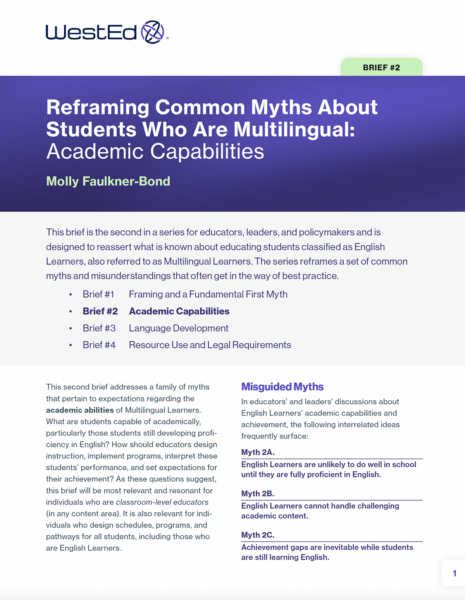
A common but harmful belief holds that English Learners must achieve English proficiency before they can succeed academically or engage with grade-level content. This second brief argues that English proficiency is not a prerequisite for academic capability—students can think, reason, and engage with complex content in any language—and that the appearance of English as a gatekeeper reflects how the education system is designed, not students’ intellectual abilities.
The brief also shows that reducing academic rigor for English Learners backfires: Research finds that the challenge level of students’ coursework predicts achievement more strongly than their English proficiency level. The solution lies not in waiting for students to change but in changing systems and instructional practices to make rigorous content more accessible through scaffolding, collaborative teacher planning, and high-quality instructional design.
This is the second brief in the Reframing Common Myths About Students Who Are Multilingual series. Read the third brief in this series here.
Author
Molly Faulkner-Bond
More Related to This Resource
Resources
Browse our high-quality publications and resources designed to inform and engage professionals in a variety of fields including K–12 education, early childhood, and health and justice.