

Product Information
Copyright: 2026
Pages: 5
Publisher: WestEd
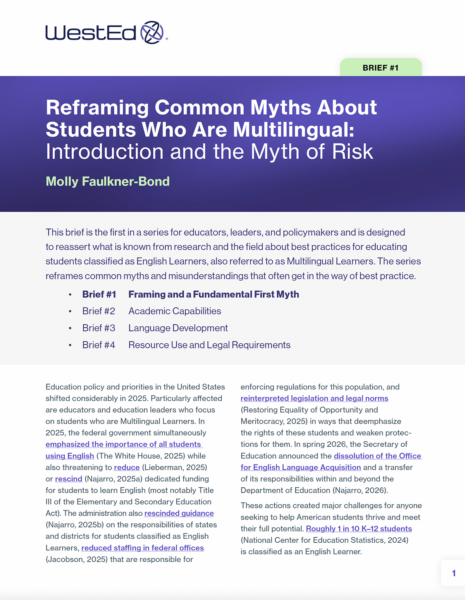
Recent federal policy changes, including reduced funding, rescinded guidance, and weakened enforcement of protections for English Learners, have created significant confusion for educators and leaders. This first brief in a 4-part series cuts through that confusion by reasserting what research tells us about best practices for educating students classified as English Learners—also referred to as Multilingual Learners—and reframes common myths and misunderstandings that get in the way of best practice.
The brief tackles a foundational myth: that multilingualism puts students at greater risk of failure. Research consistently shows the opposite, pointing to cognitive, economic, and social benefits of speaking multiple languages. The brief argues that the source of challenge for Multilingual Learners is not their linguistic background but a school system designed around English monolingualism, and it reminds educators and leaders that regardless of what happens at the federal level, the responsibility for ensuring these students receive a quality education remains with states, districts, and schools.
This is the first brief in the Reframing Common Myths About Students Who Are Multilingual series. Read the second brief in this series here.
Author
Molly Faulkner-Bond
More Related to This Resource
Resources
Browse our high-quality publications and resources designed to inform and engage professionals in a variety of fields including K–12 education, early childhood, and health and justice.