

August 20, 2026
Districts and schools often plan professional learning, coaching, and leadership development for literacy on separate timelines. Each piece might be solid on its own, but very little connects them. The result: literacy instruction that is fragmented, especially when it comes to comprehension. That fragmentation lands hardest on Multilingual Learners and striving readers, students whose progress depends on their language and literacy systems developing together.
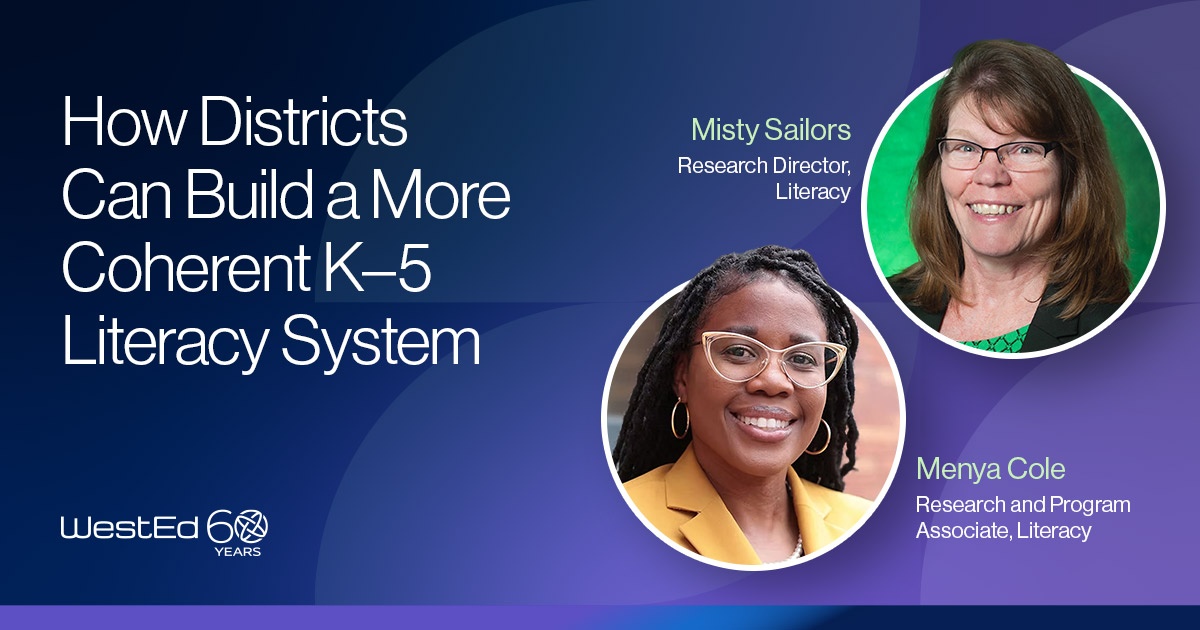
WestEd’s Language, Literacy, and Learning initiative brings together a new set of professional learning and technical assistance services for states, districts, and schools. No piece stands alone: needs assessment, systems-wide literacy plan development, professional learning, coaching, and leadership are designed to work in one interconnected system. In this Q&A, WestEd experts Misty Sailors and Menya Cole discuss Language, Literacy, and Learning to share how districts can build coherent K–5 literacy systems that support all learners.

Sailors: In our work, we noticed that school districts often described a similar challenge. They had good pieces in place: a solid curriculum, a coaching model, a reasonable professional learning calendar; but those components weren’t aligned. For example, a district could spend years developing decoding skills in young children and then try to pivot toward comprehension strategies in upper elementary, with no thread connecting them. But comprehension doesn’t just switch on once decoding is solid. Kids who spend years drilling decoding without also building vocabulary, background knowledge, and language comprehension often hit a wall when they get to 3rd or 4th grade. They can read the words on the page just fine, but they don’t have the language or content knowledge to make sense of what they’re reading once texts get more complex.
Cole: Bringing these strands together gives teachers, coaches, and leaders a clearer understanding of the instructional priorities and their role in supporting them. In my experience as a coach, the disconnect between training, coaching, and expectations was one of the most persistent challenges I saw teachers navigate. A coach entering a classroom understands what the teacher has been learning, what the district has identified as a priority, and how the coaching cycle can support implementation. If a teacher is working to make stronger connections between foundational skills and meaningful text, for example, the coach is prepared to support that work through planning, observation, modeling, or reflection—one more example of how professional learning, coaching, and leadership reinforce one another instead of operating separately.
Sailors: The research points to two related but distinct sets of needs. A Multilingual Learner might be decoding English text just fine and still not comprehend it because comprehension depends on vocabulary and oral language proficiency in English that they’re still building. A striving reader might be a native English speaker with strong oral vocabulary and background knowledge, but their word-recognition system—decoding, phonological processing—isn’t yet doing its job. Those are two different profiles, even though on paper both students can look like they’re “behind” in reading.
That’s why every workshop in this suite keeps the two distinct. Multilingual Learners get scaffolds that build English language proficiency and give them access to grade-level content while that proficiency is still developing. Striving readers get explicit instruction in whichever foundational skills aren’t yet automatic for them, phonemic awareness, decoding, and so on. Some students genuinely need both, and when that’s the case, we treat it as two things happening at once, not one blended intervention standing in for both.
Sailors: Explicit means the teacher shows a student exactly what to do. Take comprehension monitoring—noticing when something you’re reading has stopped making sense. A teacher doesn’t just tell a student to make sure that they understand what they’re reading. Instead, the teacher would read part of the text aloud and then stop and say something like, “Wait, that didn’t make sense; let me go back and reread it,” showing the actual thinking a skilled reader does almost without noticing. Then the student tries that same move themselves, with the teacher right there to catch it if they blow past a confusing sentence instead of stopping.
Systematic means that a skill gets built in a sequence. A student starts with simple retelling, moves to noticing when something doesn’t make sense, and then, to actually fix it, rereading, asking a question, and/or checking a word they skipped over. Each step depends on the one before it. Skipping ahead to repair strategies before a student can even retell what happened leaves them without the foundation required for any form of comprehension, literal or inferential.
For a striving reader, that’s the same approach, whether we’re building word-recognition automaticity or comprehension monitoring. The teacher is always showing exactly what a skilled reader does, building it step by step.
Cole: School leaders often wanted greater clarity about how to support the instructional shifts teachers were being asked to make. Teachers might participate in professional learning focused on a new comprehension routine, for example, while leaders had fewer opportunities to develop a shared understanding of what that practice should look and sound like in the classroom because they had not experienced the same training.
That’s the gap our leadership services are built to close. This support can be especially important in schools with a single site administrator or without a dedicated coach, where the school leader may also shoulder much of the responsibility for instructional guidance and follow-through. Leaders, coaches, and teachers become grounded in the same key areas of literacy development, including decoding, language, comprehension, and knowledge building. As a result, leaders are better prepared to recognize the practices teachers are implementing, ask purposeful questions, reinforce progress, and identify where additional coaching or support may be needed.
Cole: Impactful literacy coaching is grounded in a clear instructional focus and evidence from both teaching and student learning. During a coaching cycle, feedback should be connected to the specific literacy practices the teacher and coach are working to strengthen.
For example, a skilled coach might say, “You modeled that comprehension repair move really well. Next time a student gets stuck on a word, try leaving a little more space before jumping in so they get a chance to attempt the fix themselves.” That’s actionable in a way that saying to a teacher “Don’t give students the answer” is not. Actionable feedback must be specific enough to inform the teacher’s next instructional decision.
Support also continues beyond the initial professional learning experience. Cycles may include co-planning, modeling, observation, coteaching, examination of student work, and reflection over time. Initial professional learning establishes a foundation, while coaching and support create opportunities to apply, study, and refine those practices in context.
Sailors: What excites me is knowing that, with our support, a district can sustain a comprehension-first approach for multiple years because every piece of the system is reinforcing the same thing.
Cole: What excites me most is bringing these different parts of the system into alignment so that teachers spend less time interpreting competing messages and more time studying student learning and refining their instruction.
Sailors: We sit down with a district leadership team to understand what’s already in place, what’s working, and where they may be stuck. From there, we build a plan together and sequence the right mix of professional learning, coaching, and leadership support.
How We Help
WestEd helps districts align assessment, coaching, professional learning, and leadership to support improved literacy outcomes.
Visit our Language, Literacy, and Learning page for details on the full range of services or contact us directly to talk with a Language, Literacy, and Learning expert.
Misty Sailors is a research director on the Literacy team at WestEd. With over 30 years of experience in literacy teaching, coaching, education, and research, Sailors leads research for programs including Reading Apprenticeship and Language, Literacy, and Learning and is dedicated to advancing evidence-based literacy instruction that meets the needs of all students, including Multilingual Learners and striving readers.
Menya Cole is a research and program associate on the Literacy team at WestEd, where she works with the Reading Apprenticeship and Writing Apprenticeship teams and the Language, Literacy, and Learning team. She brings 20 years of experience as a teacher and literacy coach at the elementary and secondary levels, including work in Los Angeles, Detroit, and Seattle, with a focus on curriculum design, disciplinary literacy, and structured literacy.

Ready to Support Your Thriving Learners and Empowered Communities?
Connect with our WestEd experts.
"*" indicates required fields
More Related to This Post
Blogs & Podcasts
Research insights and stories designed to inform, engage, and inspire.



Resources
Browse our high-quality publications and resources designed to inform and engage professionals in a variety of fields including K–12 education, early childhood, and health and justice.