November 2, 2026
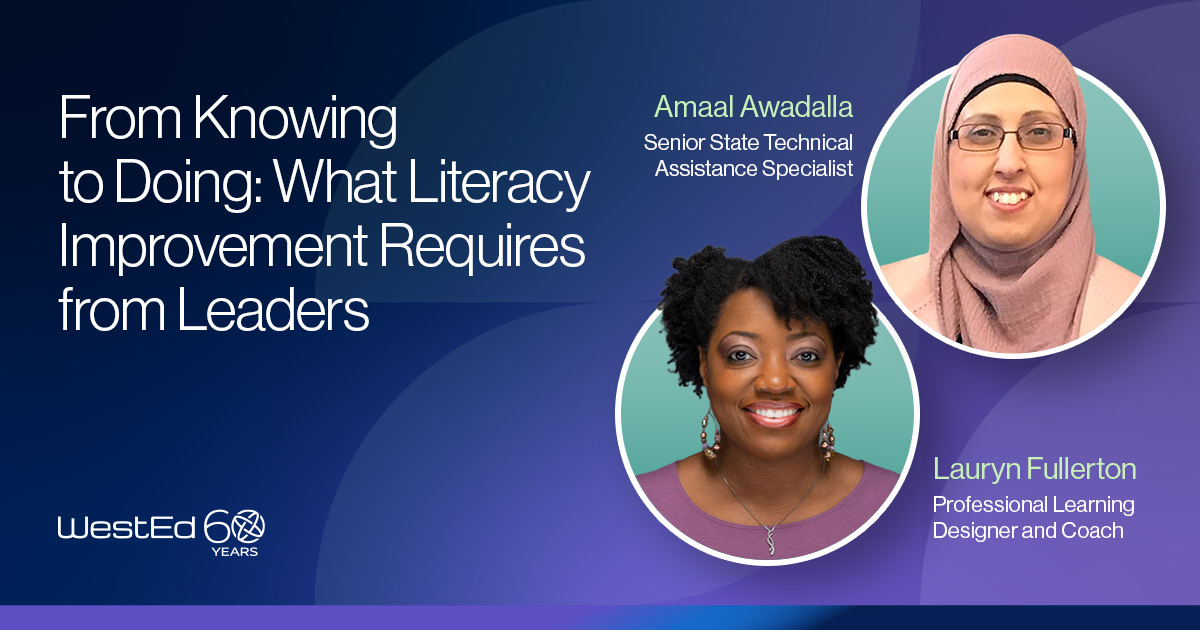
By Amaal Awadalla and Lauryn Fullerton
Literacy continues to be the focus of states, districts, and schools. Educators are deepening their understanding of how students learn to read, strengthening instruction, adopting high-quality materials, and investing in professional learning.
Improving literacy outcomes also depends on what happens beyond professional learning and individual classrooms. Schools and districts need systems that support evidence-based literacy instruction, align with high-quality materials, and respond to students’ needs.
Our experience as former district leaders taught us how critical these systems are. As we led efforts to implement structured literacy and disciplinary literacy, we found that strengthening teachers’ knowledge and practice was one part of the work. We also had to consider core instruction, additional supports for students, school leaders’ development, and the structures surrounding instruction.
We asked ourselves several questions to keep those supports connected. Were professional learning, coaching, resources, schedules, and data practices aligned with our literacy priorities? Did the school leaders we worked with have the knowledge and tools to recognize and support effective literacy instruction? Were these interconnected structures working together as a system to reinforce the same priorities?
These experiences continue to shape our beliefs and guide our work today. Literacy improvement depends on leaders translating what they know about effective literacy instruction into the systems, structures, and practices that make such instruction possible in classrooms.
Across our work, several leadership moves have become especially important:
- building leaders’ capacity to recognize and support effective literacy instruction that begins with the student experience
- creating coherence around shared literacy priorities, and
- using implementation evidence to guide continuous improvement.
Building Leaders’ Capacity to Lead Literacy Improvement
Leading literacy improvement asks school leaders to develop both instructional knowledge and the skill to put that knowledge into action. That means knowing what evidence-based instruction should look and sound like, recognizing where it is taking hold consistently and where it is not, and knowing how to respond, through feedback, coaching, or changes to the systems around teaching.
For example, a leader might notice through classroom walk-throughs that teachers understand a new literacy routine but are implementing it differently from room to room. Rather than treating each classroom as a separate issue, the leader can use that pattern to shape coaching and collaborative planning going forward.
Developing literacy leadership, then, is not simply about increasing what leaders know about literacy. It is about helping leaders translate that knowledge into practice: what they look for in classrooms, the feedback they provide, the questions they ask, and the systems they build to support sustained improvement. But underlying all of it is what leaders choose to prioritize.
Literacy improvement depends on leaders translating what they know about effective literacy instruction into the systems, structures, and practices that make such instruction possible in classrooms.
Viewing the Student Experience as a Starting Point
A literacy priority, in our terms, is a focused instructional goal, something leaders have identified as especially important for improving students’ literacy experiences and outcomes. If that priority is really taking hold, what should students be experiencing?
Working backward from the student experience helps leaders know where to look. What should students be doing, saying, thinking, reading, and writing if that priority is taking hold? Leaders can then identify the instructional practices that make those experiences possible and check whether the school or district has created the conditions teachers need to put those practices into action.
For example, if vocabulary and knowledge development are priorities, leaders might expect students to regularly encounter important words and concepts in meaningful texts, discuss their meanings, connect new learning to prior knowledge, and use new vocabulary in speaking and writing.
This leads to the next question: What instructional practices and supports must be in place to ensure students have those experiences consistently?
The point isn’t to assume what needs to change. It’s to gather evidence […] to understand what’s actually happening and decide what comes next.
Creating Coherence Around Literacy
When a literacy practice is not taking hold the way leaders hoped, it is tempting to assume the problem is teachers themselves, that they simply are not willing to change. But a more useful question is whether the systems around those teachers actually agree with what is being asked of them.
That is what we mean by coherence: teachers encountering consistent messages, learning opportunities, feedback, and support around a manageable set of priorities. Building coherence requires leaders to deliberately align everything that shapes instruction: professional learning, collaborative planning, coaching, walk-throughs, materials, schedules, and data use. If teachers are being asked to implement a practice more consistently, the real question is whether they have the materials, time, and feedback to do it.
We have seen what happens when that alignment is missing. A district introduces a new literacy practice through professional learning, but nothing else reinforces it: Collaborative planning never revisits it, coaching focuses elsewhere, and walk-through feedback does not connect back to what teachers just learned. In situations like that, the issue usually is not teachers’ willingness. It is that the surrounding systems simply are not pulling in the same direction. Leaders can respond by narrowing the focus and aligning those same systems around a single priority so that professional learning, coaching, and feedback all point the same way.
Creating coherence also means choosing what not to include. Adding another initiative, tool, or professional learning experience without real integration or support rarely improves implementation on its own. Sometimes leadership means narrowing focus, protecting existing priorities, and giving teachers the time and support to go deeper with what they already have.
Learning From Implementation
Even when leaders create these conditions with real intention, implementation rarely unfolds exactly as planned, and that gap becomes useful information in its own right.
A leadership team might expect a new instructional routine to give students more chances to discuss text. Walkthroughs, however, may show that while the routine is showing up in classrooms, students are still doing little of the talking. That gap is useful information. It might mean teachers need more coaching on how to run the routine, not that the routine itself has failed.
In another school, leaders might find the opposite: The practice is happening consistently, and student participation is climbing. In that case, the question becomes how to sustain what is working and extend it to every classroom.
The point is not to assume what needs to change. It is to gather evidence – from classrooms, student learning, teachers, coaches, and collaborative teams – to understand what is actually happening and decide what comes next.
Implementation becomes part of continuous improvement when leaders ask not just “What are we seeing?” but also “What are we learning, and what does that mean for our next steps?” Leaders also need to check whether changes in adult practice are producing the changes they intended for students and, ultimately, for outcomes.
Building Literacy Systems That Last
Sustainable literacy improvement requires leaders to connect what happens in classrooms with the systems that support instruction. That means building leaders’ capacity to recognize effective literacy instruction, creating coherence around shared priorities, and using evidence from implementation to determine what comes next.
WestEd’s Leadership Services in Language, Literacy, and Learning help school and district leaders strengthen literacy leadership while aligning the professional learning, coaching, collaboration, and other conditions that support implementation over time.
About the Authors
Amaal Awadalla is a senior state technical assistance specialist at WestEd, partnering with states, districts, and schools to build leadership capacity; strengthen instructional quality; and drive meaningful, lasting impact.
Lauryn Fullerton is a professional learning designer and coach at WestEd, partnering with school, district, and state education leaders to strengthen leadership and instructional capacity through executive coaching, strategic planning, and targeted professional development.

Ready to Support Your Thriving Learners and Empowered Communities?
Connect with our WestEd experts.
"*" indicates required fields
More Related to This Post
Blogs & Podcasts
Research insights and stories designed to inform, engage, and inspire.





Events
Research insights and stories designed to inform, engage, and inspire.


Resources
Browse our high-quality publications and resources designed to inform and engage professionals in a variety of fields including K–12 education, early childhood, and health and justice.